
Is a Widebody Kit Worth It? What Shops Should Tell Their Customers
Is widebody worth it? For one customer yes, and for the next a money pit. What shops should ask at the counter, what the bill really is, and what to say.
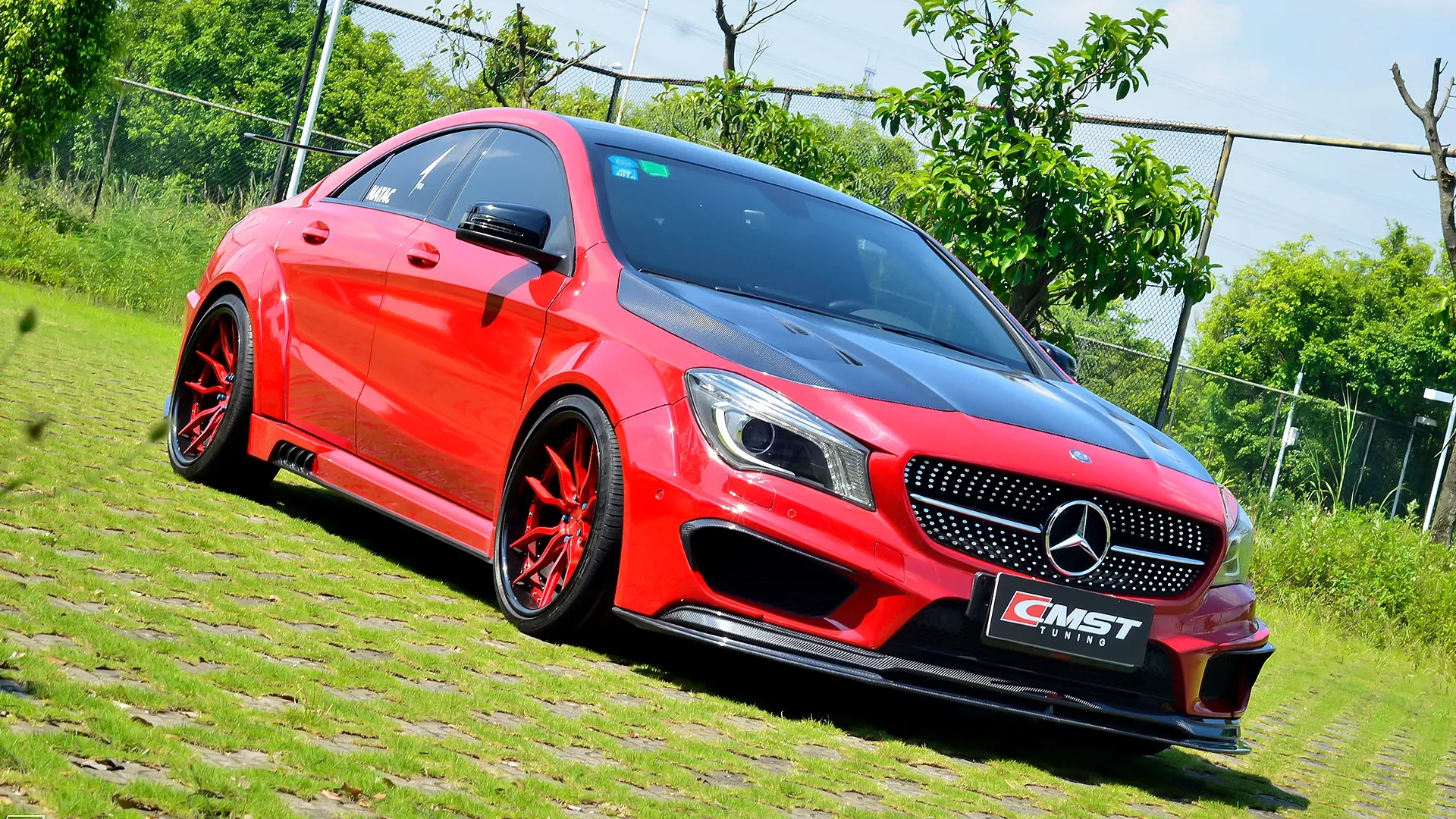
Is widebody worth it? Usually yes for the customer who keeps the car and pays for the whole conversion. Almost never for the one who wants the look on stock wheels and a two-year ownership horizon. The panels are not where these jobs go wrong. The second half of the bill is — wheels, tires, paint, labor, and the resale the owner gives up when the rear arches get cut. A shop that quotes the whole stack, in the right order, gives a better answer than a shop that quotes the kit.
What follows is the version of that conversation you can have at the counter in five minutes: the three facts that actually decide it, the numbers a customer will not find on a parts page, and the wording for the times the answer is no.
Is Widebody Worth It? Four Customers, Four Answers
Two people can ask the same question and deserve opposite answers, and the difference is rarely taste. It comes down to three facts you can establish before the estimate is written:
- How long they will keep the car. A conversion is priced against ownership length; at two years, almost none of it survives to the sale.
- Whether the rear arches get cut. Cut quarter panels are permanent; bolt-on arches unbolt.
- Whether wheels, tires and suspension are inside the budget. A wide body on the original track width is a look, not a build.
Sort the customer on those three and the rest is arithmetic:
Customer in front of you | What they are really buying | Straight answer |
|---|---|---|
Owns the car outright, keeps cars five years or more, budget covers wheels and tires | A permanent change to a car they intend to keep | Worth it |
Lease, balloon finance, or a car they will flip inside two years | A look they cannot take with them | Not worth it yet |
Track, show or weekend car, or a car already on coilovers | Tire width, grip, presence | Worth it, with a caveat on aero |
Daily driver, tight parking, wheels already curbed | Cosmetic presence on a car that has to work every day | Worth it to them after the running costs are on the table |
The order matters. Most customers arrive having priced the kit and nothing else, because the kit is the one part with a number attached. If you answer at that level, you are answering a question they did not ask. The wider version of this conversation — what a kit contains, what it costs, whether to go wide at all — sits in the widebody guide.
What the Customer Is Actually Buying
A conversion is a set of parts that change where the wheel sits relative to the body: arch extensions or widened quarter panels front and rear, bumper halves to match, side skirts, often vents and canards, plus brackets, rivets and trim. If someone is vague on what a full kit contains, what a widebody kit actually is covers the inventory, and the difference between a wide kit and a standard body kit is mostly the arch pieces and the bumpers.
There are two routes, and the customer's choice between them drives everything downstream:
Bolt-on arches fit over the existing body. No cutting, no welding, and the car can go back to standard if the original parts are kept. The trade is visible seams unless the parts are blended and painted, and the width they add is on the outside only: an extension covers a wheel that has moved out on a wider rim or a spacer, but it adds nothing at the inner edge and changes nothing about suspension travel. It lets the tire sit further out and be covered by bodywork — it does not let a wider tire fit where the well has no room for it.
A cut-in conversion removes material from the rear quarter panels so the arch can move outward by several inches. This is the version that looks factory, and it is the version that cannot be undone without panel work.
The dimension that decides which route is possible is the track width — the distance between the wheel centers on an axle — and there is a second way to get the same effect, which the two ways to widen a car sets side by side.
Then there is the factory version, which is a different product altogether. OEM widebody packages bundle the bodywork with wider wheels, bigger brakes and suspension changes in one option box, so they look expensive next to an aftermarket kit until the wheels and brakes are priced separately — which is exactly the comparison an owner on r/Challenger weighing a $6,000 factory package was given: 305-section tires all round, Brembo brakes and suspension work, with the verdict that the same set cannot be assembled aftermarket for the same money. When a customer compares your quote to a factory package, that is the comparison to correct — the Challenger widebody build is a useful worked example of what the two versions actually contain.
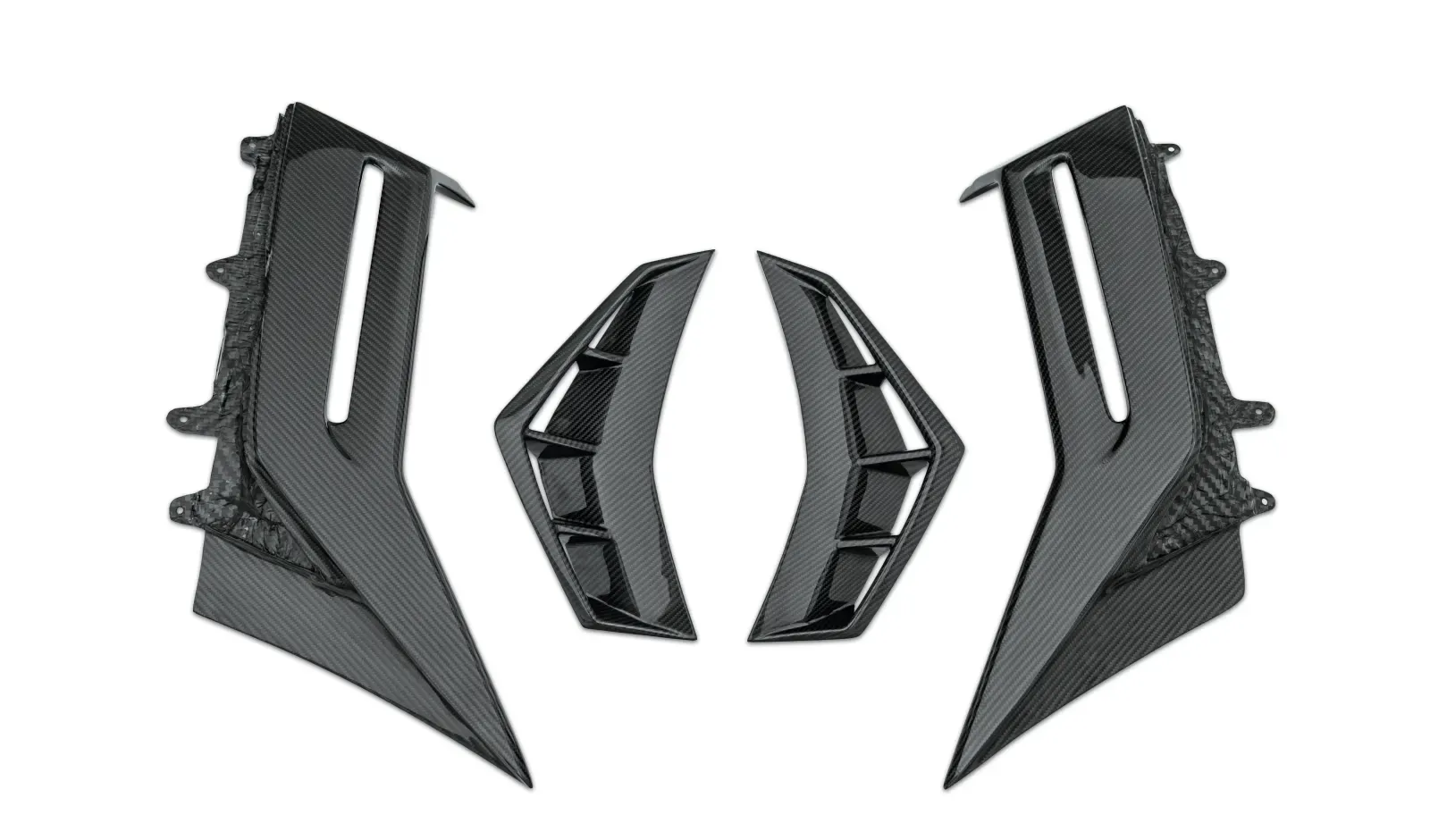
Vented fender and quarter-panel inserts in carbon, with the mounting tabs visible along the edge. The grade is the line a shop controls in the quote, and it is the one the customer can see in the part.
The Bill Nobody Quotes in Full
Here is the shape of the full bill, using market ranges from a published Charger widebody pricing guide rather than any one supplier's quote:
Line | Market range | What moves it |
|---|---|---|
Aftermarket kit | About $1,500 for basic fiberglass to $10,000+ for premium carbon | Material, part count, whether bumpers are included |
Installation and paint | About $1,000–$3,500 | Cut or bolt-on, paint match, hours at your own door rate |
Wheels, tires, suspension and extra paint work | $2,000–$5,000+ — the guide groups these as one band | Width, construction, whether forged; ride height and camber work |
Whole conversion, all in | About $4,500–$18,000+ | Everything above, plus how much of the labor is bodywork |
Read the table as market ranges, not as a price list, and not as our prices — a quote depends on the kit, the vehicle and the material grade, and the grade is the line a shop controls: the same conversion in FRP or ABS and in dry carbon are different products at different prices, which is why the quote should name the grade before it names a number.
The line shops underestimate is labor, because it is the one nobody publishes as a product. A useful reality check on rates: Rhode Island's 2025 insurance bulletin reports a prevailing rate for every insurer group holding more than 1% of the market, and the spread across those groups is wide — body and paint rates run from $46 to $65 an hour depending on the group and the class, mechanical work from $59 to $122. The largest group, Progressive at 32.7% of the market, files $55 in Class A and $53 in Class B for sheet metal and refinish, and $70 for mechanical (Rhode Island Department of Business Regulation). Those are insurer-paid rates, and a custom shop doing retail work will charge more than that — but they show the order of magnitude, and they explain why a conversion quoted at "a grand fitted and painted" is not a quote anyone can stand behind.
So quote hours, not a lump sum. A customer who sees "kit $3,800, paint and body $2,400, wheels and tires $3,200, suspension $900, alignment $180" understands what they are buying. A customer who sees "$5,200 fitted" will come back when the wheels do not fit.
The kit is the cheapest part of the job, and it is the one part with a published price. Everything that makes the conversion expensive is the work around it.
What a Widebody Changes, and What It Does Not
The performance case is real but narrower than the marketing suggests, and a shop that overstates it loses credibility the moment the customer drives the car.
It lets you widen the track and fit wider tires. That is the mechanism behind most of the handling gain: more rubber, a wider stance, less body roll, more cornering grip. None of that happens if the wheels and tires stay stock, which is why "arches first, wheels later" so often ends as a car that looks modified and drives identically.
It does not add downforce by itself. Arch extensions are bodywork. Downforce comes from a designed aero package — splitter, underbody, wing — developed together and validated at speed, and a bolt-on arch kit that covers wider wheels is not that. A car that looks like it has aero and has none is the most common outcome in the scene, and the customer driving it at 80 mph will not notice either way.
Bodywork changes what the car looks like. Downforce changes what the car does. A customer paying for the first and expecting the second is the most expensive misunderstanding in this conversation.
It adds weight, and usually more than the panels alone. The arch pieces are the visible mass; the wider wheels, bigger tires and any brake or suspension work add more. More grip can be worth more weight, but a heavier car with wider tires is not automatically quicker in a straight line.
It changes how the car lives. Steering gets heavier with wider front tires, the turning circle grows, and the car starts meeting driveways, speed bumps and ramps at an angle. For a weekend car that is a quirk. For a daily driver it is the thing the owner complains about in month two.
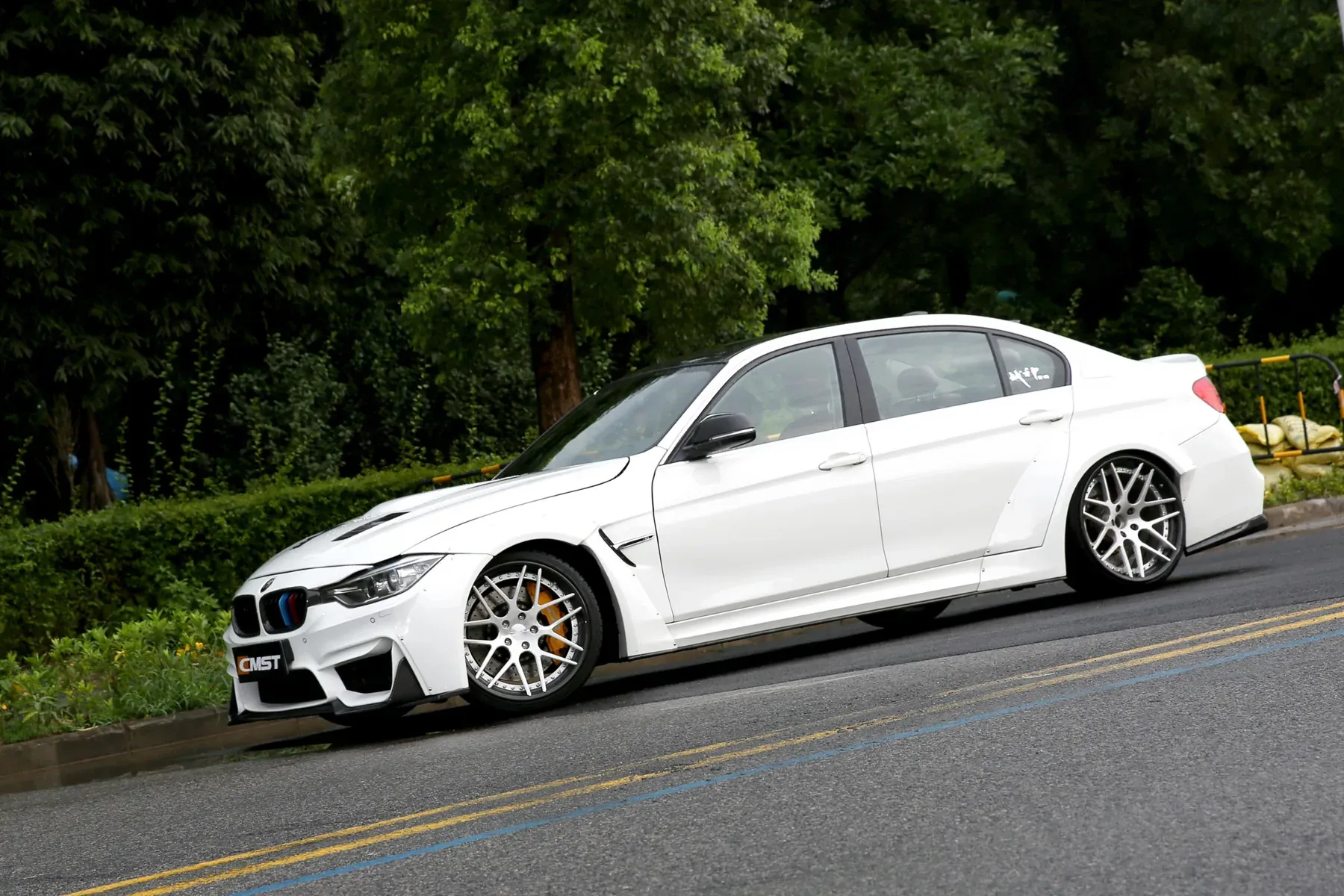
The relationship to read in any finished build is arch lip to tire shoulder: how much of the tire the arch covers, and whether the wheel still has room to travel.
Legality, Insurance and the Paper Trail
Legality is the question customers ask first and understand least, because the honest answer is "it depends where the car is registered" — and that is not a dodge, it is the mechanism. Equipment rules are set state by state and country by country, and they are written about the tire, not about the kit.
Two examples show how specific it gets. Washington requires fenders that cover the entire tire tread width, from at least 15 degrees ahead of the vertical centerline to at least 75 degrees behind it, and states that the tire must not contact the body, fender, chassis or suspension (WAC 204-10-022). Pennsylvania tests something different in its passenger-car section: the car must carry fenders of a type used as original equipment, no tire may come in contact with the body, fenders or chassis, and fender flares may not exceed 3 inches (67 Pa. Code § 175.77). The 15-degree, 75-degree and street-rod-exemption wording that gets passed around as the Pennsylvania rule belongs to a different subchapter — § 175.208, which covers street rods, specially constructed and reconstructed vehicles — not to the rule an ordinary passenger car is inspected against.
Notice what those rules are actually testing: tire coverage and clearance. That is the same thing the arch is for, which means a well-fitted conversion usually passes the coverage test and a badly fitted one fails it — and no amount of paperwork about the part fixes a tire that sits outside its arch or rubs on the liner. The three-inch figure is the one to remember from the Pennsylvania example: an arch extension that adds several inches per side is past that cap on paper, and whether a cut-and-widened quarter panel counts as a flare or as bodywork is a question for the inspector standing in front of the car, not for the supplier.
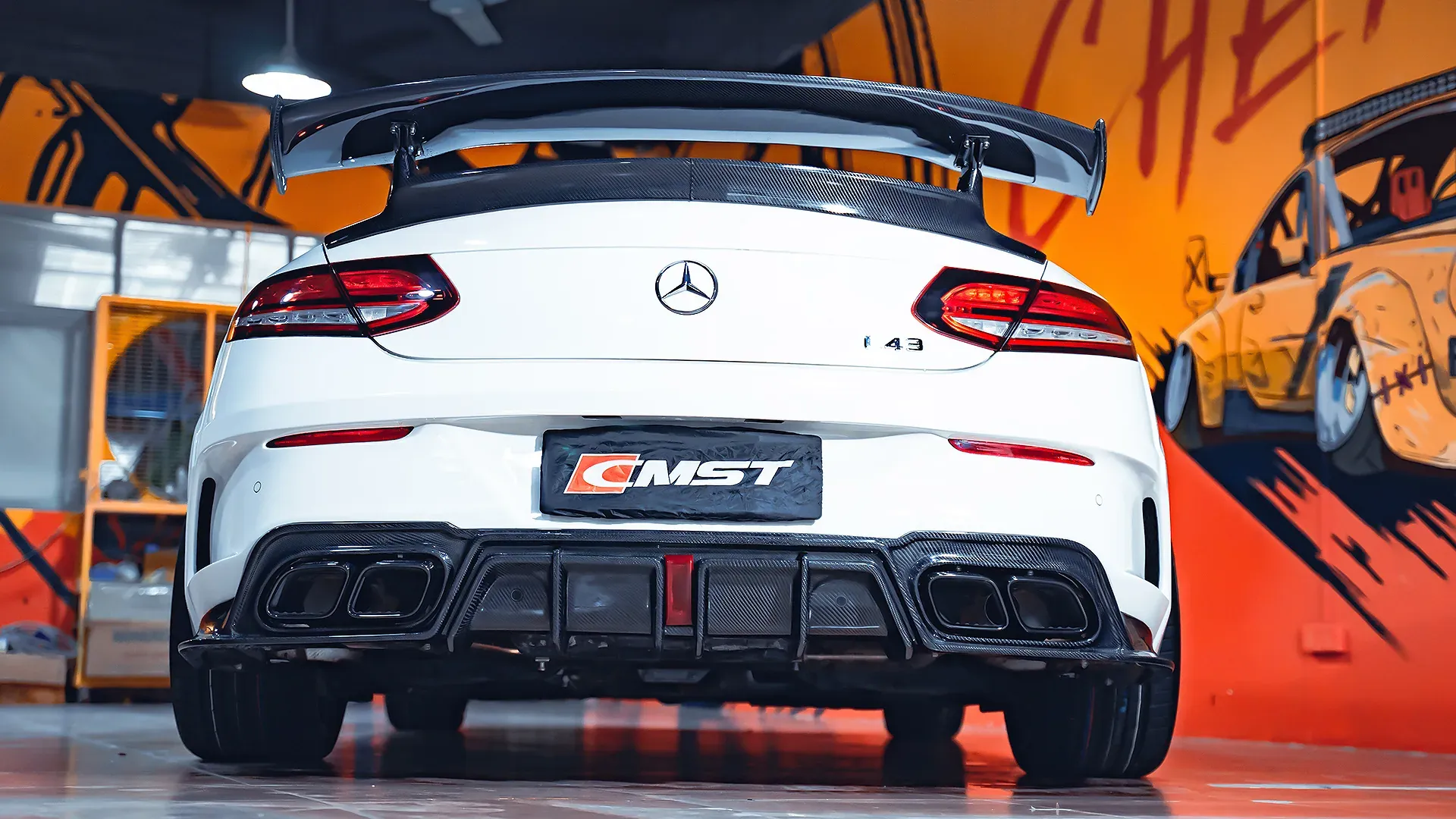
A finished conversion from behind: the wing, the diffuser and the exhaust tips are the carbon that shows. This angle sits too low to judge tread coverage — the shot below is the angle that answers it.
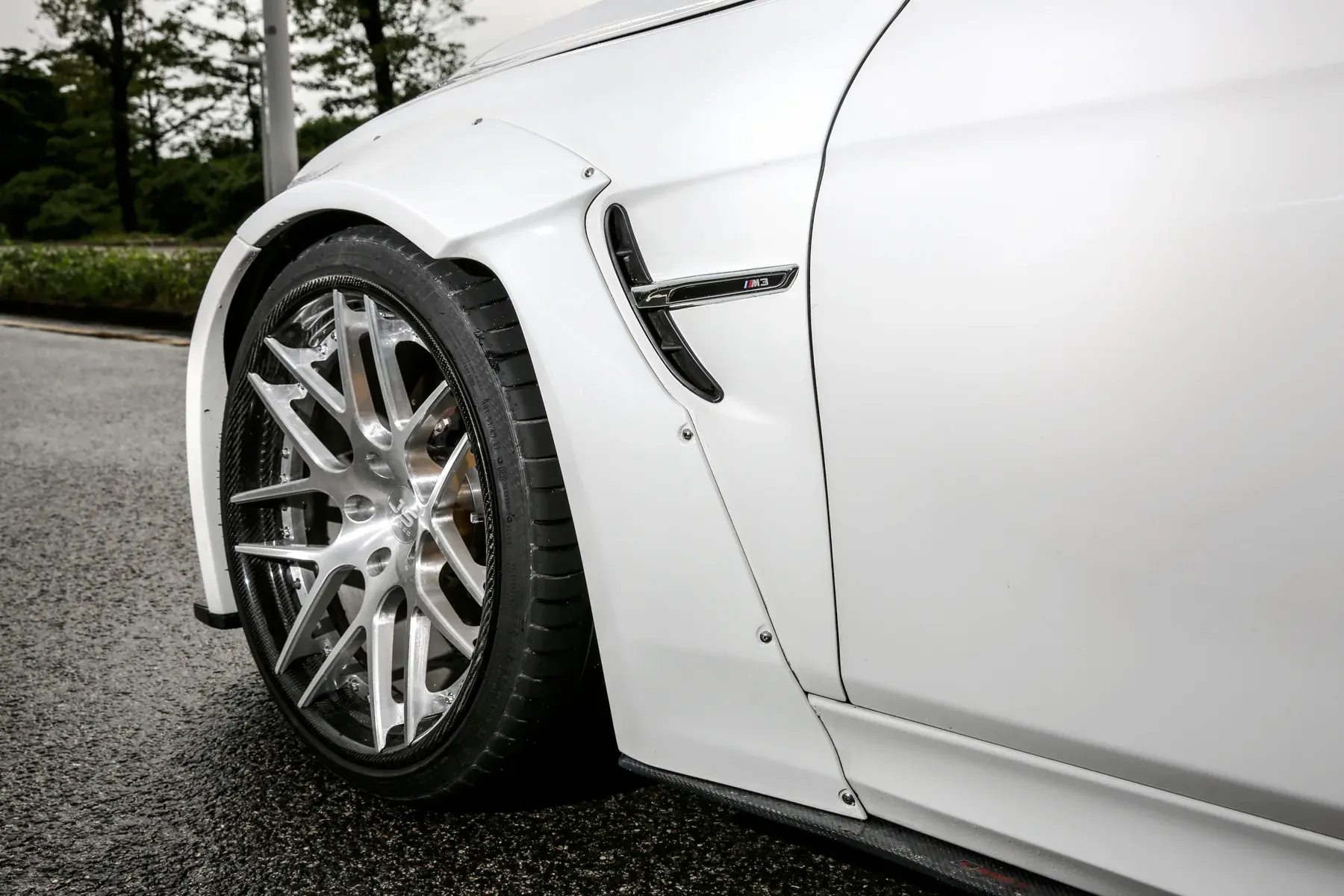
Arch lip to tire shoulder, level with the wheel: the tread sits inside the extension, which is what the coverage rule asks for. Travel is a separate check, and that one needs the car on a ramp rather than a photograph.
What a shop can say honestly: the customer needs to check the rules where the car is registered, and the shop can tell them what the car will measure. What a shop should not say is that the kit is legal, approved or compliant anywhere. That is a claim about a jurisdiction, not about a part, and it belongs to the customer and their inspector. What a shop can control is the geometry itself, which is why fitment is checked against a real car rather than a spec sheet before anything is cut or drilled. Conversion work should also be disclosed to the insurer, because a converted car is a modified car and the policy was written against a stock one.
Reversibility and Resale
If one number decides whether the upgrade is worth it, it is what the car is worth afterwards.
Cut arches are permanent, and the market prices that in. Kelley Blue Book's explainer on aftermarket parts sets out the mechanism without spin: an upgrade can affect resale either way, but each one personalizes the car further and narrows the pool of people who want it — to the point where too many upgrades can lower the vehicle's overall value despite the combined value of the parts. A conversion is close to the most personalizing change you can make to a car's silhouette, so it sits at the sharp end of that rule.
The reason is worth spelling out to a customer who assumes their taste is the market's taste. A wide car sells to the people who want a wide car, and everyone else either walks or discounts the price by the cost of putting it back — which for a cut-in conversion means bodywork and paint, not four bolts. Owners who recover anything tend to be the ones with documentation: photographs of the work in progress, receipts, and the original parts kept.
That is the cheapest thing a shop can offer on a conversion, and almost nobody does it: photograph the car before, during and after, keep the panels that came off, and hand the file over at collection. It costs an hour and it is the difference between "modified car, unknown history" and "modified car, documented build" at sale time.
The Running Cost After the Invoice
The invoice is not the end of the spend, and this is the part that decides whether the owner still likes the car in year two.
Tires. Wider tires cost more and wear faster, and the sizes that fill a wide arch are not the cheap ones. In the same Challenger thread, owners put a set of 305s at $300 or more per corner; a car that eats a set a year is a $1,200+ annual line that did not exist before.
Curb strikes. The arch lip is now the outermost part of the car at wheel height. Every curb, every tight parking lot, every steep driveway ramp meets it first, and a cracked or scuffed arch extension is a paint and bodywork job, not a touch-up.
Paint matching on repairs. Arch extensions are painted to match, and matching a three-stage pearl or a metallic on a curved add-on panel is harder than matching a door. Repairs on a converted car cost more per panel for that reason alone.
Clearance. Lower, wider cars meet ramps, speed bumps and multi-story parking lots differently. Some owners end up avoiding particular roads and ramps altogether. That is a real cost, just not a financial one.
Insurance and inspection. A modified car may need to be declared, and in inspection states the conversion is part of what gets inspected. Both are ongoing, not one-off.
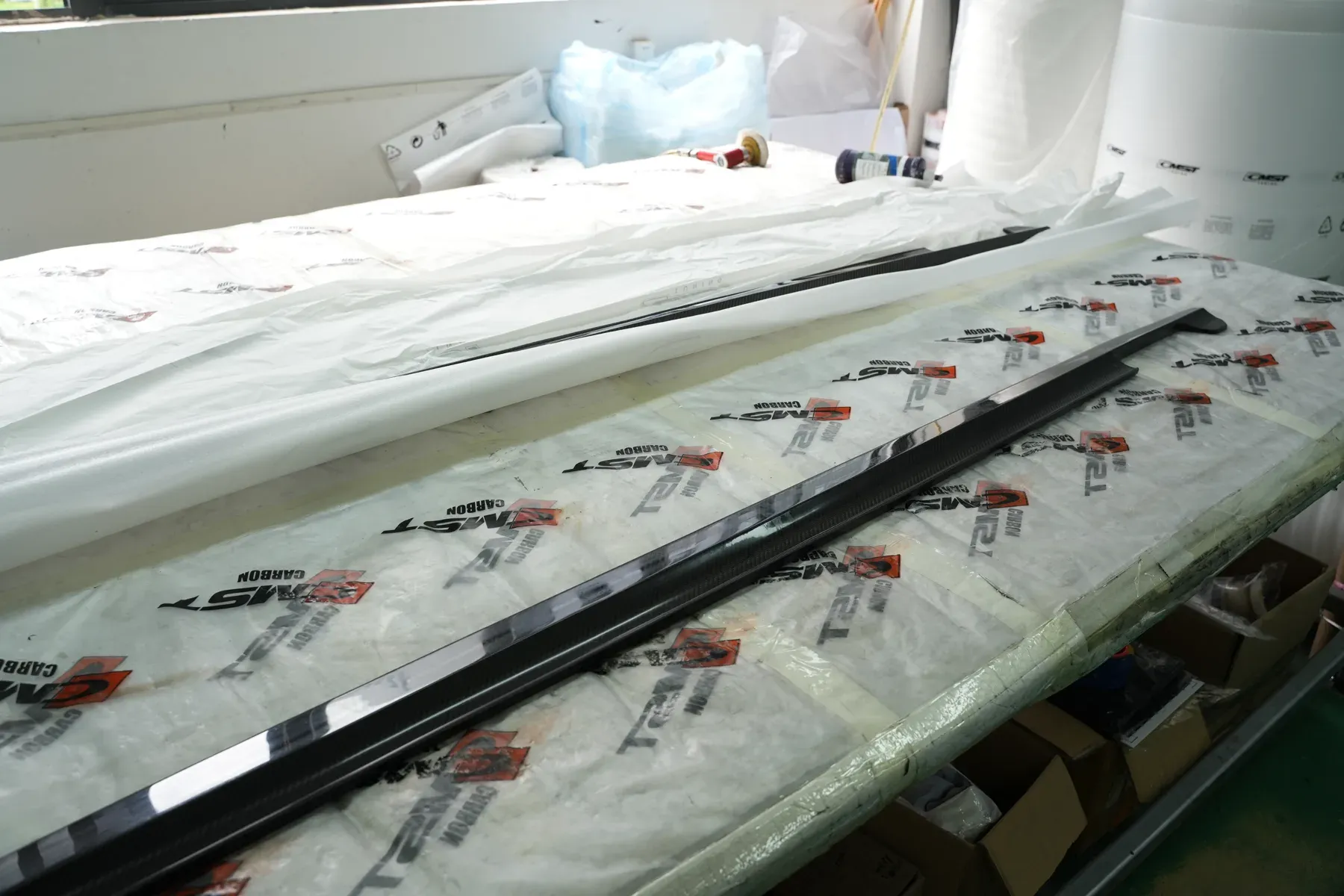
What arrives is usually unpainted or cleared, wrapped and untrimmed. Prep, test-fit and paint are hours the customer is paying for and rarely expects.
What to Tell the Customer: A Five-Minute Script
Six questions, asked in this order, will get you to an honest answer before anyone talks about a deposit:
- How long are you keeping the car? Under two years, the resale math usually ends the conversation on its own.
- Are the rear arches getting cut, or bolted? This decides whether the change is reversible.
- Are wheels and tires in the budget now, or later? "Later" usually means never, and a wide body on stock track is a look.
- Is the suspension staying standard? If it is, expect arch-to-tire clearance to be tight and ride height to limit how wide you can go.
- Where is the car registered, and does it get inspected? That is what determines the equipment rules the finished car has to satisfy.
- Have you told your insurer? Cheaper to find out now than at renewal.
Then the verdict, in plain words:
- Worth it: "This is a permanent change to a car you are keeping. Here is the full number, in lines, including wheels and tires."
- Worth it with a caveat: "For track and show use this does what you want. Do not expect downforce from the arches; that is a separate aero package."
- Not worth it yet: "The kit is affordable. The conversion is not, at your ownership horizon. If you are still in this car in five years, come back and we will price it properly."
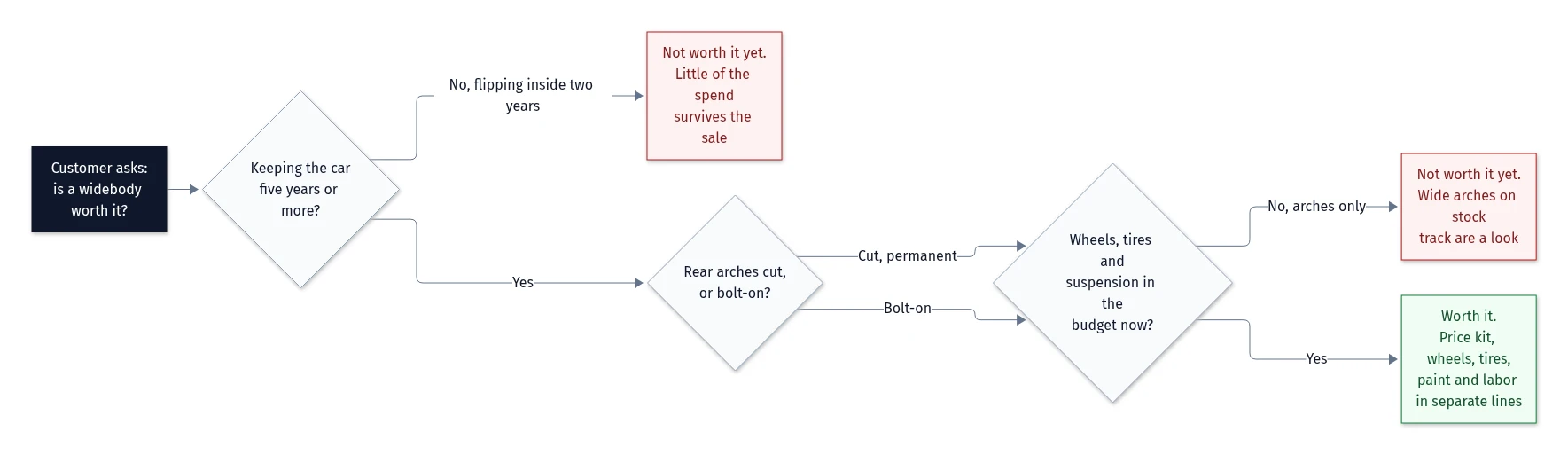
The three facts from this section, drawn as a path: how long they keep the car, whether the arches get cut, and whether wheels and tires are in the budget now. The two red exits are the answers worth saying out loud early — they save a customer a five-figure mistake and save you a warranty conversation.
Three Ways Shops Get This Wrong
Quoting the kit as the price. The kit is one line of five. A quote that stops at the kit is the reason customers arrive at collection expecting to pay half of what the job cost, and it is the reason conversions get abandoned half-finished with the car in primer.
Selling arches without track width. A customer who fits wide arches and keeps stock wheels has paid for a look and lost the clearance. If the budget cannot cover wheels and tires in the same pass, the honest recommendation is to wait.
Cutting before asking how long they keep the car. Reversibility is not a detail; it is the difference between a modification and a commitment. Ask the ownership question before the saw comes out, not after.
FAQ
Is a widebody kit worth it on a daily driver?
Sometimes, but the daily-driver case is the hardest to justify on cost. The handling gain is real if wheels and tires follow, and the resale hit is real either way. What usually decides it is tolerance: heavier steering, tighter turning circle, a car that meets ramps at an angle, and arch lips that collect every curb. A customer who has owned a lowered car before knows what they are agreeing to. One who has not usually regrets it in the first month.
Are widebody kits legal?
Not as a category, and any answer that starts "yes" or "no" is wrong. Equipment rules are set locally and are written about the tire — how much of the tread the fender covers, and whether the tire can contact the body or suspension. A conversion that covers the tire properly is in a very different position from one that leaves the tire proud of the arch. The customer should confirm the rules where the car is registered, and no supplier can certify compliance in a jurisdiction they do not control.
How much does it cost to install a widebody?
Published market ranges put installation and paint at roughly $1,000 to $3,500 on top of the kit, with the spread driven by whether the arches are cut or bolted and how much paint blending the job needs. Labor is the variable: in a 2025 state survey of insurer-paid body rates, sheet metal and refinish rates ran from about $46 to $65 an hour depending on the insurer and the market — a conversion that takes forty hours is past $2,000 in labor alone before materials. Ask for hours, not a package price.
Do wide body kits affect performance?
Yes, through the tires and the track width rather than through the panels. Wider wheels and tires and a wider stance raise cornering grip and reduce body roll; that is the real mechanism, and it depends entirely on the wheels and tires changing with the arches. Aerodynamics is separate: arch extensions are bodywork, and downforce needs a designed aero package tested at speed. Weight goes up, and straight-line performance can go either way depending on what was added.
Where This Leaves Your Counter
The question "is widebody worth it" has a defensible answer for every customer who walks in, and it is never about the panels. It is about how long they keep the car, whether the arches get cut, and whether the wheels and tires are part of the budget. Get those three facts before the estimate and the rest is arithmetic you can show them.
If the answer is yes, quote the whole stack and name the material grade, because that is the line that moves. CMST builds the range in FRP, ABS, PP and two carbon grades, and carbon parts are prototyped as 3D-printed samples and test-fitted on a real car before the tooling is cut — the step that keeps the arch where the drawing says it is. The widebody kit range is where the kit-level detail lives, and if you would rather have the answer for a specific vehicle and a specific customer, send us the build.
If the answer is no, say so in the first five minutes. A customer who is told honestly that the conversion is wrong for their car this year is a customer who comes back when it is right — and a shop that quotes the whole stack, including the parts it does not sell, is the one they believe.
Next step
Send the vehicle, the parts you are considering and the finish you want — we reply with fitment notes and a quote.
Send an inquiryKeep reading
Related notes
What Is a Body Kit? Parts, Types, Full Kits
A body kit is a set of exterior panels and aero parts, not one product — so what a full kit includes depends on the seller. Types, parts and what is left out.
What Is a Widebody Kit? A Beginner's Guide
A widebody kit widens a car's arches so wider wheels and tires will fit. Here's what is in one, what gets cut, and how to tell if a wide build suits your car.
Carbon Fiber vs Kevlar: Which Fits Your Car?
Carbon fiber is stiff and brittle; Kevlar is tough but flexes, fades and hates compression. A part-by-part comparison of weight, failure and cost on a car.