
Carbon Fiber vs Kevlar: Strength, Weight and When It Matters
Carbon fiber is stiff and brittle; Kevlar is tough but flexes, fades and hates compression. A part-by-part comparison of weight, failure and cost on a car.
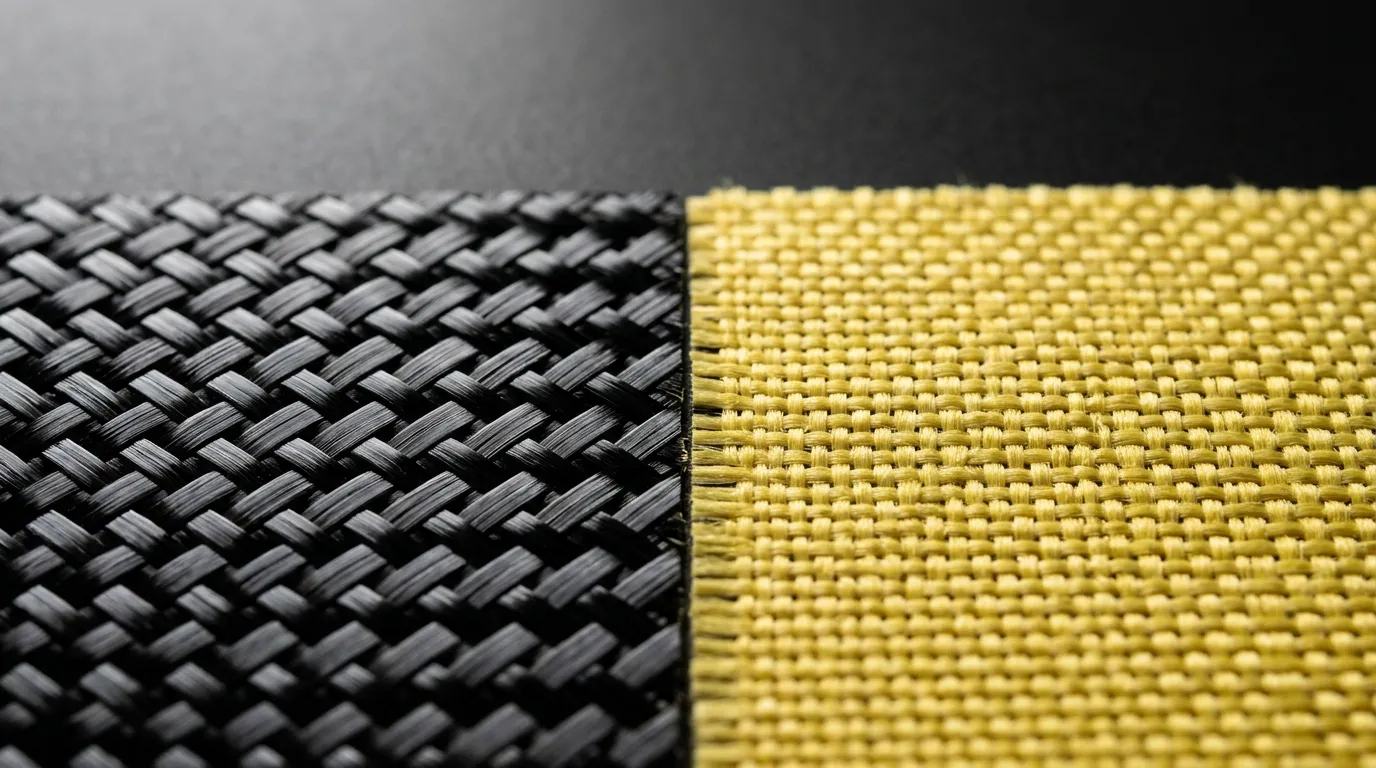
Carbon fiber vs Kevlar has no single winner — the part decides. Carbon fiber is roughly twice as stiff as aramid for the same thickness and it holds a panel's shape at speed, which is why it owns hoods, wings and diffusers. Aramid — Kevlar is a brand name for it — is tougher, shrugs off impact and fatigue, is about 18% lighter per unit volume, and is close to carbon on strength per kilogram. What it does not do is stay stiff under compression, and it does not like sunlight. On a car that usually resolves to carbon on the surfaces that have to hold a shape, aramid only where something is expected to be hit, and for most painted panels, neither one.
What Carbon Fiber and Kevlar Actually Are
Both materials are composites: a fiber carries the load and a resin holds it in the shape you molded. Neither is a solid block of its namesake. A "carbon fiber" panel is somewhere near 60% fiber by volume and the rest resin, and that ratio is why the numbers on a datasheet never match the numbers on the finished part.
The fibers themselves come from very different processes. Carbon fiber starts as polyacrylonitrile (PAN) or another precursor, which is oxidized and then carbonized at high temperature until it is more than 90% carbon, then surface-treated and sized so resin will bond to it (Toray). Aramid is an aromatic polyamide spun from a liquid-crystal solution — a low-energy route that produces a fully oriented fiber straight out of the spinneret (DuPont Kevlar technical guide). One is cooked, the other is spun. Nearly every property difference downstream follows from that.
Kevlar is a brand; aramid is the family
DuPont's Kevlar and Teijin's Twaron are both aramid, and the trade treats the words as interchangeable when a fabric is quoted. The distinction matters for one reason: aramid is the material, Kevlar is one supplier's version of it, with grades that differ in stiffness by more than 50%. So when a listing says "carbon fiber vs aramid" or "Kevlar vs carbon fiber", it is the same comparison — you just have to know which aramid grade is on the table.
Why fiber data is not part data
This is the first thing most comparisons get wrong, including the ones ranking today. Toray's data sheet for T300 gives a fiber tensile strength of 3,530 MPa. Turn the page and the same document gives the cured laminate — 60% fiber volume in epoxy — a tensile strength of 1,820 MPa and a compressive strength of 1,470 MPa (T300 data sheet). Half the number, for the same fiber.
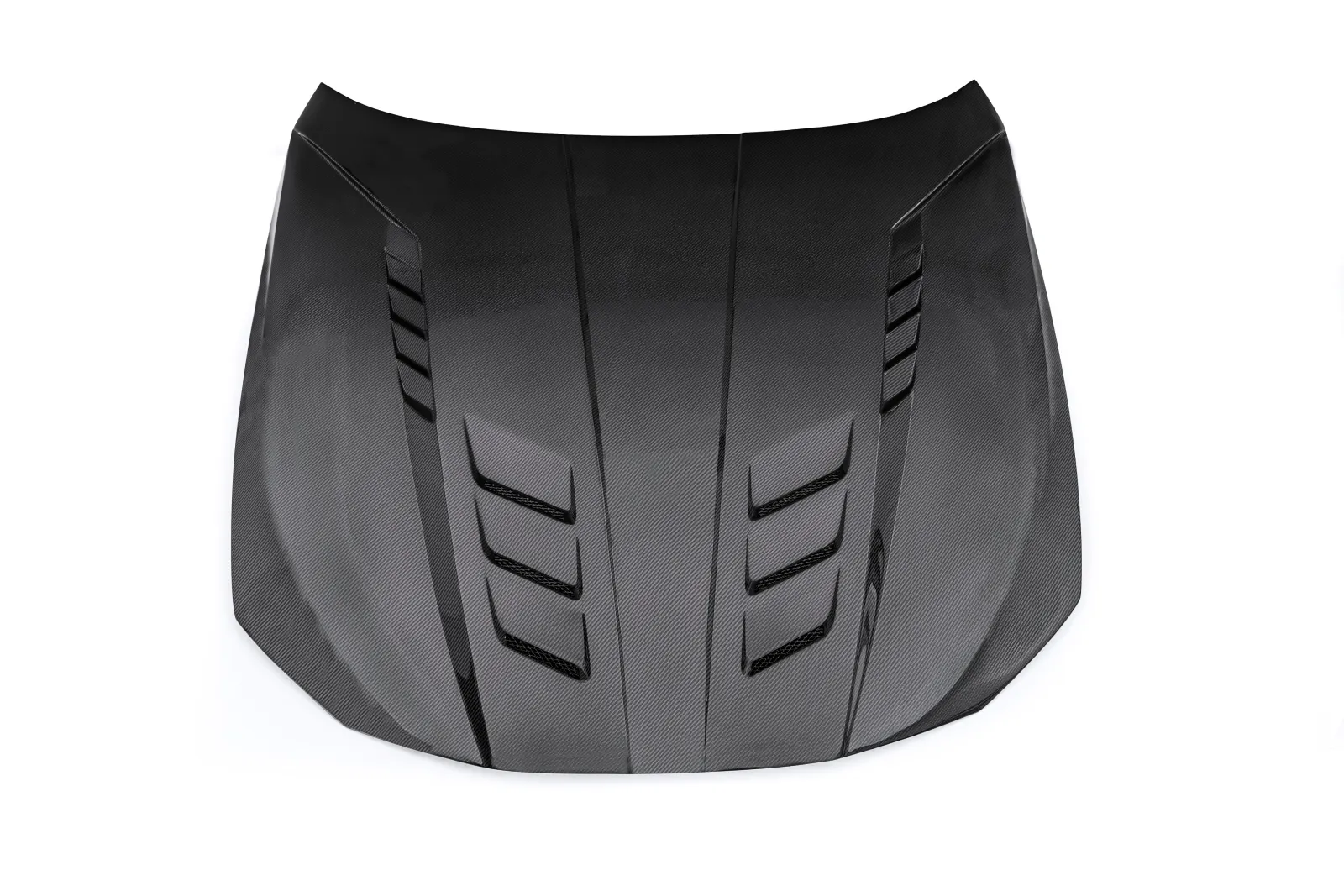
A finished dry carbon hood. The pattern is the weave itself under clear coat — and the panel is roughly half the strength of the fiber it was built from.
Fiber values describe one filament pulled in one direction. A part has resin between the plies, a surface, a bolt hole, and a load that does not arrive in a straight line. Anyone quoting you 4,000 MPa for a body panel is quoting the fiber, not the panel.
Carbon Fiber vs Kevlar: What the Numbers Actually Say
Both manufacturers publish fiber-level data from standard tensile tests, which makes the comparison closer to fair than most.
Fiber property | T300 carbon | Kevlar 49 | Kevlar 29 |
|---|---|---|---|
Density | 1.76 g/cm³ | 1.44 g/cm³ | 1.44 g/cm³ |
Tensile strength | 3,530 MPa | 3,000 MPa | 2,920 MPa |
Tensile modulus | 230 GPa | 112 GPa | 70.5 GPa |
Strain at break | 1.5% | 2.4% | 3.6% |
Read the strength row first. Kevlar is not weaker than carbon — the stiff grade is within 15% of it and the tough grade within 18%, and both are lighter. Divide each strength by its density and the order flips: Kevlar 49 comes out marginally ahead on strength per kilogram, Kevlar 29 level with carbon.
Now read the modulus row, which is where the argument actually lives. Carbon is twice as stiff as the stiffest standard aramid and more than three times as stiff as the tough ballistic grade. That gap is the whole reason a carbon wing does not change angle under load and an aramid one does.
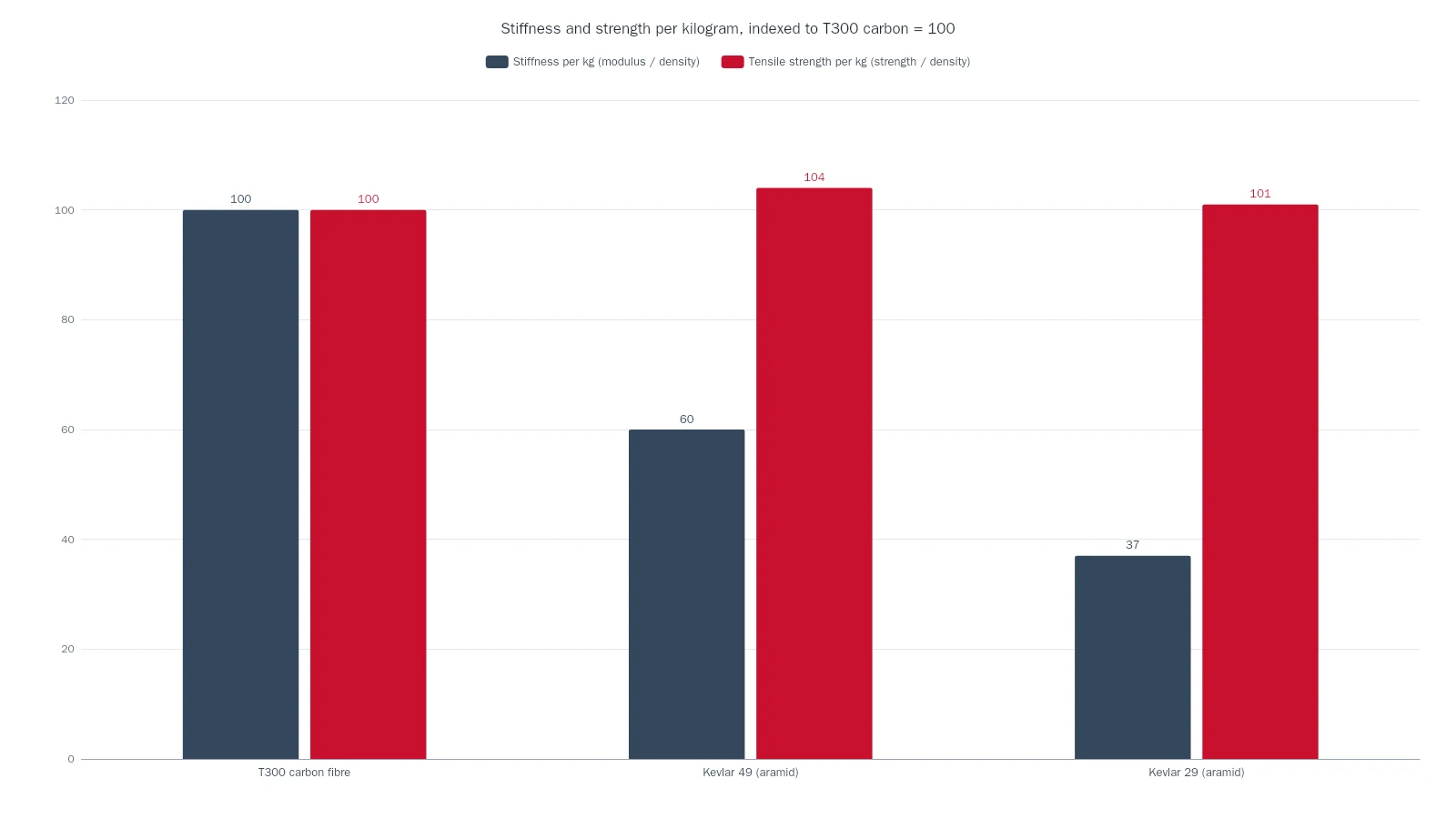
Same datasheets, divided by density and indexed to carbon. Kevlar matches carbon on strength for its weight; it gives up 40% of the stiffness.
The indexes come from the same two data sheets. Treat them as indicative rather than exact: the carbon figure is a single filament, the aramid figures are yarn tests, and different test methods move the numbers by a few percent.
Stiffness, Strength and the Compression Problem
Here is the part no comparison article bothers with, and it changes the conclusion.
A body panel is not loaded in pure tension. It is loaded in bending, and bending stiffness scales with the modulus times the cube of the thickness. Aramid is lighter, so an equal-weight aramid panel can be thicker — and the extra thickness buys back most of what the lower modulus took away. Take one published laminate table, both materials unidirectional at 60% fiber volume (Performance Composites): standard carbon at 135 GPa and 1,600 kg/m³, aramid at 75 GPa and 1,400 kg/m³. Equal weight makes the aramid panel 1.14 times thicker, and 1.14 cubed is 1.49, against a modulus penalty of 0.56. Net: roughly 0.83.
So the equal-weight aramid panel comes out about 17% softer in bending, not the 40% the per-kilogram stiffness gap suggests. Hold on to the difference between those two numbers: the 40% in the chart above is stiffness per kilogram. The 17% is what happens when you spend the saved mass on thickness.
Then the compression problem arrives and spoils it. The stiff face of a panel in bending is in compression, and the same table gives aramid a compressive strength of 280 MPa against 1,200 MPa for standard carbon — about a quarter. Absolute values move with resin and layup; the ranking does not. At fiber level the same weakness shows up as aramid's compressive strength sitting in E-glass territory, nowhere near carbon (ScienceDirect).
A panel does not fail because it is not stiff enough. It fails when the face under compression goes first — and that is where aramid is weakest.
That is the real answer to "is Kevlar stronger than carbon fiber": in tension, it is close enough that the difference is academic. In compression — and therefore in bending — it is not, and car panels live in bending.
How Each Material Fails
Design around the failure mode, not the datasheet maximum, and the two materials separate cleanly.
Carbon fails suddenly. Strain at break is 1.5%, so there is very little warning: a carbon panel loaded past its limit cracks, the crack runs, and plies separate. It does not dent, and it does not bend back. For a low splitter that will meet a speed bump or a steep driveway, that is a real cost of ownership rather than a theoretical weakness.
Aramid fails politely. It stretches to 2.4–3.6% before breaking, absorbs impact energy instead of transmitting it, and has excellent fatigue and creep resistance. A hit that cracks carbon often leaves aramid scuffed. The trade-off is that the same toughness makes it a nuisance to cut and machine — the fibers fuzz instead of slicing cleanly, which is the complaint every fabricator raises.
Repair follows the same logic. A cracked carbon panel needs the weave direction matched and the clear coat redone, and in our experience the repair is visible from a meter away; replacing is often cheaper than repairing well. Aramid is worse to refinish, because you cannot sand it to a clean feathered edge — it fuzzes. Painted FRP remains the material a body shop actually enjoys working on. Repair and fitment are the same conversation anyway: a panel that has to be forced into place will never look repaired, which is why the trial fit matters more than the material datasheet.
UV, Abrasion and What Bare Aramid Looks Like in Two Years
Carbon does not degrade in sunlight. The clear coat over it does, which is a different problem with a cheaper fix — and the reason a bare carbon part lives or dies by its coating, as we go through in whether dry carbon is worth the premium.
Aramid has the harder job. DuPont's own guide is blunt about it: unprotected yarn discolors from yellow to brown under prolonged UV, and extended exposure can cost mechanical properties. Two details get lost in the retelling. Degradation only happens in the presence of oxygen, and the fiber is self-screening — a thicker fabric or a bigger bundle protects its own interior, so UV stability rises with denier. Where protection is needed, the coating has to absorb in the 300–450 nm band rather than be UV-transparent.
Practical translation: a bare aramid exterior panel on a road car is the wrong specification, not because it will fail next month but because nothing in the finish is doing the UV work. Painted or gel-coated, the paint is the barrier, and the objection mostly disappears.
Abrasion runs the other way. Aramid resists abrasion better than either glass or carbon, which is why it turns up in friction linings, belts and hoses inside the car rather than on the outside of it.
Carbon Fiber vs Kevlar Weight: Where the Grams Actually Go
The table gave the density gap; here is where those grams actually land. The gap is real and smaller than the headline suggests: 1.44 against 1.76 g/cm³ is 18% lighter per unit volume at fiber level, and rather less once resin — the same resin in both — is counted.
Where those grams matter on a car is specific. A hood carries its weight high and forward, and you lift it every time the car is serviced. A roof or a trunk lid sits at the top of the mass. A wing or a diffuser sits at the extremity, where a stiff part does its job without adding mass to the end of the car. On a bumper shell that will be painted, wrapped around a crash structure and aimed at the road, eighteen percent of very little changes nothing a driver can feel.
So the weight question is not "which is lighter". It is "which part is heavy enough, and high enough, that the difference registers". Kevlar wins the density contest and loses most of it back the moment the part is stiffness-driven, because you buy the missing stiffness with thickness.
Cost and Manufacturability
Carbon costs more, and only part of that is the fiber.
The fiber is expensive because the route is expensive: precursor, oxidation, carbonization at temperature, surface treatment, sizing. Aramid skips carbonization entirely — it is spun from solution — so its fiber line is shorter and uses less energy than a carbon line. What that does to the delivered price of a part is less obvious than it looks, for three reasons.
First, carbon for exterior panels usually arrives as prepreg: cloth pre-impregnated at a fixed resin ratio, stored cold, cured under heat and vacuum or in an autoclave. That is equipment, cycle time and tolerances.
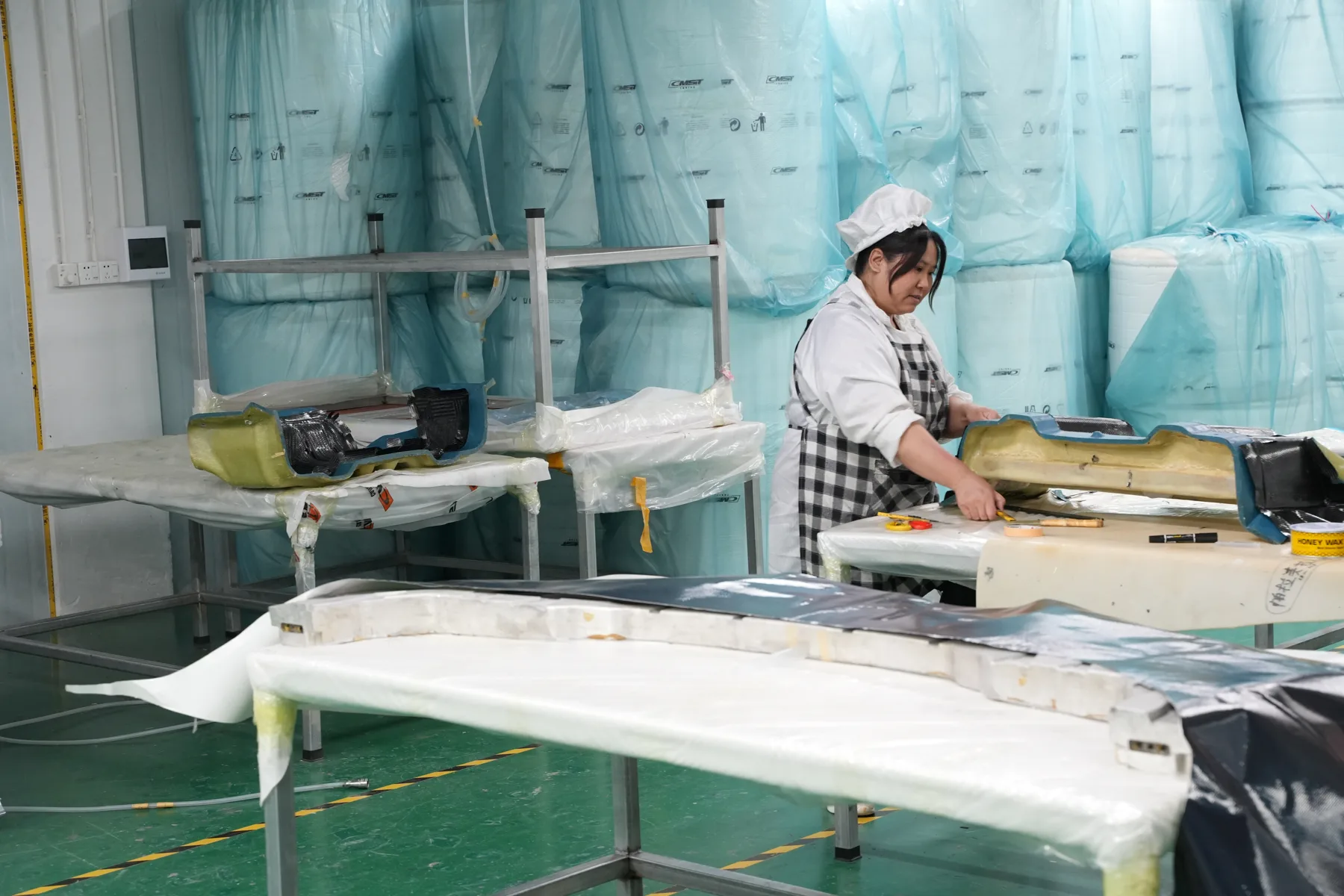
Prepreg arrives sealed in branded wrap and stays bagged until it is cut — cold storage and shelf life are part of what you pay for.
Second, aramid is awkward to machine — cutting, drilling and trimming all fight the fiber, and the dust needs managing. Third, the finishing step: a bare carbon part can leave the mold finished, while an aramid part needs a coating that blocks UV, which is a paint line by another name.
That last point is where the spreadsheet usually settles: a carbon part with a visible weave and no paint step can cost less to deliver than an aramid part that looks right, because the paint line is the expensive part of the job. None of it is material-specific either — a mold costs what it costs whichever cloth goes into it, and how these parts are actually made is a longer story than the fiber.
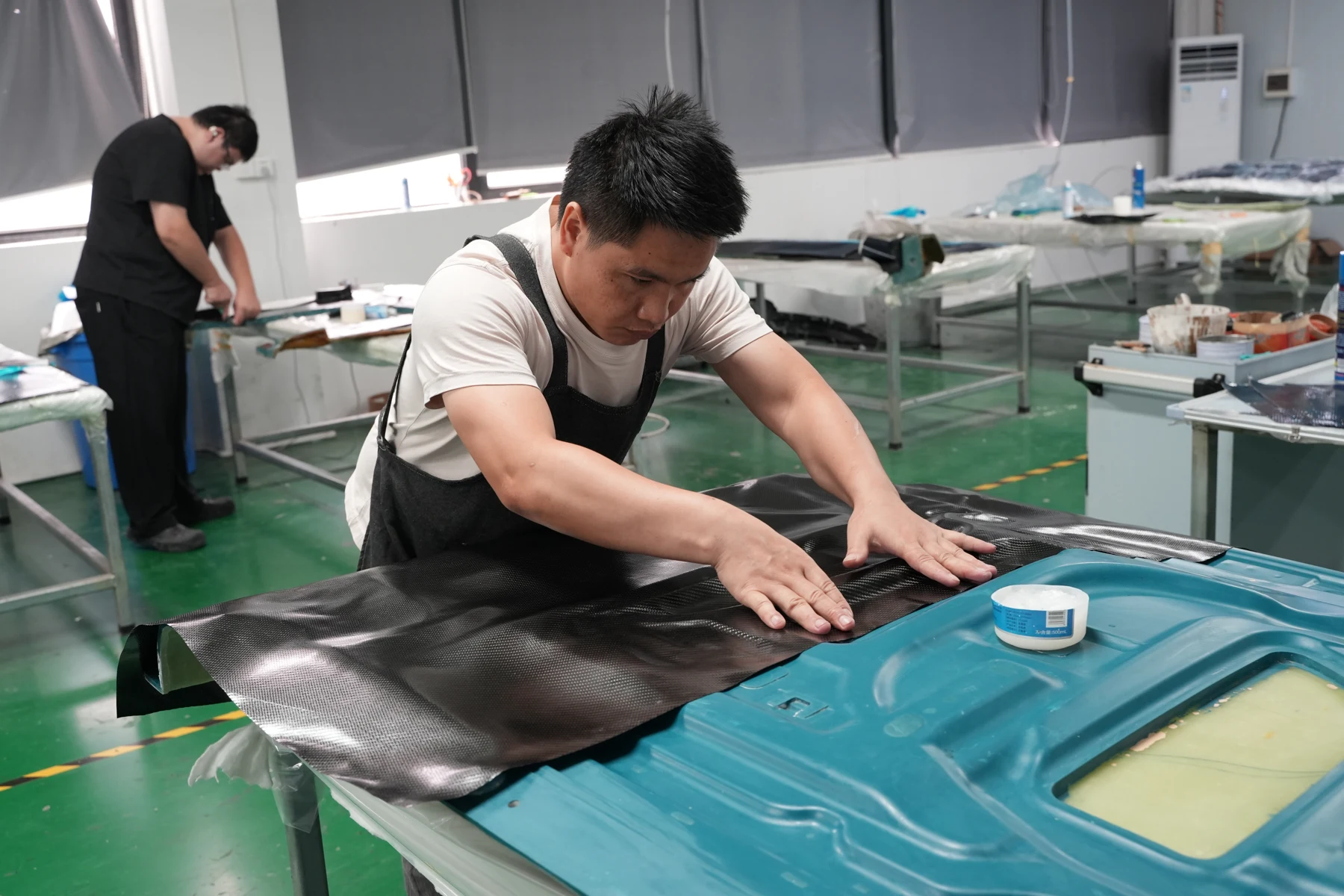
Laying cloth by hand, ply by ply. Labor is a larger share of a composite part's price than most buyers expect — and neither fiber removes it.
Carbon Kevlar Hybrid: Where the Mix Actually Earns Its Place
If one fiber is stiff and brittle and the other is tough and soft, weaving them together sounds like the obvious answer. Sometimes it is, and the logic is worth understanding because it explains why "carbon Kevlar" parts exist at all.
A hybrid works when the two fibers are doing different jobs in the same laminate. In the hull of an offshore race boat, for example, an aramid/glass woven hybrid puts aramid where elongation and impact resistance are wanted and lets the glass carry the compression the aramid cannot (CompositesWorld). The same principle appears in helmets, seat shells and anything designed to be hit rather than to hold a shape.
Which brings the comparison back to where it started: carbon Kevlar vs carbon fiber is not "in between" in a simple sense. A hybrid is stiffer than aramid and tougher than carbon, and heavier than carbon for the same thickness — so it wins where impact is the design load and the part is allowed to be a little heavier. On an aero surface whose job is to stay flat at 200 km/h, adding aramid buys toughness the part does not need and costs stiffness it does.
There is also a cosmetic version of the hybrid: the yellow-and-black weave sold as a look. That is a legitimate finish choice, but it is a finish, and it should not be priced as an engineering upgrade.
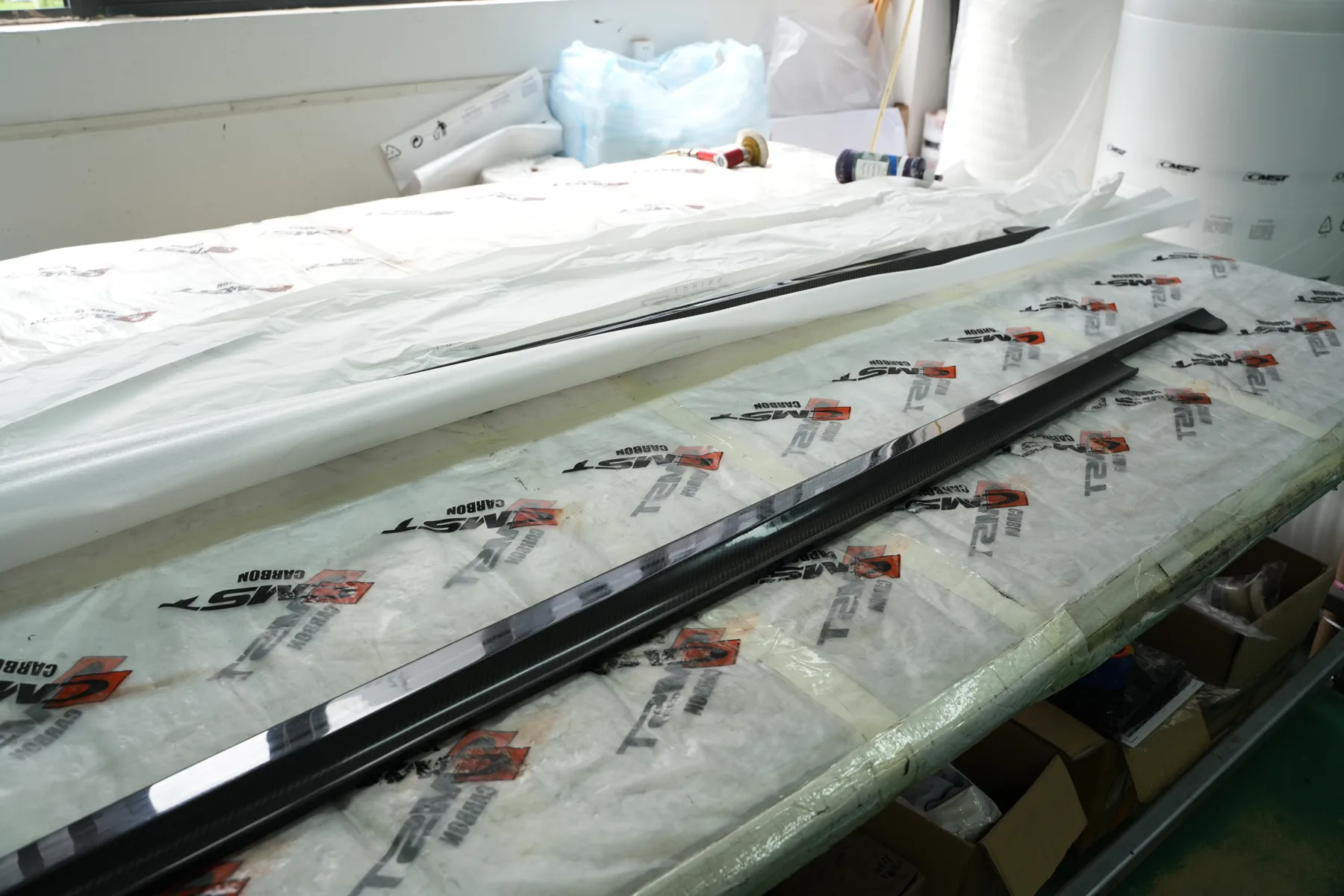
Long parts like skirts and lips leave the shop wrapped and protected. They are also the parts most likely to meet a curb.
Part by Part: What We Would Specify
Walk the kit instead of the material, and the decisions get easy. Before the table, the disclosure it deserves: CMST supplies dry carbon, high-temperature vacuum carbon, FRP, ABS and PP, and does not quote aramid panels. The table below is written from that product line — which happens to be one of the two materials in this comparison.
Part | Load it actually sees | Sensible material | Why |
|---|---|---|---|
Hood | Bending, lift, engine heat | Carbon (dry carbon if left bare) | Weight sits high and you lift it often |
Front splitter or lip | Impact first, bending second | Carbon if the look matters, PP/ABS if it will meet curbs | The most damage-prone panel on the car |
Rear wing | Stiffness under aero load | Carbon | A wing that flexes changes its own angle of attack |
Rear diffuser | Stiffness plus debris impact | Carbon | Exposed aerodynamic surface, weave reads as intended |
Side skirts | Curb contact, paint | FRP or PP | Long, exposed, painted body color |
Bumper shells | Impact, stone chips, paint | PP or FRP | Large, painted, and designed to deform |
Arch extensions | Stone chips, paint | FRP | Big surface area, painted anyway |
Seat shell or interior impact part | Impact and weight | Aramid or aramid hybrid | The one place aramid's toughness is the design driver |
Undertray | Abrasion and debris | PP, or a glass/aramid hybrid | Nobody looks at it; it gets hit constantly |
Two things fall out of that table. Aramid's honest home on a road car is behind the trim and under the floor, not on the outside of the car. And mixing materials inside one kit is normal rather than a compromise — FRP shells with carbon detail parts is one of the most common specifications we quote, because it puts the expensive material where a buyer can see and feel it.
If a build genuinely calls for an aramid panel, that is a conversation for a specialist rather than a line on our sheet. The material grades we do quote are set out one at a time, and there is a wider read on weaves and care in the carbon fiber guide.
FAQ
Is carbon fiber better than Kevlar?
Neither, and the framing is the problem. Carbon is better where a part must stay stiff and light and can be left bare. Kevlar is better where a part must absorb impact, resist abrasion and survive fatigue — and where it can be protected from UV, or hidden inside the car. If you want one question that settles the choice: is this part loaded in bending and left on show? Yes means carbon. No means look at aramid or a hybrid, or at FRP if it is going to be painted.
What are the downsides of carbon fiber?
Three that matter on a car. It is brittle — 1.5% strain before failure, so damage arrives without warning and a cracked panel rarely repairs invisibly. It is electrically conductive, which means carbon bolted against steel or aluminum can drive galvanic corrosion of the metal unless the interface is isolated with a barrier ply (CompositesWorld). And it is expensive, not because the fiber is precious but because prepreg, heat, pressure and tight tolerances all cost more than a wet lay-up.
Will carbon fiber stop a bullet?
No. Carbon is strong along the fiber and brittle across it, which is the opposite of what armor needs — armor absorbs energy across many layers and deforms rather than shattering. That job belongs to aramid, which is why body armor and ballistic helmets are aramid and not carbon. A carbon body panel is a stiff, light surface, not protection.
What are the disadvantages of Kevlar?
Poor compressive strength, sensitivity to UV, and difficult machining. Compression is the one that limits it structurally: its compressive strength sits in the same class as E-glass, well below carbon, so aramid is a poor choice for any panel whose stiff face is in compression. UV discoloration is manageable — the fiber self-screens and any coating that blocks 300–450 nm protects it — but an unprotected bare aramid exterior will go yellow-brown and lose properties. And cutting or sanding it fuzzes the fibers, which is why fabricators charge more to finish it.
If you are weighing a specific part rather than the materials in the abstract, send CMST the vehicle and the piece — the answer usually depends on which of these failure modes that part is actually exposed to. For a painted shell the honest comparison is not carbon against aramid at all: it is carbon against fiberglass, and the paint step decides it. Whichever way you go, compare the parts on a quotation rather than the two material names in an article.
Next step
Send the vehicle, the parts you are considering and the finish you want — we reply with fitment notes and a quote.
Send an inquiryKeep reading
Related notes
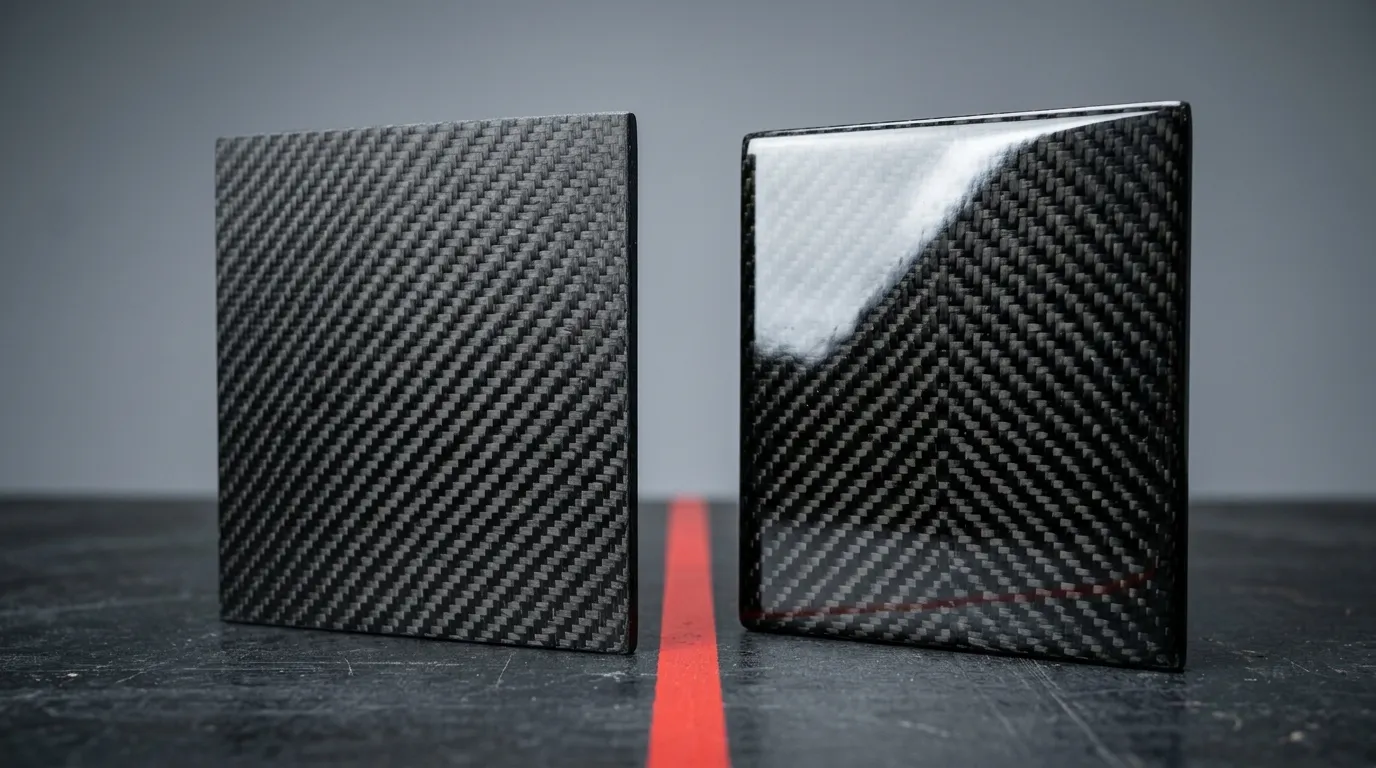
Is Dry Carbon Worth It on a Street Car?
Dry carbon is worth the premium on the panels you look at and lift, not on the parts that get hit, painted or replaced. Here is where the money actually goes.
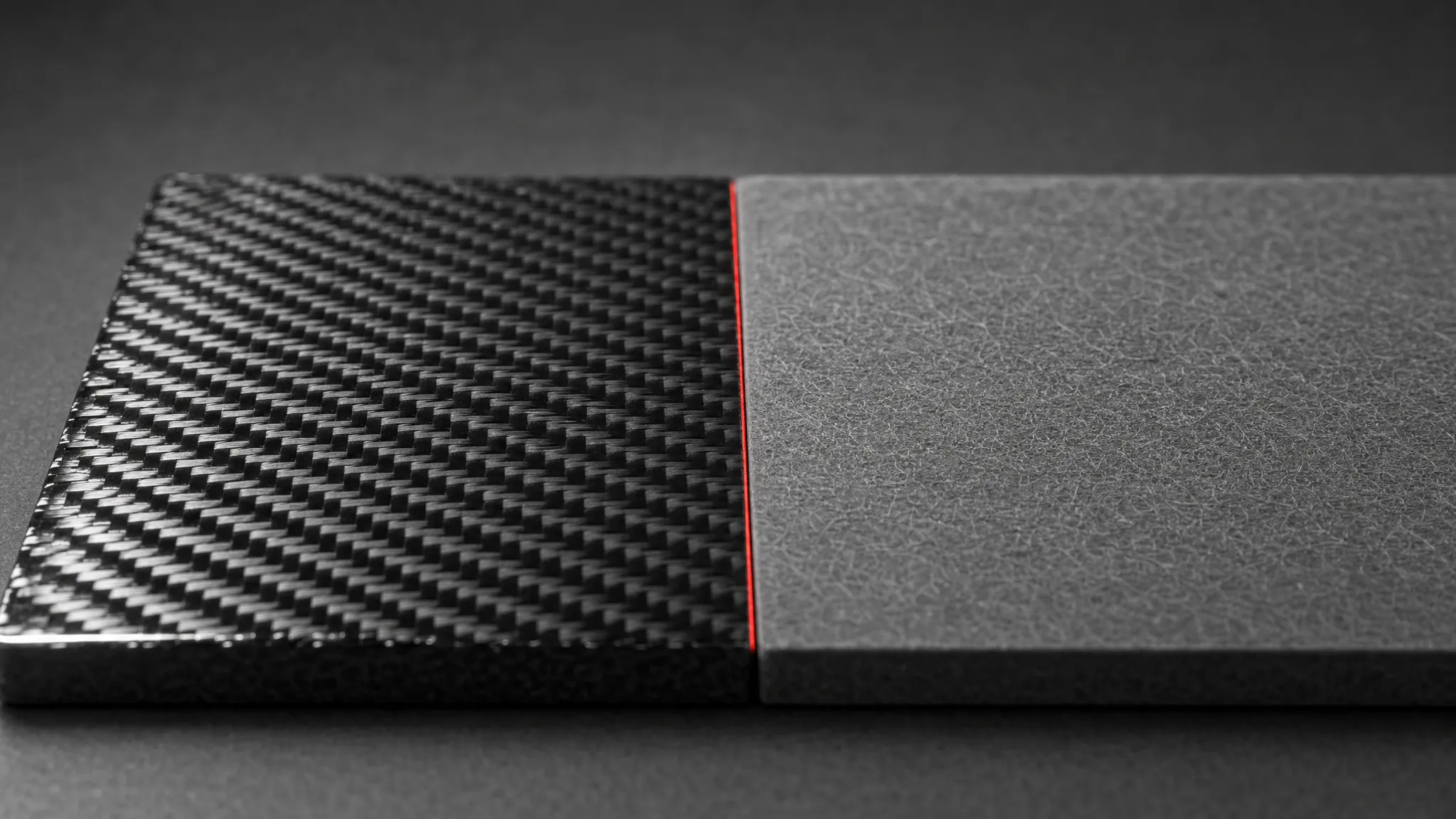
Carbon Fiber vs Fiberglass Body Kits
Carbon fiber or fiberglass for a body kit? Part by part: carbon earns its price on hoods, wings and diffusers; FRP and molded plastic win on bumpers and arches.
Supplier vs Manufacturer: Who Owns the Mold?
A trading company can quote like a factory. Five checks - mold ownership, fitment answers, custom programs, remedies, cost - and where CMST stands on each.