
Overfenders vs Fender Flares: What the Difference Is, and Which One Your Car Needs
Overfenders and fender flares are one part under two names. What each term means, the three ways to cover a wider wheel, and how to measure before you buy.
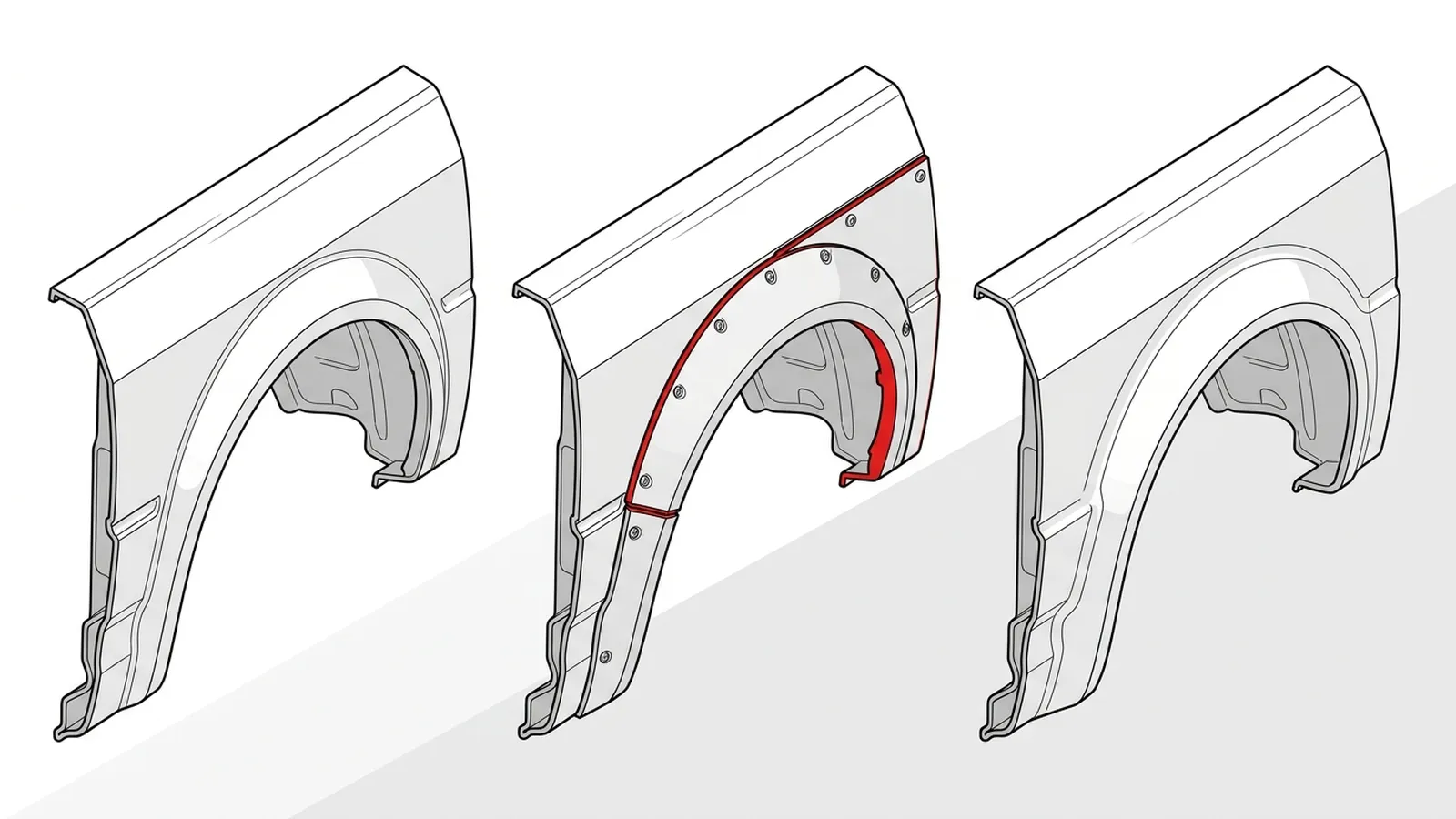
Overfenders vs fender flares is a vocabulary question, not a product question: they are the same kind of add-on wheel arch extension under two names, and the choice that matters is which of three routes you take to cover a wider wheel.
"Overfender" is the Japanese tuning term for an extension bolted or riveted over the wheel arch; "fender flare" is the North American aftermarket term for the same idea, used mainly on trucks and SUVs. The three routes — a bolt-on extension, a wide fender replacement panel, and rolling or pulling the factory arch — differ in what they cost, what they cover and whether you can undo them.
This is from CMST — we build these parts, so treat what follows as a maker's view rather than a neutral roundup. Where a bolted-on extension is the wrong purchase, this article says so.
One warning before anything else: most people searching "fender flares" are not looking for what this article covers. If your vehicle is a pickup or an SUV and you want to stop gravel from hitting the paint, that is a different product with different mounting, different sizing and a different price band. What the two words have in common, two sections down, explains the split so you can tell which side of it you are on.
Overfenders vs Fender Flares: What Each Term Actually Means
The confusion is real, and it comes from two markets that developed the same part independently and gave it different names.
Where "overfender" comes from
In Japanese tuning, an overfender is the part you add when a wider wheel and tire no longer fit inside the body. Rather than rebuild the whole body — expensive — you modify or bolt on a crescent- or trapezoid-shaped panel that follows the curve of the wheel arch and sits outside the original fender line. It appeared as a custom technique on cars like the S30 Fairlady Z and the C10 Skyline GT-R, and manufacturers later designed wide arches into production models rather than leaving it to the aftermarket.
The mounting detail matters more than it sounds: overfenders are normally fixed with screws or rivets, and adhesive tape alone is not accepted, because the part has to stay on at speed and satisfy periodic roadworthiness inspection (Japanese Wikipedia, automotive fender). If you take one thing from this article, take that: an overfender is a mechanical attachment, not a trim piece.
Where "fender flare" comes from
In the North American market the same part is a fender flare, and it is described in two directions at once. Wikipedia's treatment of the automotive fender lists flares as an accessory that blocks mud and stones or covers rust, notes that manufacturers fit them when a model runs wider tires than the base car, and records the three common styles — OE-style, bolt-on with exposed fasteners, and cut-out flares that require the fender to be trimmed (Wikipedia, Fender (vehicle)). That same entry puts the usual width of a fender flare at 1–8 inches (25–200 mm) and lists fiberglass and ABS as typical materials, with metal used where durability matters more than weight. It also names sports cars alongside trucks and SUVs, which is where the two vocabularies collide.
So which word should you use?
Use both, in the right places. When you are searching a parts catalog, "fender flare", "wheel arch extension" and "over fender" all reach the same category of product. When you are talking to someone from the Japanese tuning scene, "overfender" is the word they will recognize instantly. When you order from a factory, describe the part rather than the label: an add-on arch extension that goes over the original fender, with the mounting method you want.
Our own arch and fender parts sit in one range, whatever the label on the shelf — the fender and wheel arch range lists them by vehicle, not by vocabulary.
Overfender | Fender flare | |
|---|---|---|
Where the word is standard | Japanese tuning (JDM) | North American truck, SUV and off-road |
Typical vehicles | Sports cars, JDM classics, widebody builds | Pickups, SUVs, Jeeps, off-road builds |
How it is fixed | Bolted or riveted to the arch | Bolted, riveted, clipped or taped depending on style |
What it covers | Whatever the wider wheel needs, matched to the tire | Tire coverage, commonly 1–8 in (25–200 mm) |
Usual materials | FRP, carbon fiber, ABS | ABS, polypropylene, fiberglass, sometimes metal |

Arches wide enough to cover the tire change the whole read of the car — this is the effect both words are describing.
What Overfenders and Fender Flares Have in Common
Strip the vocabulary away and both are the same object: a panel that attaches to the outside of the wheel arch and stands proud of the original body line. Neither is a structural part. The fender or quarter panel underneath carries the loads; the flare or overfender is a cover.
They exist for the same two reasons. The first is physical: a wider wheel, a lower offset or a taller tire can push tread beyond the arch, and the extension brings the body line back out over the tire. The second is visual — the car reads wider and more planted even when the suspension has not changed.
Both can be made in the same materials, and both can be painted body color or left in a finished surface. A part described as a flare in one catalog and an overfender in another can be the same mold with a different photograph.
Why this article is not for most "fender flare" shoppers
If your vehicle is a pickup or an SUV, the flare you are shopping for is doing a job overfenders were never designed for. Truck and off-road flares are sized to deflect gravel, mud and road spray, and in many places they exist to satisfy a legal requirement that tire tread not sit outside the body. They are usually wider than they need to be for tire clearance, they are often fitted to a vehicle that will see rough surfaces, and they are commonly made in ABS or polypropylene because they will take hits.
An overfender is sized around one job: making room for a tire. It is narrower, it is stiffer, and it is usually finished to be looked at rather than to be scraped. If your concern is stone chips on the doors, you are on the other side of this split and the truck-oriented guides in the search results are the ones you want.
The Three Ways to Cover a Wider Wheel
This is where the real decision lives, and it is the part most guides skip past.
Bolt-on and riveted extensions
The add-on panel — the actual overfender or flare — is the reversible route. It mounts over the original arch with bolts, rivets, clips or factory mounting points, and it can be removed later. Coverage is a design choice: you buy the width that matches how far your tire sits out, so a mild pull covers a mild offset and an aggressive riveted panel covers a much wider setup. The riveted style is the one most people picture when they say overfender — the fixings are meant to be seen, and they are genuinely holding the part on rather than decorating it.
What you give up is integration. There is a visible seam where the extension meets the original panel, and on a light-colored car that seam is where dirt and water collect. Fit quality is also entirely down to the maker: a bolted panel either follows the arch line or it does not, and no amount of adjustment hides a mold that was shaped badly.
Wide fender replacement panels
The second route replaces the fender itself with a wider one. Instead of an extension sitting on top of the factory panel, you fit a panel that already includes the extra width, with the arch drawn in the new outer skin. Done well this is the cleanest result available: no seam, no stacked layers, and the vents and surface detailing can be part of the same mold.
Done well is the operative phrase. The panel has to be painted to match, which on a metallic or pearl finish means a painter who can blend into the adjoining panels, and it is not reversible — the original fender does not go back on once it is off. The materials split matters here too: glass fiber and its resin cousins are cheaper and easier to repair and paint, while carbon fiber is stiffer and lighter and can be left with its weave showing, at a cost that reflects the fiber and the curing process (CompositesWorld, high-performance fibers).
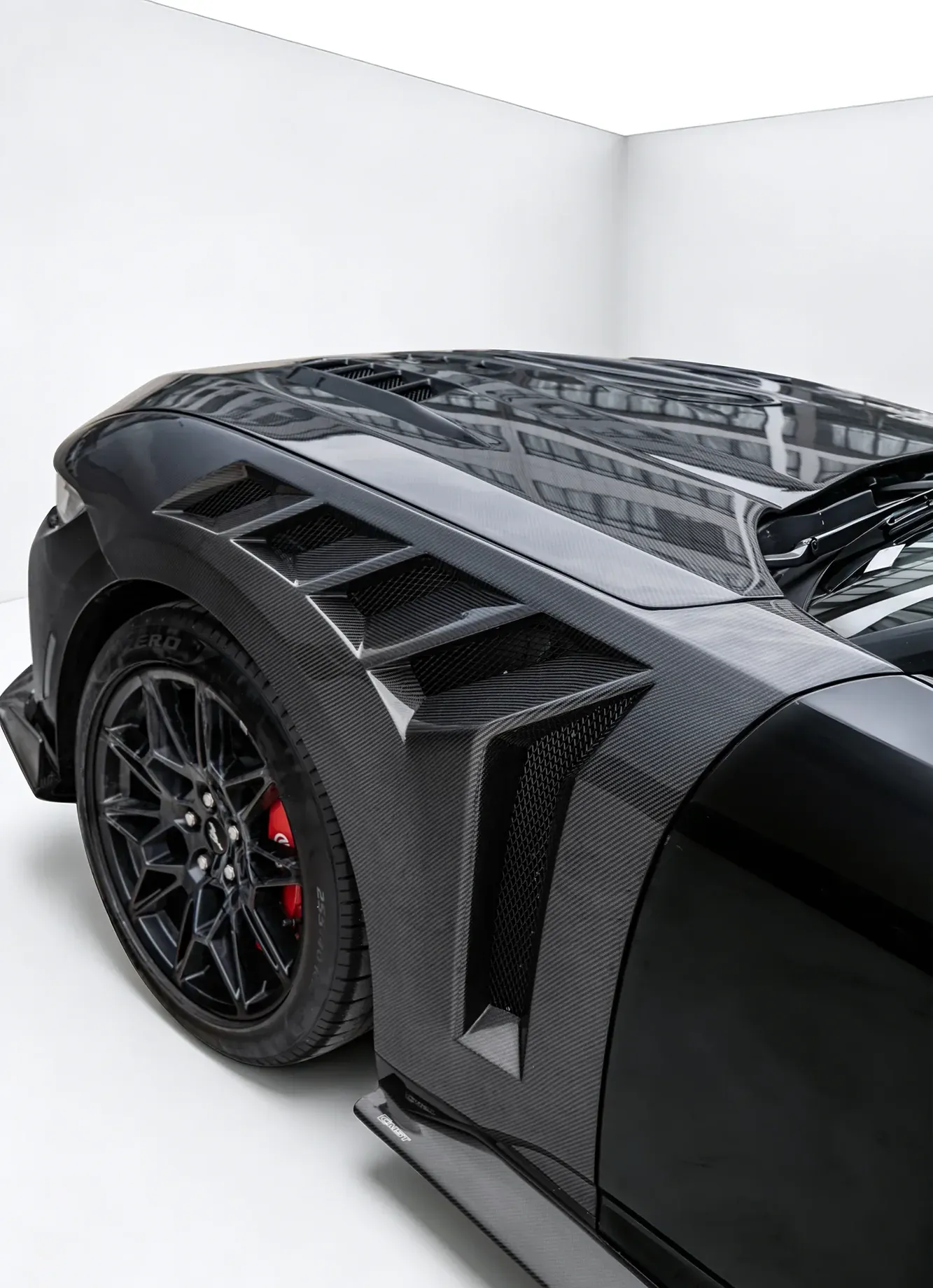
A replacement panel rather than an extension: the extra width and the vents are part of the fender itself, which is why the surface is unbroken.
We trial-fit on a real car before a mold is signed off for exactly this reason — a replacement panel has no adjustment range, so it either fits the arch and the door gap or the mold goes back. That process is written up under how we trial-fit on a real car.
Rolling and pulling the factory arch
The third route does not add a part at all. Rolling folds the inner lip of the arch upward to gain a small amount of clearance; pulling pushes the whole arch outward to gain more. Neither uses the vocabulary of this article, which is why it almost never appears in flare guides — but it is the option most people should evaluate first, because it keeps the car looking standard and costs less than bodywork.
Its limits are real. The gain is measured in millimeters, not inches, and it depends on how much material the manufacturer left in the arch. Pulling works the metal, so the paint is under strain and can crack, particularly on older or previously repaired panels. And it is irreversible: once the arch is pulled, you cannot put it back. If you need tire coverage measured in inches, rolling will not get you there, and you should be looking at a bolt-on extension instead.
Route | Reversible? | Coverage ceiling | Where the money goes | Main risk |
|---|---|---|---|---|
Bolt-on / riveted extension | Yes, unbolt it | Set by the panel you buy | The part, plus paint if you color-match | Visible seam; fit depends on the mold |
Wide replacement fender | No | Substantial, integral to the panel | The panel, plus paint and blending | Paint matching; no adjustment range |
Rolling / pulling the arch | No | Millimeters | Labor at a body shop | Cracked paint; limited gain |
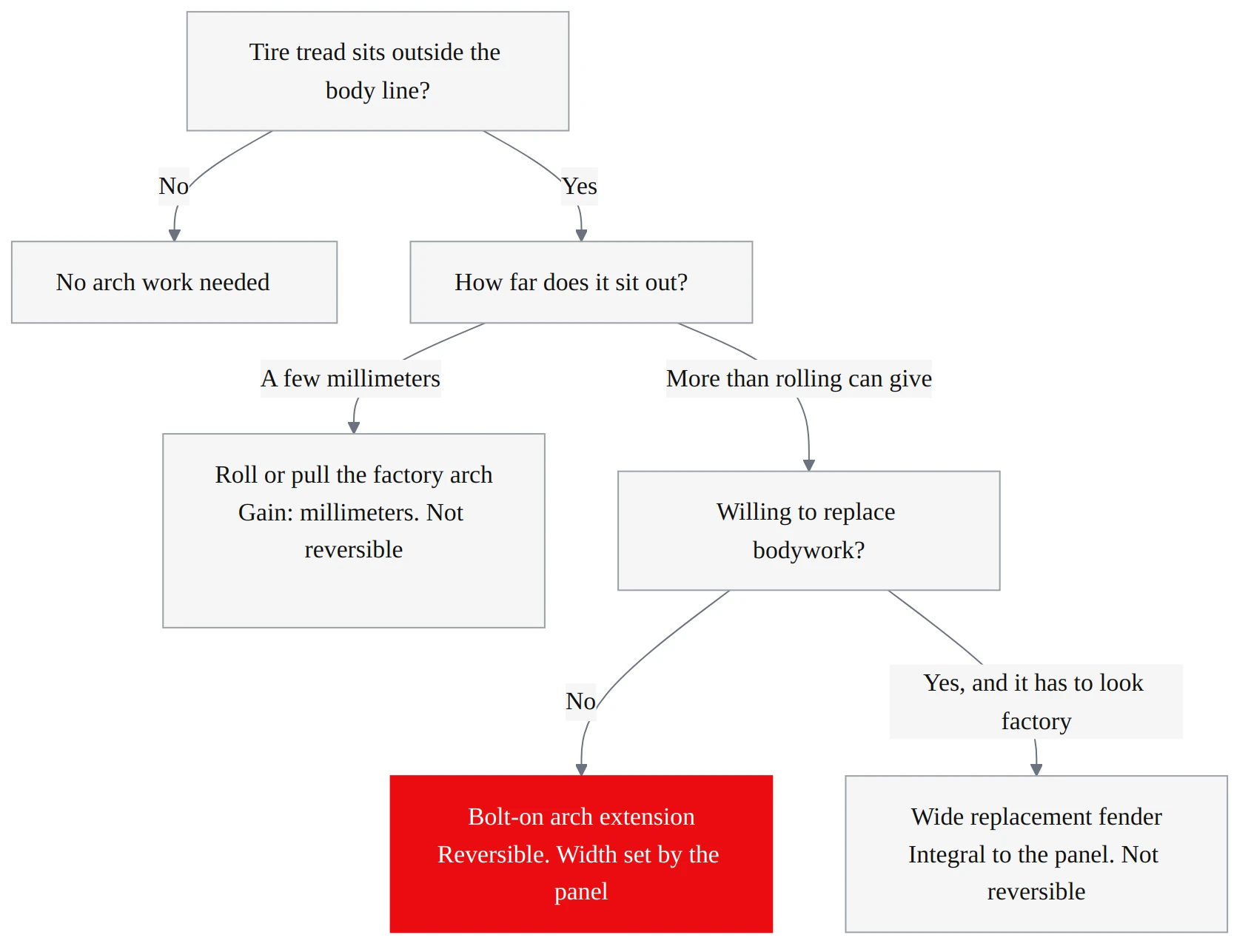
Three questions decide the route: how far the tire sits out, whether you are willing to cut or replace bodywork, and whether you ever need to put the car back to standard.
Overfender, Flare or Widebody: Where the Line Is
A single extension covers one arch. A widebody conversion changes the car's whole silhouette — front and rear arches, side skirts, and usually a wider track to match. The words overlap in casual use, but they are different purchases.
One thing a wider arch is not: a downforce modification. Airflow around an exposed wheel and lift at the front axle are a separate problem from tire clearance, and a widebody car with no other aero work has more room for its tires rather than more grip from the air.
The dividing line is whether the factory body underneath survives. Bolt an extension on and you have widened the arches; the car is still the car. Cut or replace arches front and rear as a set, add skirts between them and space the wheels to fill the new width, and you have a widebody build, where the parts were designed to work together and buying them one at a time usually produces a car that looks assembled rather than built.
Most builds never need to cross that line. If the tire sits out by a little and the rest of the body is standard, a pair of extensions is the whole job. When the goal is a different proportion front to rear, that is a set, and it has its own page — widebody conversions — rather than a section inside this one.
Material and Finish: Which One to Specify
Arch parts are a case where the cheap material is often the right one, which is the opposite of how most people reason about carbon fiber.
An arch extension lives on the outside of the car at wheel height. It is a large surface, it is usually going to be painted to match the body anyway, and it is the part most likely to meet a curb, a ramp or a stone. That profile favors glass fiber and molded plastics: they are cheaper per part, they tolerate a hit, and a repair disappears under primer and paint.
Carbon fiber earns its price on stiffness and weight, and it can be left with the weave visible instead of painted. On a show build or a track car where the material itself is the point, that is worth paying for. On a painted arch cover it buys you nothing a driver can feel.
Our own parts are quoted in five grades, and the same mold often serves more than one of them: dry carbon, high-temperature vacuum carbon, FRP, ABS and PP. Which grade a part is specified in, and why, is set out under the material grades explained. The property difference behind that list is not subtle — PAN-based carbon fiber is around 1,744–1,800 kg/m³ against roughly 2,630 kg/m³ for E-glass fiber, so carbon is in the region of 30 percent lighter for the same volume (Engineering Toolbox), and E-glass remains the reinforcement in well over 90 percent of all glass fiber used in composites (CompositesWorld, glass fibers). On an arch cover that weight difference is measured in grams.
One specification note worth knowing before you order: carbon fiber is electrically conductive, and carbon in contact with metal can drive galvanic corrosion of the metal, so a barrier layer at the interface is standard practice rather than a premium option.
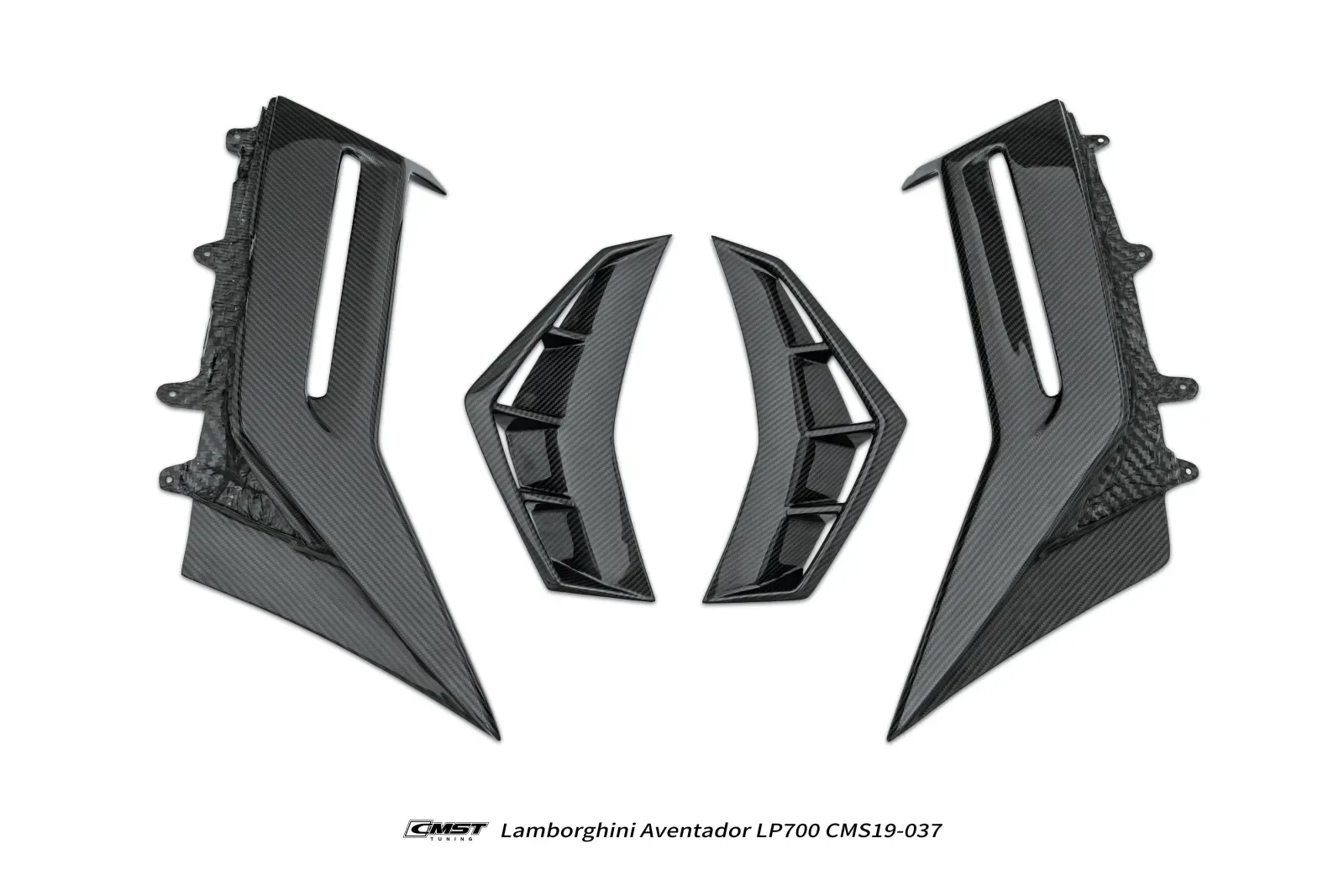
What actually arrives when you order a replacement panel rather than an extension: the part is the outer skin, with its own arch line and vent detailing.
How to Choose: Measure Before You Buy
Work through these five questions before you spend anything, and the route usually picks itself.
How far does the tire sit out? Stand behind the car and look along the arch. If the tread pattern is visible beyond the body line, note how far — this is the coverage you need, and it is the number every other decision hangs on. A few millimeters of tread showing is within reach of rolling.
What is your wheel width and offset? The tire sticking out is usually the result of a wider rim, a lower offset, or both. If the offset is the main culprit, correcting it with the wheel rather than the body is worth considering first.
What suspension are you running, and how much does it compress? An extension adds material inside the arch as well as outside it. On a lowered car with limited travel, the tire can catch the new panel under compression. This is the failure people find out about after painting.
Are you willing to cut or replace bodywork? If the answer is no, you are choosing between a bolt-on extension and rolling the arch. That one answer removes half the options.
What is the car for? A daily driver that will meet curbs and speed bumps argues for a part you can unbolt and replace. A show car argues for the integral look. A track car argues for the stiffest, lightest panel you can get in the size you need, with the expectation that low parts get damaged eventually.
When you know the route, the sizing question becomes straightforward — the catalog is organized by vehicle and by part, and the kit catalog lists what exists for each platform. If you would rather judge the result than the specification, the build gallery shows finished cars across the range.
Legal and Practical Notes
Many jurisdictions require that tire tread not protrude beyond the body, and an extension is one of the ways to meet that requirement — it is not a modification that creates the rule. How your part is fixed matters at inspection time: mechanical fasteners are accepted in places where adhesive alone is not, which is one reason the riveted style endures even where it is not the prettiest option.
Two practical notes. A painted arch part takes stone chips at exactly the height where the tire throws them, so a clear coat or a protective film is worth budgeting for; and a riveted part leaves holes if you remove it, so treat "reversible" as meaning the car can be returned to standard with some bodywork rather than none at all.
FAQ
What is another name for a fender flare?
Overfender, over fender, wheel arch extension and arch trim all name the same category of part. The choice of word tells you which market the seller comes from rather than what the part does.
Are overfenders the same as fender flares?
Functionally, yes — an add-on panel covering the wheel arch to make room for a wider wheel. The difference is convention and fitment culture: overfender is the term used in Japanese tuning, where the part is a bolted and widened arch piece, while fender flare covers the same product for trucks, SUVs and off-road use, where coverage from debris is the main purpose.
Do overfenders work on a daily driver?
They do, with two conditions. Choose a width that matches the tire rather than the widest panel available, so the car does not become awkward to park and the wheels do not foul the new arch under compression. And finish the part properly — an unpainted extension on a daily-driven car looks unfinished within a season.
How wide should a fender flare be?
As wide as the tire coverage you actually need, and no wider. Measure how far the tread sits beyond the body line, add a small margin, and buy that. Buying wider than necessary adds weight, drag, curb risk and a gap between the extension and the arch that collects dirt.
Bottom line
Overfenders and fender flares are one part with two names, and the vocabulary is the least important thing about buying either. Decide the route first: roll the arch if a few millimeters is all you need, bolt on an extension if you want the width without cutting anything, replace the fender if you want the result to look factory and can commit to paint. Buy the width your tire needs, not the width the catalog advertises.
If your build is going to need more than arches, read the rest of the aero parts guide for where the arch work sits alongside lips, skirts, diffusers and wings — the parts have to work as a set, and the arch is usually the constraint the rest of the bodywork has to respect.
Next step
Send the vehicle, the parts you are considering and the finish you want — we reply with fitment notes and a quote.
Send an inquiryKeep reading
Related notes

BMW M4 Widebody Kits (G82): A Buyer's Guide
Going wide on a G82 M4 is bodywork, not styling. What a widebody kit contains, what gets cut, what it costs, and the four decisions to settle before you order.

What Is a Widebody Kit? A Beginner's Guide
A widebody kit widens a car's arches so wider wheels and tires will fit. Here's what is in one, what gets cut, and how to tell if a wide build suits your car.
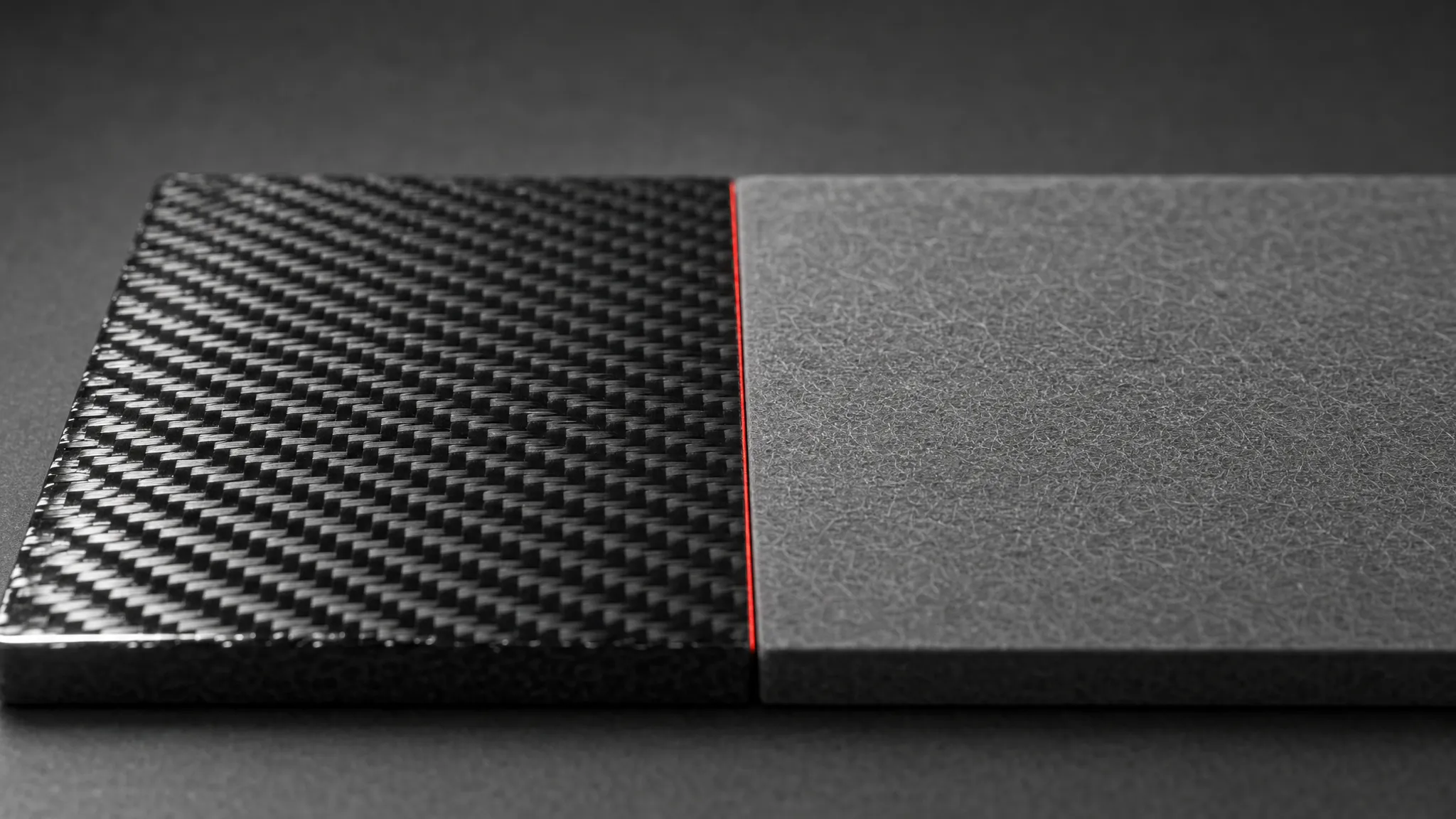
Carbon Fiber vs Fiberglass Body Kits
Carbon fiber or fiberglass for a body kit? Part by part: carbon earns its price on hoods, wings and diffusers; FRP and molded plastic win on bumpers and arches.