
Dodge Challenger Widebody: The Buyer's Guide for Shops and Owners
A Challenger widebody is either the factory package or a conversion a shop builds. What the factory changed, and what a narrowbody job really takes from you.
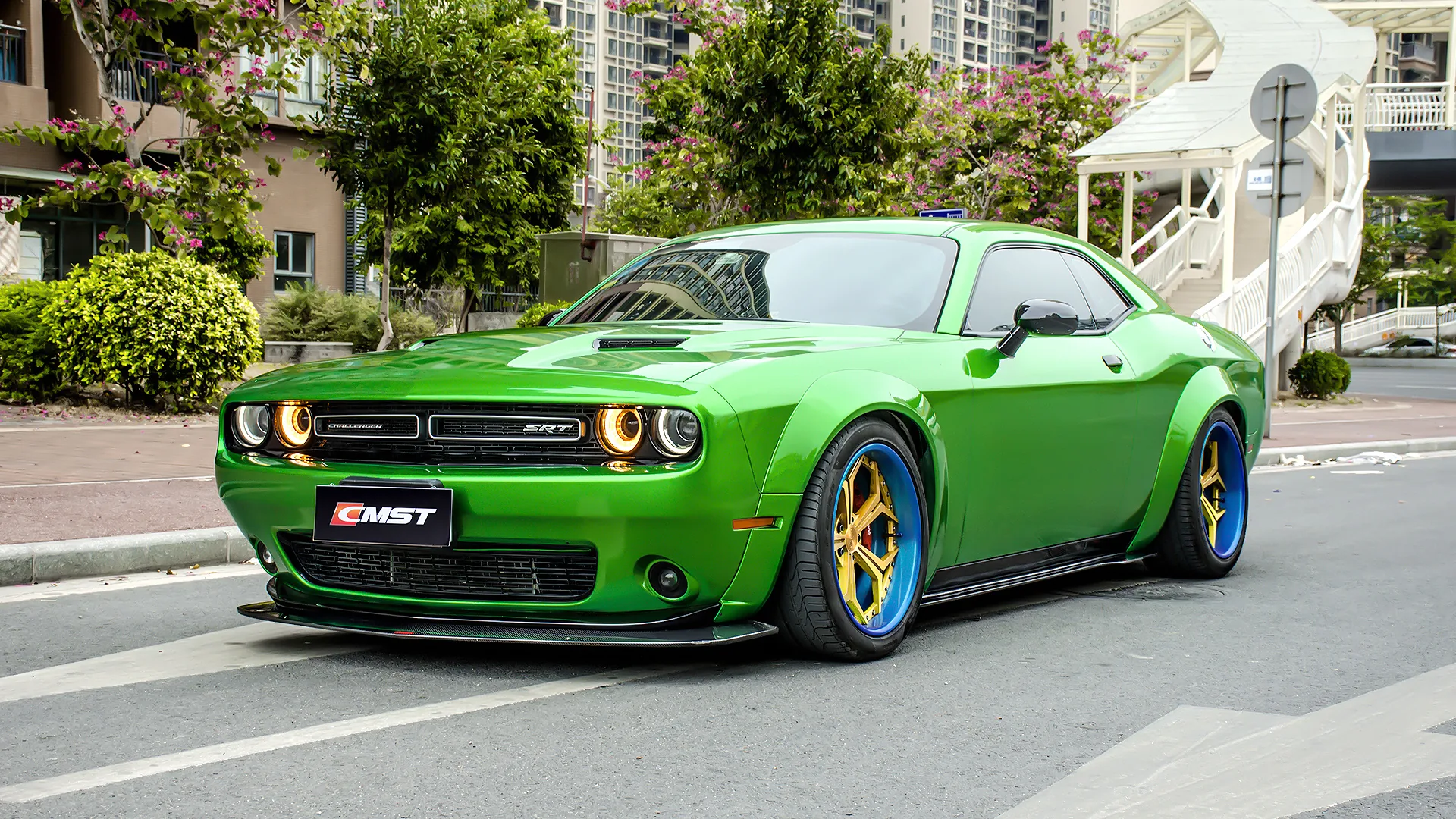
A Challenger widebody is one of two things, and the two cost different money: it is either the package Dodge built at the plant, which adds 3.5 inches of width, or it is a conversion a shop builds onto a car that never left the line that way. Most of what is written about the term describes the first. The second is where the labour, the fitment risk and the rework live.
Two different people are searching for this. One is shopping for the car — a used widebody Challenger, the flared version of a Scat Pack or a Hellcat — and what that person needs is the specification, which is in the next section. The other has a Challenger in the bay: either a customer asking whether their narrowbody can be made to look like the wide one, or an owner who has decided it can. This guide is written for that second reader, and it works through the decisions in the order they actually arrive — what the factory car is, how the two shells differ, what a conversion involves, what material the parts should be, and what goes on the quotation. If your platform question is broader than one model, the platform-by-platform body kit guide is the place to start.
What the Factory Challenger Widebody Actually Is
The flares came first from the Demon, and they landed on a regular production Challenger with the 2018 SRT Hellcat Widebody. A year later the same treatment reached the naturally aspirated R/T Scat Pack, and for 2021 it extended again to the Scat Pack Shaker and the T/A 392. That sequence matters for a shop because it defines the pool of cars that are already wide: if a customer says "it's a widebody" without naming a year, you are being told a trim name, not a body.
What the package changed is more than the arch outline. Per Dodge's 2018 release material, the fender flares add 3.5 inches to overall width, they cover 20 x 11-inch "Devil's Rim" wheels on 305/35ZR20 Pirelli P-Zero tires, and the front side markers were restyled to follow the shape of the flare — a small detail that tells you how much of the front corner changed. For the tape-measure answer to "how wide is a Challenger widebody": Dodge's 2020 specification sheet lists a standard car at 75.7 inches across the doors and a widebody at 78.3 inches across the front flares. Those two numbers do not add up to 3.5, and that is not a mistake on Dodge's part — they are measured at different points on the car, which is exactly the kind of gap that opens up when a customer holds a tape against a press release. The flares themselves are separate parts fixed with concealed attachments rather than a restamped quarter panel, which is how the car gains width without a new body side. On the Scat Pack version — the 485-hp 6.4-liter 392 HEMI — the package arrived with larger six-piston Brembo front brakes, a wider wheel and tire set and suspension work, and it is quoted at roughly two seconds a lap on a 2.1-mile course against the non-widebody car. The Hellcat version of the same period carried the 707-hp supercharged 6.2-liter HEMI, which is the other reason the wheel and brake package is not cosmetic: more grip was the point. The 2021 Shaker and T/A 392 cars added an SRT-tuned chassis and SRT-tuned adaptive damping to that list.
Read that list as a buyer and the useful conclusion is unglamorous: the factory widebody is a system, not a look. Wider arches exist to clear a wider wheel and tire; the brakes and the damping changed because the grip did. Copy the arch and skip the rest and you get a car that looks the part and drives like the narrow one it still is. What a widebody conversion actually changes covers the general logic of that system; this article is about the Challenger-specific version of it.
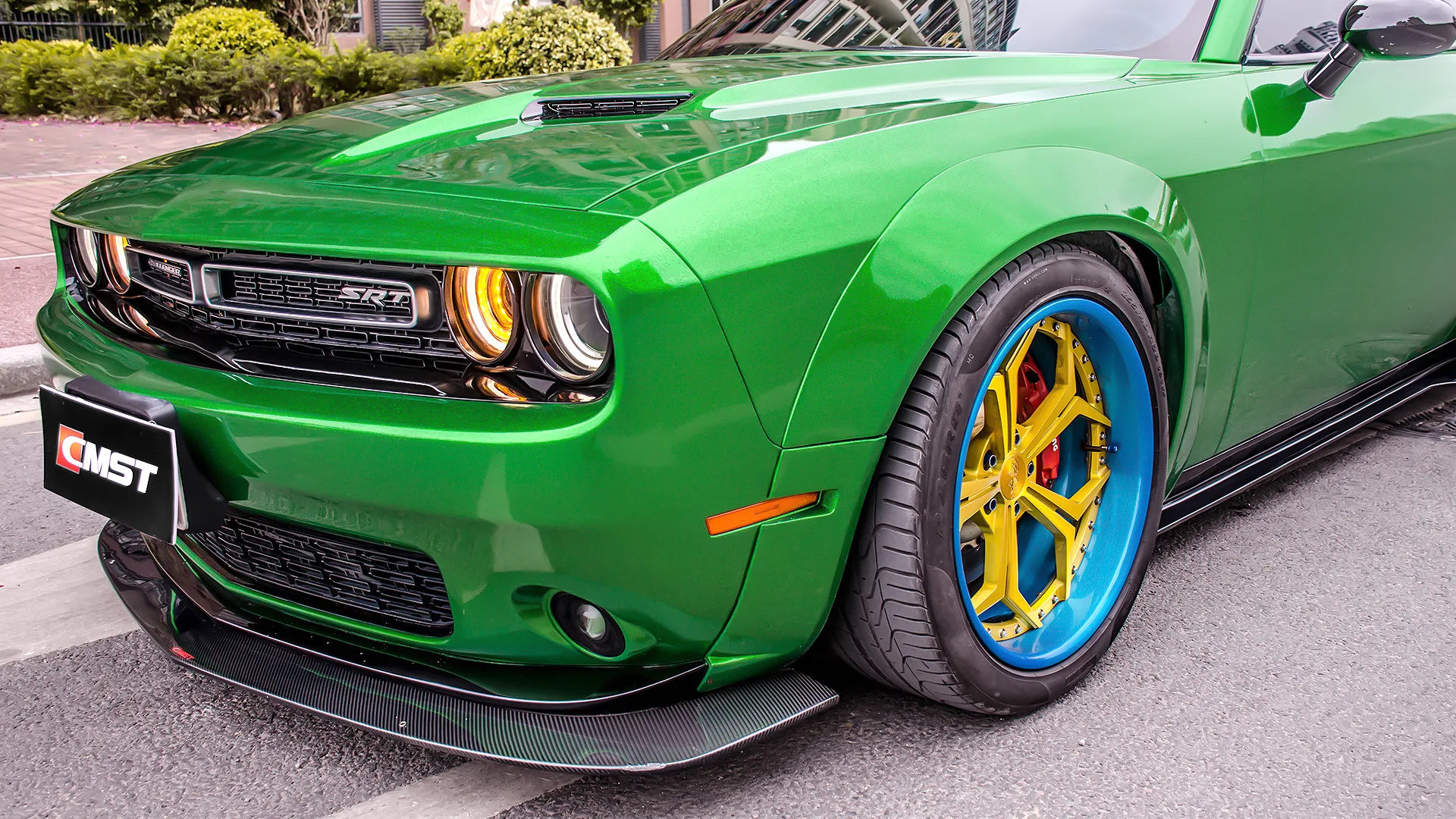
Everything visible here sits on top of whatever shell the car already has: the lip, the skirt and the wheel package are the layer most customers copy first, and none of them change the arch opening.
Narrowbody or Widebody: Check the Shell Before You Quote
The first question on any Challenger widebody job is not which parts the customer likes. It is which shell they are bringing, because everything that touches the arch line is shell-dependent. Whether the customer's message says widebody Challenger, Challenger wide body or Challenger widebody, the answer does not change: the shell decides, not the wording.
Two cars that look similar in a photo can be on opposite sides of this. A narrowbody R/T and a widebody Scat Pack share a platform, a wheelbase and most of their interior, and they do not share the front arch, the rear arch opening, the bumper corner that meets it, or the way the side skirt terminates. A part drawn against the wide car's arch will not sit correctly on the narrow one, and the reverse is worse: narrowbody parts on a widebody car tend to foul at the corners rather than fail obviously, which is the kind of fault that shows up after paint.
Our own catalogue carries the concrete example. The four-piece Challenger kit we tool is listed for the 2015–2019 car, and its rear lip is specified for the narrowbody with a note that a widebody car needs a small modification at the corners. That is one line on a product page and it is the whole argument of this section: the parts are close enough to look interchangeable and not close enough to bolt on. A shop that quotes from a photo will discover it at fitting.
Two more things belong in this check. The Challenger ran from 2008 to 2023 on the same underlying platform, with the styling and fascias revised along the way, so model year is a stronger filter than generation — a 2015 car and a 2019 car are the same generation and not the same front end. And the trim name is not the body. The versions that could be ordered with the factory flare are the Hellcat, the Redeye, the 2018 Demon and the 2023 Demon 170, the R/T Scat Pack, the T/A 392, the 2021 Shaker and the special editions built on them; the SRT 392, R/T, SXT, GT and SE never offered it. A car badged SXT sitting on flares has been modified by somebody, and that changes what you are quoting — you are pricing work on a modified car, not a factory one, so the first job is finding out who did the last one.
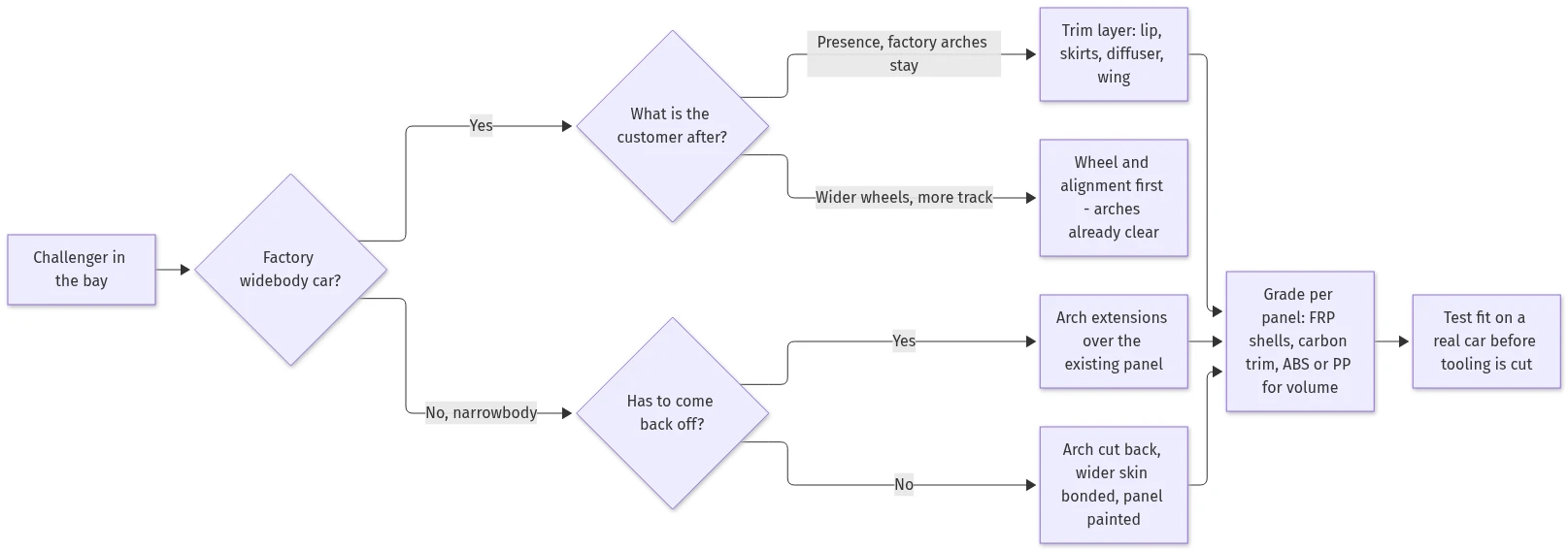
Three routes, not two. The trim-only route is legitimate and is what most customers actually want once the wheel and paint budget is on the table.
If You Are Converting a Narrowbody, What the Job Involves
Strip the marketing off a conversion and there are three layers of work, and they fail in a fixed order.
Clearance first. The arch has to let the wheel travel. A wider wheel on a wider track still swings inboard at full steering lock and again at compression, and the place it touches is behind the arch lip where nobody looks until the tire is already damaged. So the inner lip, the arch liner and the fasteners behind them get dealt with before any exterior panel goes on. This is also the step that decides how much of the job is reversible.
Then the arch surface. This is where the two families split: arch extensions that fix over the existing panel, or a replacement skin that changes the panel itself. The first keeps the original metal and can come back off; the second reads as a factory shape and does not. Both are covered in more depth in flare and overfender, side by side, and the choice is usually made by the customer's appetite for permanent work rather than by looks.
Then the finish. Cut or trimmed edges are bare material, and bare material at an arch rusts from the inside out. A properly finished conversion grinds, primes and seals the edge before the new panel covers it. Skip it and the failure surfaces a season or two later, underneath a panel that now has to come off again — the most expensive kind of comeback, because the labour is repeated and the paint is not recoverable.
There is a fourth thing that is not bodywork and gets forgotten in the quote: the wheels. If the car is going wide, the wheel and tire package is part of the conversion, not an accessory to it. A shop that fits arches to a car still on stock offsets ends up with a stance that looks unfinished and a customer who thinks the panels are wrong.
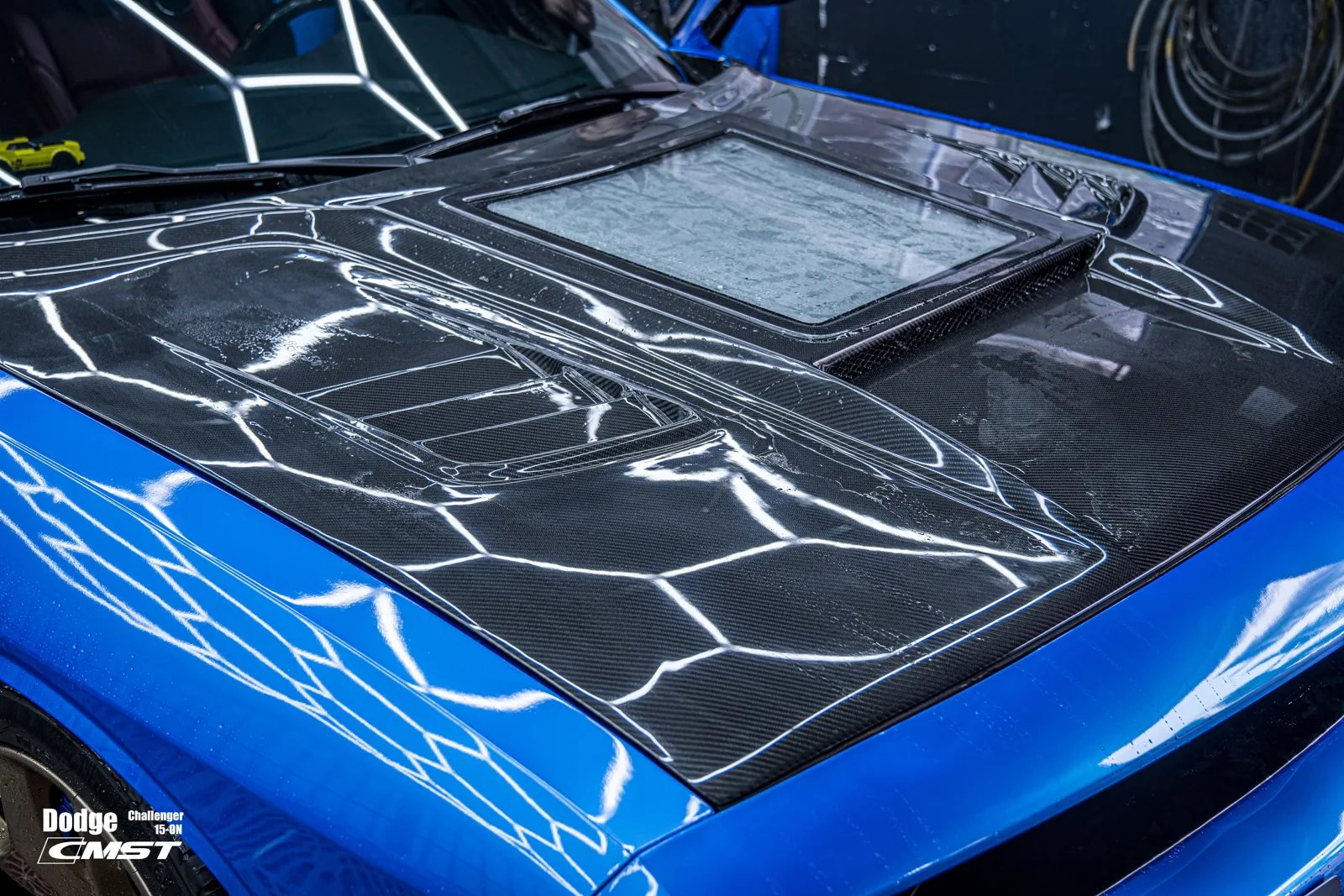
A replacement panel, not a cover: this hood mounts on the factory hinges and latches. On a conversion, knowing which parts replace and which sit over the original is what keeps the paint and labour estimate honest.
Choosing the Material, Panel by Panel
Material is where a Challenger quote varies most between two shops quoting what sounds like the same job. The same mold can run in more than one grade, and the grade decides three things the customer feels: weight, what it looks like out of the box, and whether it needs paint before it goes on the car.
Grade | Process | On arrival | What it does to the job |
|---|---|---|---|
Dry carbon | Prepreg, cured under heat and pressure | Finished twill or forged weave | Lightest; no paint step; the show and track choice |
Vacuum carbon | High-temperature vacuum forming | Gloss clear coat | The volume carbon grade — gloss carbon, more weight than dry |
FRP | Glass fiber with resin primer | Primed, paint-ready | The paint step was happening anyway; right for large shells and arch sets |
ABS | Vacuum-formed sheet | Gloss or matte black, molded in | No paint, no drying time — fit and invoice the same day |
PP | Injection molded | Gloss or matte black, molded in | Heaviest and most impact tolerant; OE-style behaviour for kerb and stone-chip areas |
Run the table against the panels on a Challenger and the split writes itself. Arch sets and bumper shells are large, they get painted body colour anyway, and FRP is the sensible answer — carbon there adds cost the customer will never see. Lips, canards, diffusers and a ducktail spoiler are the parts that are looked at, so carbon earns its price. A car that gets driven daily and kerbed weekly is a PP conversation for the lower trim. Mixed grades inside one order are normal rather than a compromise: FRP shells with a dry carbon lip is one of the most common splits we quote.
Two checks keep this honest. Ask what the part weighs in the grade being quoted, not in the grade in the photograph, and read the arrival condition literally — "primed, paint-ready" means the shop's paint booth is in the critical path, and a job that mixes FRP with carbon still needs that booth for part of it. Carbon fiber and fiberglass walks through the same trade-off at part level, and the material grade guide is where the arrival conditions above are documented.
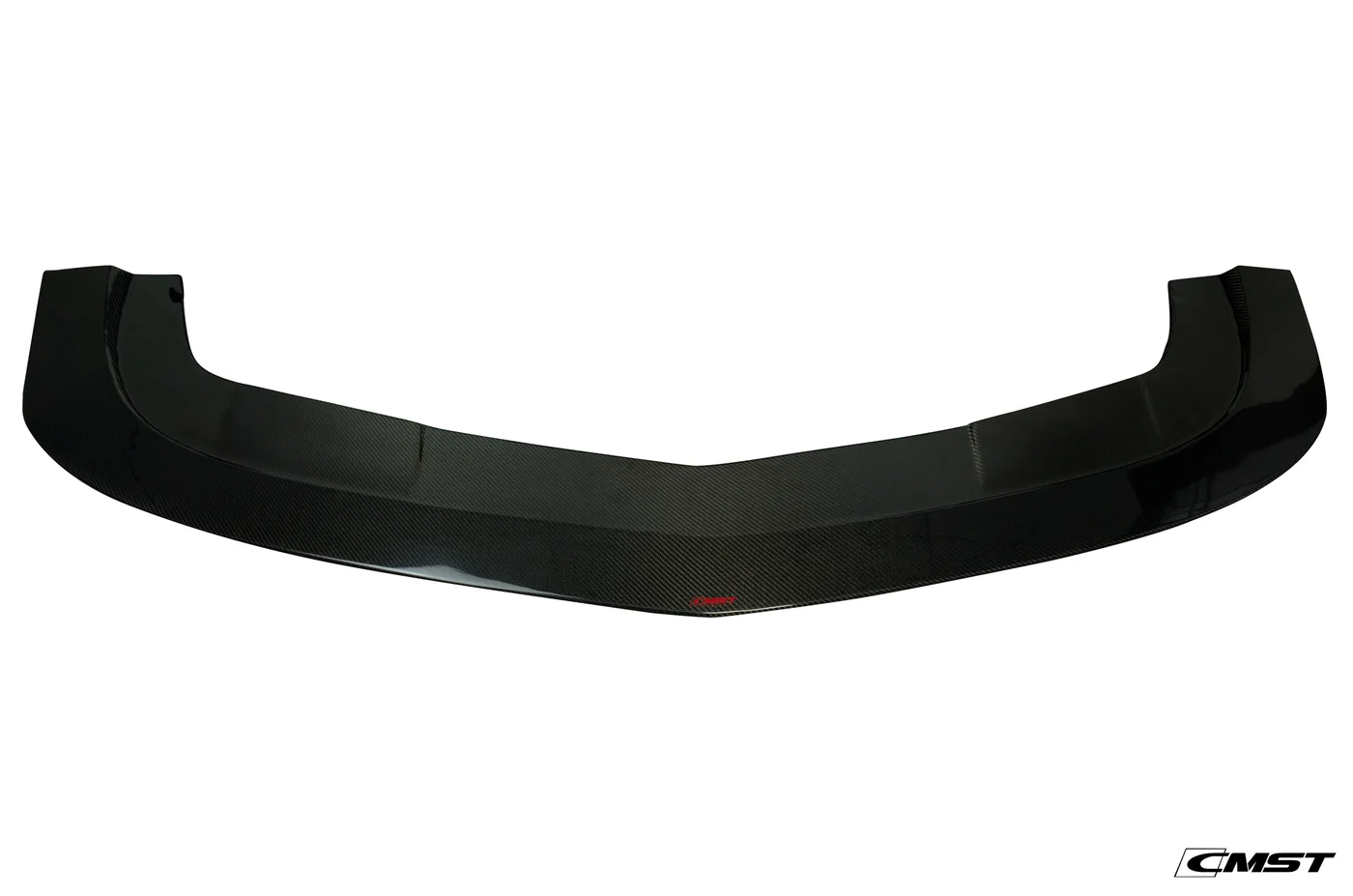
The same lip in two different grades is two different jobs. Photograph tells you the weave; only the quotation tells you which grade you are buying.
What a Shop Should Put on the Worksheet
The job is quotable once the shell, the route and the grade are settled. What separates a quote that survives the build from one that gets renegotiated halfway is whether the following lines are on it.
Parts, by grade and by position. Not "widebody conversion" as one line — each panel with its grade, because that is what the customer is actually comparing when they get two quotes.
Paint, itemised. Which panels are painted, which arrive finished, and whether the arch edges are being sealed. An FRP arch set plus a carbon lip is two different finishing paths in one order.
Labour, with the fitting steps named. As a benchmark for the size of each step rather than a promise about any particular car: our published fitting data for the Challenger parts runs about two hours for the front lip — bolt or screw on, secured with additional adhesive — and about two hours for the rear diffuser, which replaces the original on factory mounting points, with bumper removal recommended for the best result. A hood is a straight replacement on factory mounting points, also about two hours. Those numbers are per part on a car that is already straight; a conversion adds the arch work on top.
Wheels and alignment, if the car is going wide. And lead time, stated as a range and confirmed against the production schedule rather than assumed: our standard is 7–20 days, with peak-season extensions flagged before an order is confirmed. Minimum order is one piece and orders can be mixed across vehicles, which is what lets a shop quote a single customer's car without committing to a pallet.
A test-fit record. The part of the process that answers "will it fit" is not a photo of another car. Ours runs 3D design, drawings, a 3D-printed sample, a test fit on a real car, sign-off, then tooling and a production sample before anything ships. Ask any supplier what their equivalent is; the answer tells you how much of the fitment risk they are carrying and how much they are handing to you.
Price, and what resale does with it. This job does not have a headline number, and we do not publish one: the figure is set by how many panels are involved, which grades they are, how much paint the work needs, and whether the arch gets trimmed or replaced. What is worth saying to a customer before the deposit is the resale side. A factory widebody car is a model in its own right; a converted narrowbody is a modified car, and buyers price those two differently, because one has a build record and the other has a story. A conversion is money spent on the car the customer already owns rather than value added to it — and a customer who has heard that from the shop before the work starts is a customer who does not come back angry. Keep the parts list, the grade per panel and the photographs of the test fit; that file is what answers the question at sale time.
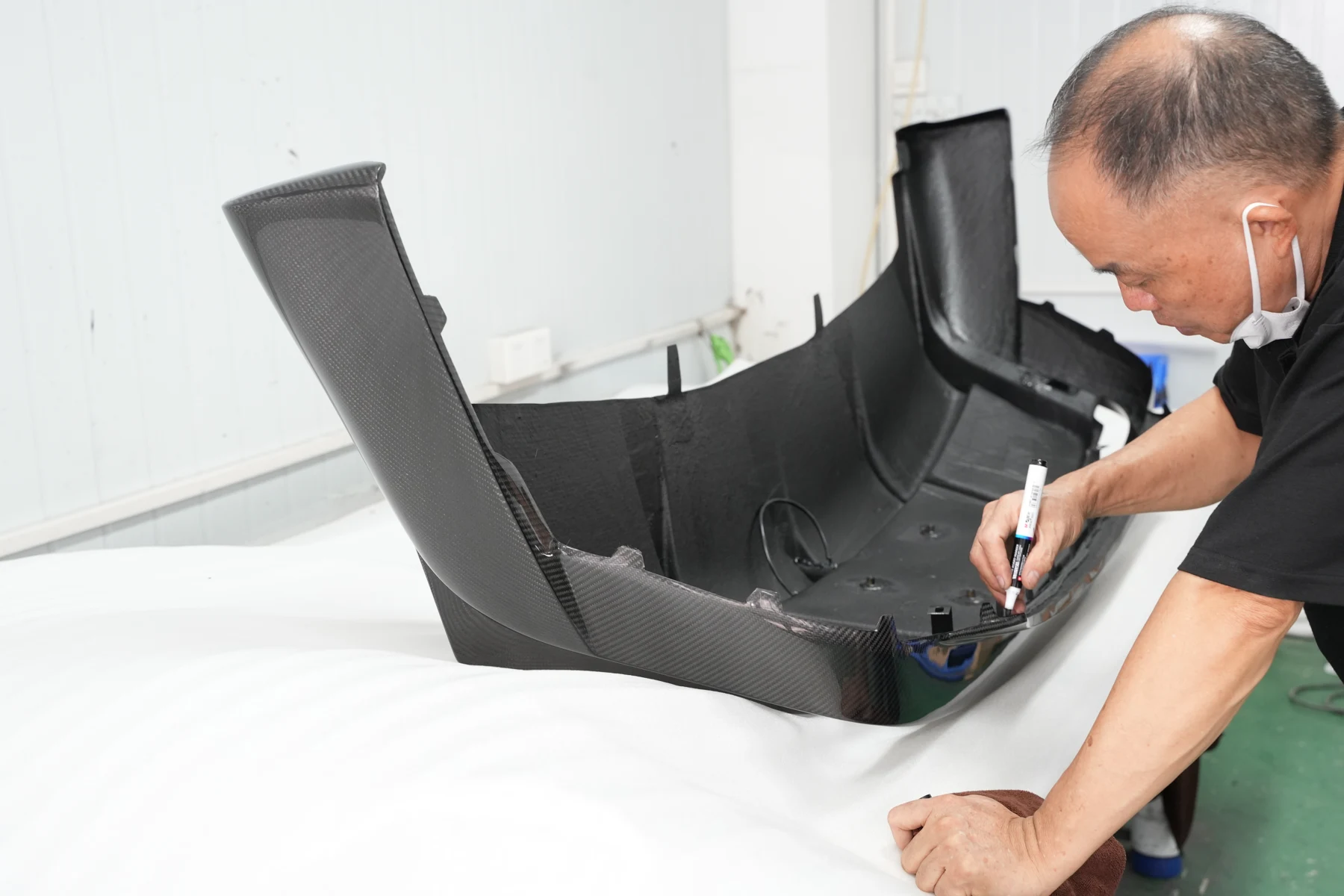
The step that decides whether a kit fits is the one before tooling, not the one after shipping. The Challenger parts and kit listing carries the per-part fitting data — method, time, and what is in the box.
Six Questions to Settle Before You Quote
# | Question | Why it changes the number |
|---|---|---|
1 | Which shell — narrowbody or widebody? | Arch-line parts are not interchangeable between them |
2 | Which model year, and which fascia? | The platform ran 2008–2023 with revised front and rear ends |
3 | Does the arch opening change, or only the arch outline? | Outline-only parts widen the look, not the clearance |
4 | Which grade, per panel? | Paint booth in or out of the critical path |
5 | Is the wheel and tire package part of the job? | Offset and track decide whether the stance reads as finished |
6 | Reversible or permanent? | Decides whether the arch is trimmed or the panel replaced |
Question three is the one worth pushing on, because it is the difference between a kit that is genuinely wide and a set of trims that photographs well. How fitment is proven explains what evidence to ask for — drawings, a test-fit car, a sample part — and it applies to any supplier, including us.
Where This Goes Next
The Challenger went out of production at the end of 2023, which changes the shape of this work rather than ending it: the fleet is now a used-car fleet, and a used-car fleet gets modified. Expect more narrowbody cars arriving with a Challenger widebody question, and expect a share of them to have been modified once already — so inspect the previous work before quoting the new work.
If you own the car, settle the shell question first and only then compare parts. If you are quoting the job, send the year, the trim and the shell, plus what the customer actually wants out of it, and ask the supplier what the part does to the arch opening. Everything else in the quote follows from those three answers.
Next step
Send the vehicle, the parts you are considering and the finish you want — we reply with fitment notes and a quote.
Send an inquiryKeep reading
Related notes

BMW M4 Widebody Kits (G82): A Buyer's Guide
Going wide on a G82 M4 is bodywork, not styling. What a widebody kit contains, what gets cut, what it costs, and the four decisions to settle before you order.

What Is a Body Kit? Parts, Types, Full Kits
A body kit is a set of exterior panels and aero parts, not one product — so what a full kit includes depends on the seller. Types, parts and what is left out.
What Is Fitment? Panel Gaps and Trial Fits
Fitment is how well an aero panel agrees with the car: the gap, the flush and the contact pattern, measured on a real car — not promised by the word bolt-on.