
Carbon Fiber vs Fiberglass: Which Should Your Body Kit Be Made Of?
Carbon fiber or fiberglass for a body kit? Part by part: carbon earns its price on hoods, wings and diffusers; FRP and molded plastic win on bumpers and arches.
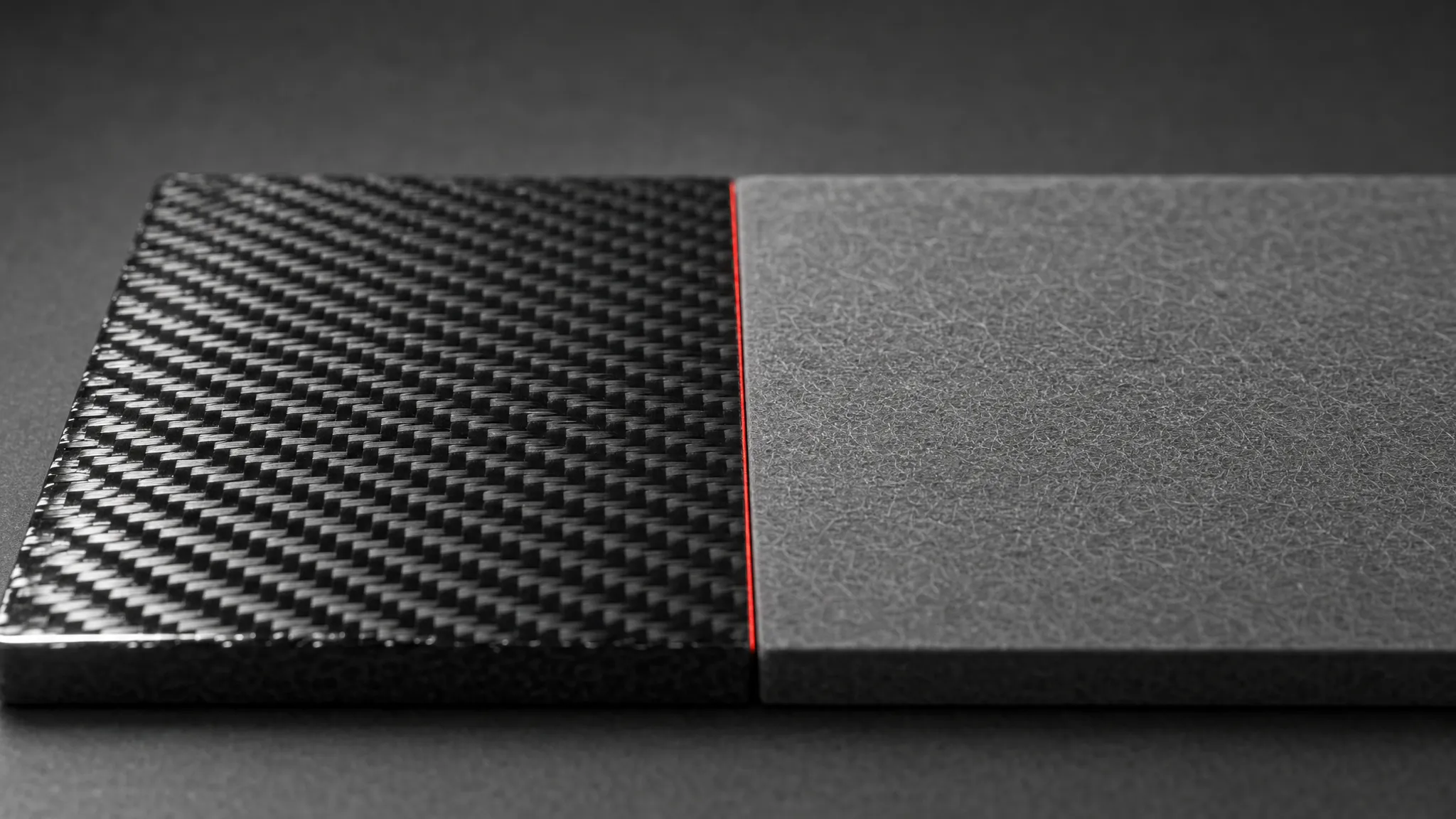
Carbon fiber vs fiberglass has no single winner — the part decides. Carbon fiber earns its price where a part has to be light and can stay bare: hoods, trunk lids, wings, diffusers. Fiberglass (FRP) and molded plastics earn theirs where a part is large, gets painted body color anyway and has to survive stone chips and curbs: bumper shells, side skirts and arch sets. Most kits we quote mix the two, and the split becomes obvious once you walk the kit part by part instead of comparing the materials in the abstract.
What Carbon Fiber and Fiberglass Actually Are
Both are composites: a fiber carries the load, and a resin holds the fiber in the shape you need. That is the whole idea, and it is why a "carbon fiber" part is never pure carbon fiber — a meaningful share of its weight is resin, and resin does no load-carrying work at all.
The difference is the fiber. Fiberglass uses glass filaments, mostly E-glass, the standard reinforcement grade that accounts for more than 90 percent of all glass fiber used in composites, with at least half of its chemistry being silica oxide (CompositesWorld). Carbon fiber starts as polyacrylonitrile (PAN) or another precursor that is heated and stretched until it becomes a stiff, strong filament that weighs very little (CompositesWorld).
FRP vs carbon fiber: the same comparison, different acronyms
Trade literature makes this look harder than it is. FRP and GRP both mean glass fiber plus a plastic resin; CFRP means carbon fiber plus a plastic resin. When a parts list says FRP, it usually means a part that arrives primed and gets painted. When it says carbon — or dry carbon — it usually means a part whose surface is the finished product. On a body kit quotation, the two acronyms are doing the same job as the words fiberglass and carbon fiber.
"Is carbon fiber just epoxy?"
No, and this one comes up often enough to answer properly. The carbon fiber is the reinforcement; epoxy is the matrix that binds it. You can build the same carbon cloth into an epoxy part, a polyester part or a vinyl-ester part, and you can put glass cloth in any of those resins too. Carbon fiber is a fiber. Epoxy is glue that happens to be structural.
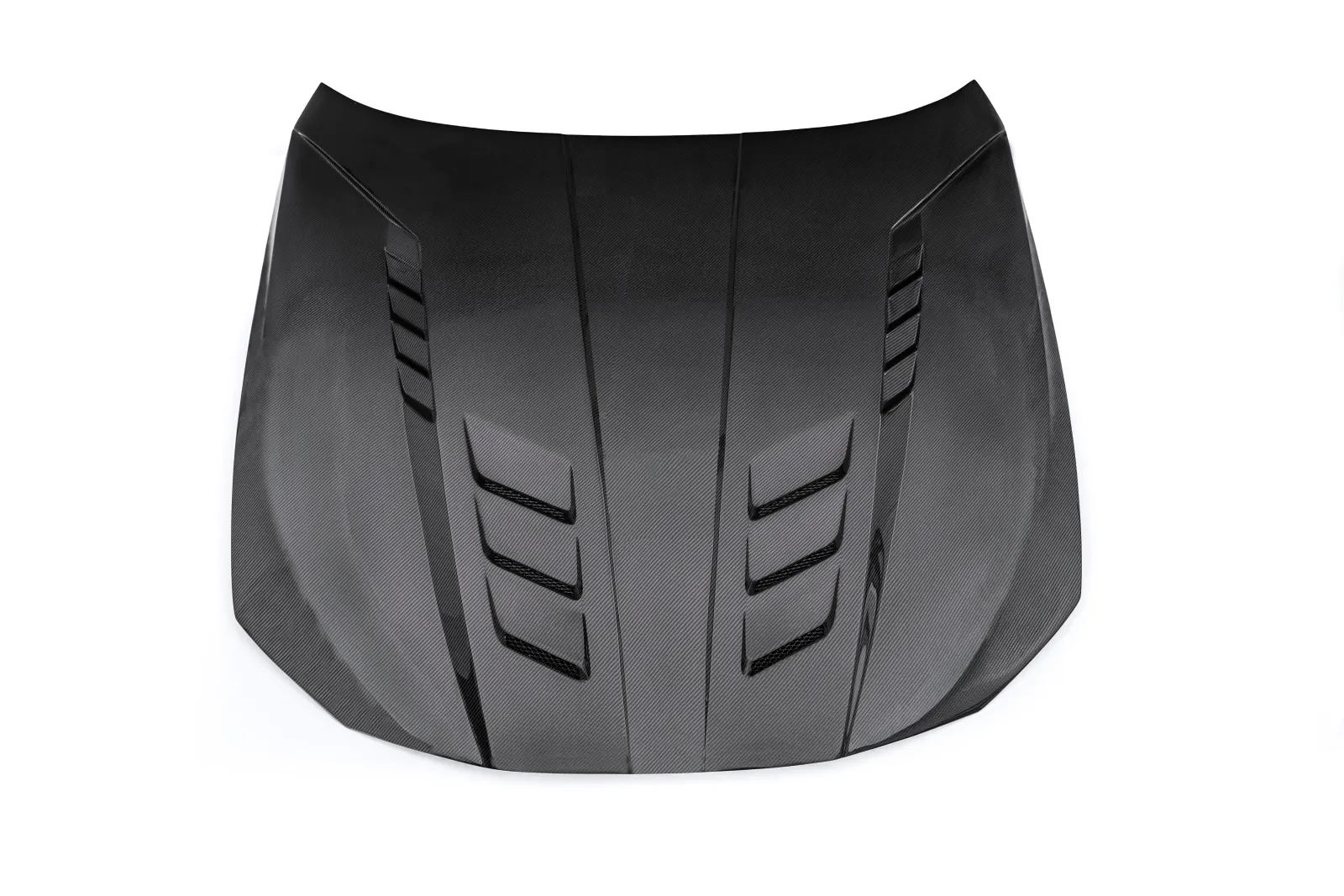
A dry carbon hood as it leaves the mold. The pattern is the fiber itself, laid at an angle and left visible under the clear coat — not a print and not a wrap.
Weight: How Much Lighter Is Carbon Fiber Than Fiberglass?
Yes, carbon fiber is lighter — about 30 percent lighter fiber for fiber. Published material data puts E-glass at roughly 2,630 kg/m³ against 1,744–1,800 kg/m³ for PAN-based carbon (Engineering Toolbox). The gap on a finished part is a little narrower, because both materials are roughly half resin and the resin densities are similar, but it does not disappear.
Where the grams earn their keep is specific, not universal. On a hood or a trunk lid the weight sits high and away from the middle of the car, and you lift it every time the car is serviced. On a rear wing or diffuser you are adding stiffness at the extremity of the car, where a stiff part does its job without being heavy. On a bumper shell that is going to be painted, wrapped around a crash structure and pointed at the road, saving two kilograms changes nothing a driver can feel.
Carbon fiber vs fiberglass, side by side
Carbon fiber (PAN, fiber level) | E-glass / FRP (fiber level) | What it means on the car | |
|---|---|---|---|
Density | ~1.74–1.80 g/cm³ | ~2.55–2.63 g/cm³ | Carbon is ~30% lighter for the same volume |
Tensile strength | ~4,000 MPa | ~3,500 MPa | Closer than most buyers expect |
Stiffness (modulus) | ~245 GPa | ~72.5 GPa | Carbon is roughly 3× stiffer |
Toughness / impact | Brittle, low elongation | Flexes before it fails | Glass forgives a hit; carbon tends to crack |
Failure mode | Cracks and delaminates | Crazes, whitens, repairable | FRP is the friendlier material to damage |
Cost driver | Fiber price plus prepreg, heat and pressure cure | Cheaper fiber, wet lay-up, then paint | FRP is cheaper, but it needs a paint step |
Finish out of the mold | Finished weave under clear coat | Primer only | Only carbon can be left bare |
Repairability | Specialist work; cosmetic repair is hard to hide | Standard body-shop repair | A repainted FRP panel hides its history |
Fiber-level values come from published material data (Engineering Toolbox, AZoM). In a finished laminate the numbers compress: a coupon test of carbon and glass epoxy panels found carbon only about 11 percent stronger in tension but close to twice as stiff (IOP Conference Series).
Strength and Stiffness — and How Each Material Fails
Read that table carefully and the popular version of this comparison falls apart. Carbon fiber is not dramatically stronger than good glass fiber. It is dramatically stiffer, and it is lighter. Those two facts, not raw strength, are what you are paying for.
Stiffness is what holds a panel's shape at speed, keeps a splitter from folding under load and stops a wing from changing angle when the air pushes on it. If the part is structural or aerodynamic, stiffer usually means better, and carbon delivers roughly five times the stiffness per kilogram of E-glass. If the part is cosmetic — an arch cover, a skirt, a bumper shell — stiffness is not doing much work.
What is a disadvantage of carbon fiber?
Three real ones, and they matter more on a car than the laboratory numbers suggest.
It fails suddenly. Carbon is brittle. Where a glass panel will flex, craze and whiten, a carbon panel loaded past its limit cracks, and the crack can run through the laminate. For a low splitter that will meet a speed bump or a steep driveway, that is a meaningful risk.
It is hard to repair invisibly. A repaired carbon panel rarely looks untouched, because the weave and the clear coat have to be matched. A repaired FRP panel disappears under primer and paint.
It galvanizes against metal. Carbon fiber is electrically conductive, and carbon in contact with metal can drive galvanic corrosion of the metal. Fabricators get around it with a barrier layer or veil ply — often fiberglass — at the interface (CompositesWorld). That is worth knowing if you are bolting carbon panels onto aluminum brackets: specify the isolation, don't discover it a year later.
Cost: Where the Price Difference Actually Comes From
Carbon fiber costs more for four reasons, only one of which is the fiber itself.
The fiber costs more per kilogram: it is made in a controlled, energy-hungry process rather than melted from cheap minerals, and prepreg — carbon cloth pre-impregnated at a fixed resin ratio — costs more again while needing scheduled storage and cure.
The process costs more too. Parts cured under heat and pressure take longer, tie up expensive equipment and tolerate fewer mistakes than a wet lay-up done by hand at room temperature. Labor is a bigger share of a composite part's price than most buyers realize, and carbon parts absorb more of it.
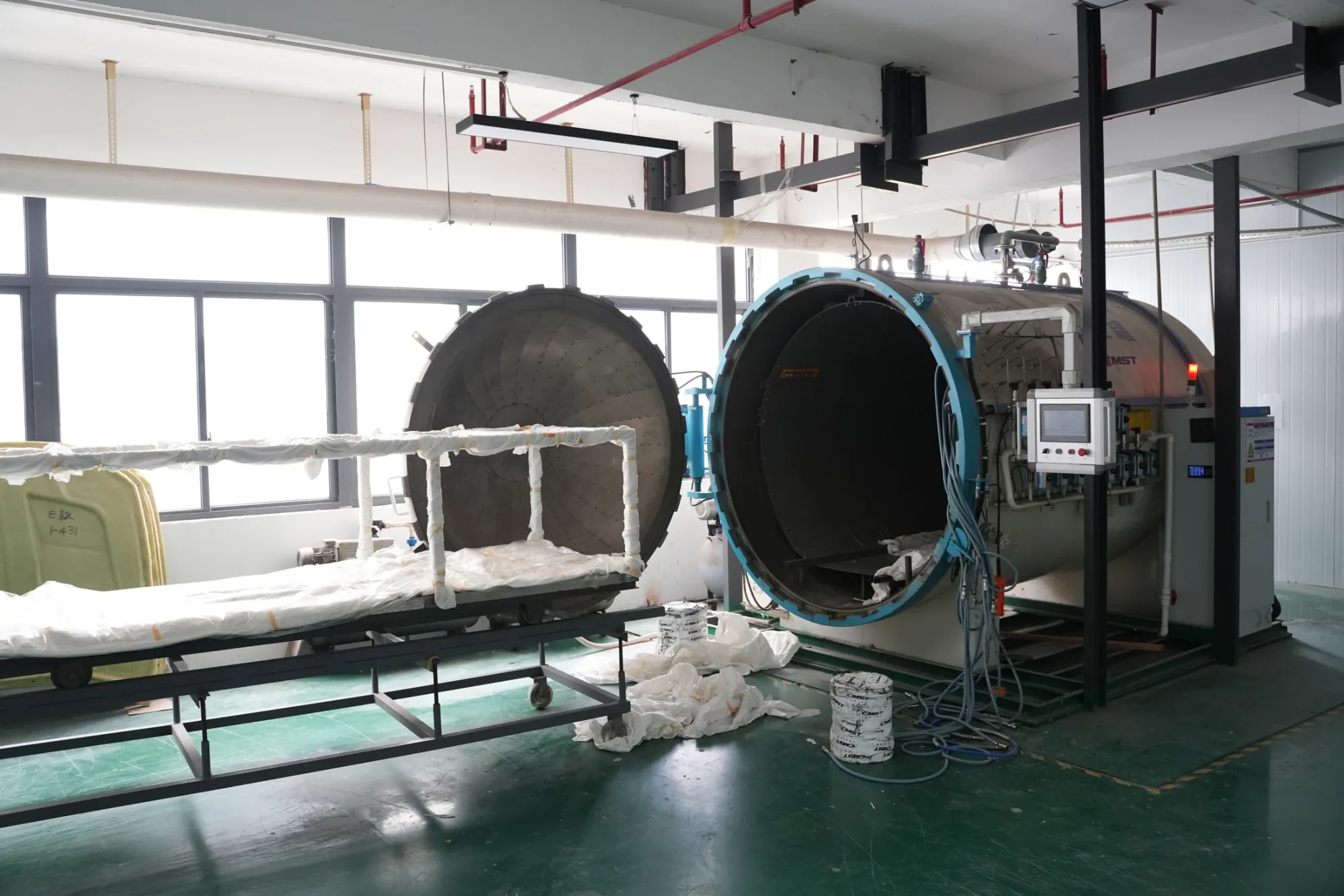
Parts curing under heat and vacuum in our shop. Prepreg and that equipment are two of the reasons a dry carbon part costs more than a wet lay-up.
Then the paint step runs the other way: an FRP kit arrives primed and has to be painted, and painting a multi-piece kit — prep, base, clear, drying bays — is real money and real days, while a bare carbon part skips all of it.
What you pay for | Carbon fiber part | FRP part |
|---|---|---|
Raw material | Highest cost per kilogram | Cheap and widely available |
Process | Prepreg, heat and pressure, tight tolerances | Wet lay-up, room temperature, more hand work |
Paint and prep | Not needed if the part stays bare | Primer, base, clear, drying time |
If it gets damaged | Specialist repair, often replace | Standard body-shop repair |
What it buys | Stiffness, low weight, visible weave | Body-color finish at a lower price |
That last point is the one that changes decisions. The honest comparison is not "carbon part versus FRP part". It is "carbon part versus FRP part plus preparation and paint." The gap stays, because carbon really is more expensive to make, but it is narrower than the parts list suggests — which is why a kit with three carbon pieces and six FRP pieces so often lands inside a budget that a full carbon kit blows straight through.
Durability and Finish: UV, Clear Coat and Primer
Carbon arrives finished. A dry carbon part comes out of the mold with its weave already visible under a clear coat, and if the part is going to stay bare, that coat is its only protection — which is why UV exposure, yellowing and clear-coat care are a subject of their own. FRP arrives primed and unprotected by design: it is not finished until it is painted, and the paint is what takes the sun.
Both materials are affected by the same rules. A scratched clear coat on carbon needs attention early, because it exposes laminate. Stone chips in a painted FRP bumper are a paint repair, which any body shop can do.
Watch for one thing on cheap parts: "carbon look" finishes. A printed or hydro-dipped pattern over a plastic panel can look convincing in a photograph. Turn the part over. If the back is plain plastic with no weave and no laminate, you are looking at a graphic, not a composite — and the part will weigh and flex like the plastic it is. A real carbon part is carbon on both faces, because it was made in a mold from cloth.
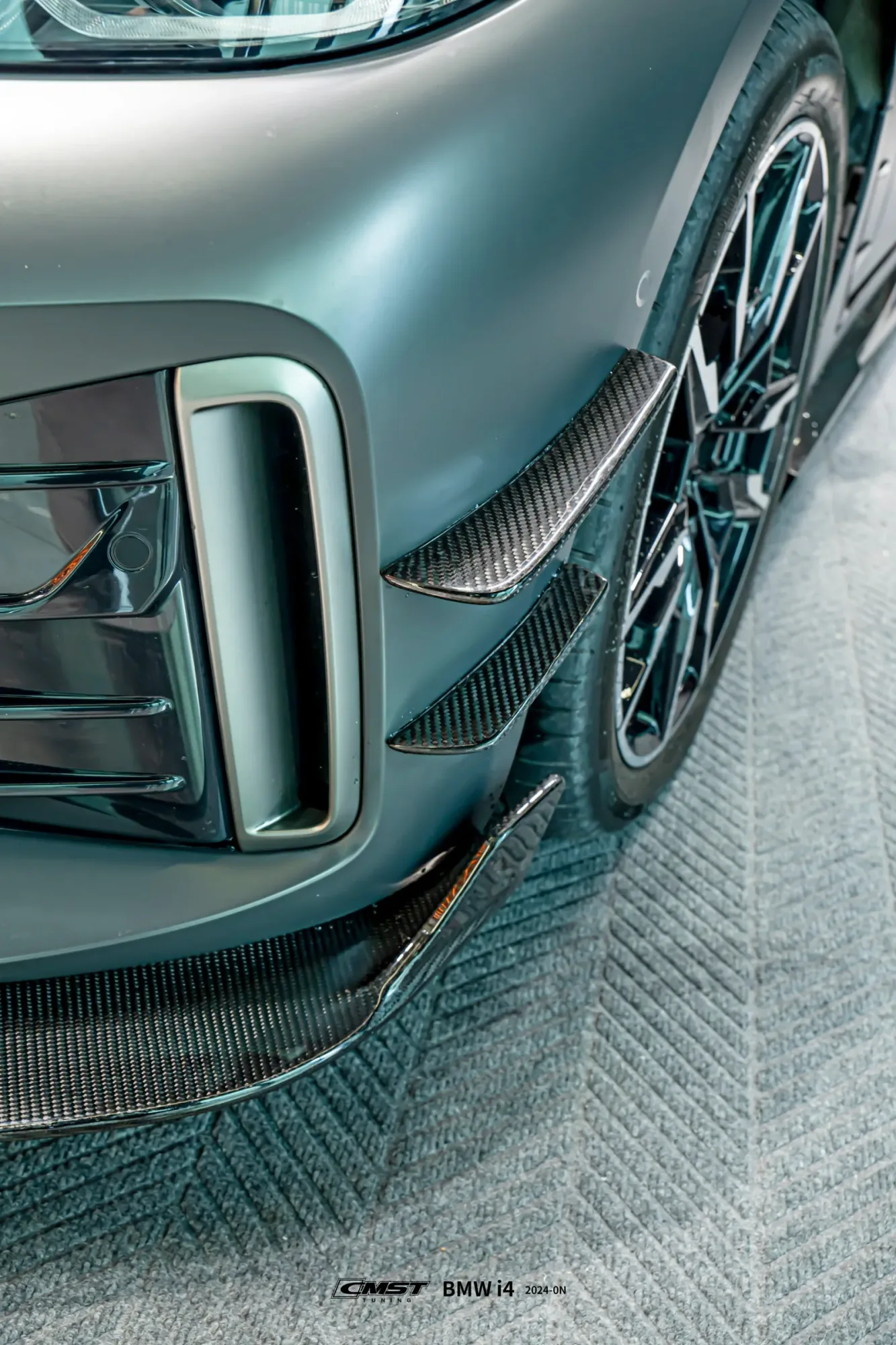
The split you will see most often in the wild: a painted body-color shell with bare carbon detail parts — lip, canards and diffuser left unpainted.
Repairability and Fitment: The Part Nobody Talks About
Ask a body shop which material it prefers and the answer is usually FRP, for reasons that have nothing to do with performance. A cracked or holed glass panel can be ground back, re-laid with glass and resin, primed and painted, and the repair is invisible. The same damage in a carbon panel needs the weave direction matched and the clear coat redone, and the result is visible from a meter away. For many carbon parts, replacing is cheaper than repairing well.
Fitment is a separate subject from material, but the two interact. Every panel has to be trial-fitted, gaps checked and mounting points lined up before the kit is accepted — that is a normal part of the process on both materials, and it is why we trial-fit on a real car before a mold is signed off. What changes with material is forgiveness. "Bolt-on" describes the mounting points, not the panel gap. A stiff carbon panel holds its shape and will show a bad gap rather than being persuaded into place; a flexible plastic or thin FRP panel can often be nudged into a respectable line. If you are buying sight-unseen, that is an argument for buying from whoever built the mold and can tell you what the trial fit looked like.
Part by Part: Which Material for Which Component
The decision is easier when you walk the kit instead of the catalog.
Kit part | Usual choice | Why |
|---|---|---|
Hood / trunk lid | Carbon (dry carbon if it will be seen) | Weight sits high and you lift it often |
Rear wing / spoiler | Carbon | Stiffness matters; weight at the extremity does not help |
Rear diffuser | Carbon | Aerodynamic surface, exposed, and the weave reads as intended |
Front splitter / lip | Carbon if the look matters, ABS or PP if it will meet curbs | The most damage-prone panel on the car |
Canards | Carbon | Small, light, mostly visual aero |
Front and rear bumper shells | FRP, ABS or PP | Large, painted body color, stone-chip territory |
Side skirts | FRP or PP | Long, exposed to curbs, painted |
Fender flares / arch sets | FRP (carbon for show builds) | Big surface area, usually painted, occasionally replaced |
Two consequences follow. Painting a carbon part is allowed but wasteful — you pay for a weave and then cover it, so if the panel is going to be body color anyway, FRP does the same job for less. And mixing grades inside one kit is the normal outcome, not a compromise: an FRP shell with a dry carbon lip, canard and diffuser is a common specification, because it puts the expensive material exactly where a buyer can see and feel it.
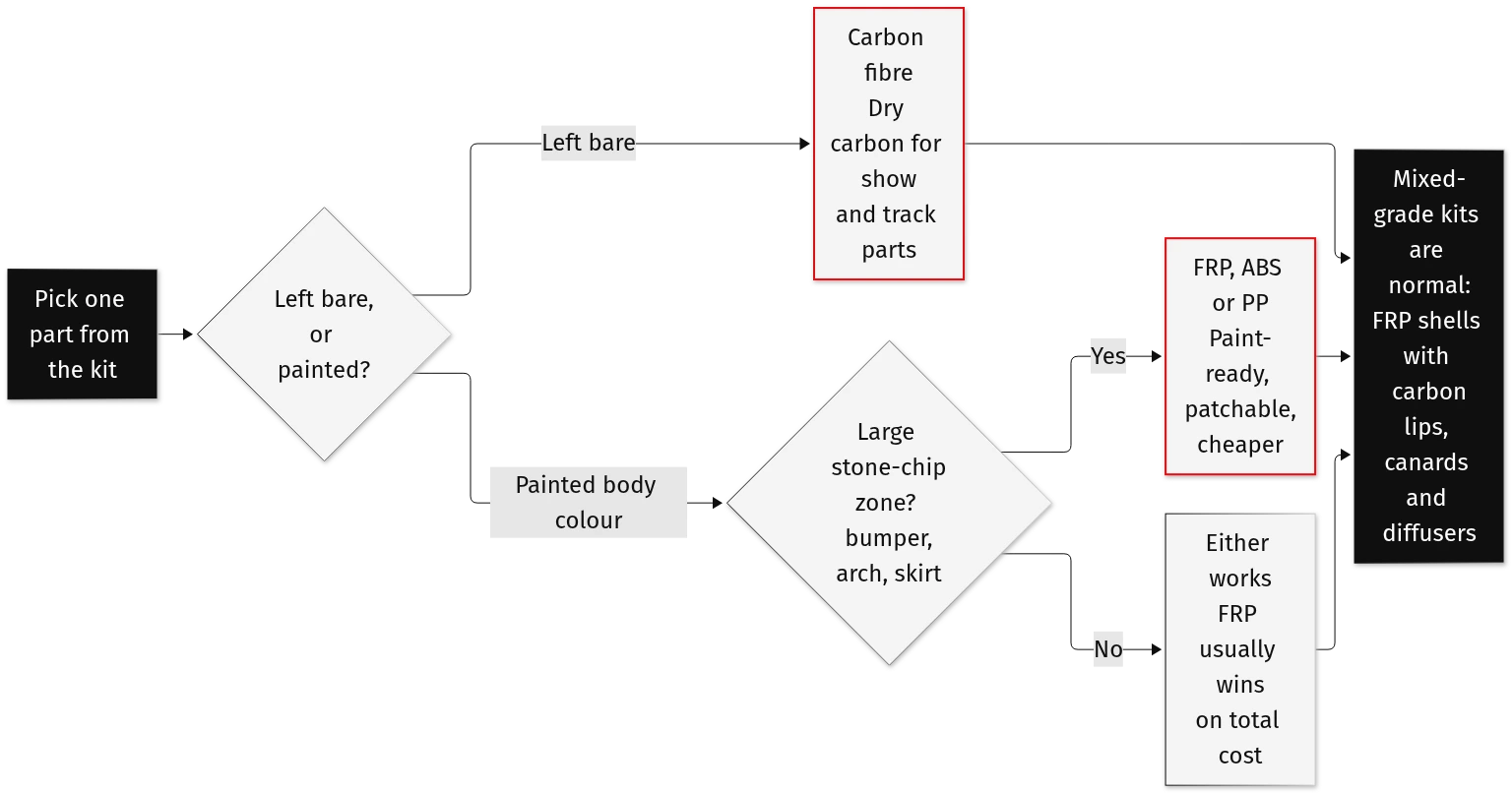
Three questions settle most kits: will the part stay bare, will it be painted, and will it take hits. The answer is per part, not per kit.
Specification sheets list more than two options — polyurethane, ABS and polypropylene sit alongside FRP, and each changes the paint step. Our own parts arrive as dry carbon, high-temperature vacuum carbon, FRP, ABS or PP depending on the part (see how the grades are specified), and the same mold often serves more than one of them.
Which Material for Your Build Type
Daily-driven street car. Put the money on the parts you can see and lift: a carbon hood, a carbon lip or diffuser. Take FRP or molded plastic for bumpers, skirts and arches, which will collect chips and are cheaper to replace. You will spend less and the car will look the same from three meters away.
Show car. Bare carbon where the weave is visible, FRP underneath anything that gets painted. The material story is the point here, so dry carbon — with the weave finished out of the mold rather than cleared over afterwards — is the specification the people you are building it for will notice.
Track car. Carbon where stiffness and weight matter and the rules allow it, with the understanding that low aero will be damaged at some point. Budget for replacement, and prefer parts you can buy singly rather than as a matched set.
Shop or distributor building for stock. Grade mixing is how you hold a price band: FRP or plastic on the large shells where freight and paint dominate, carbon on the pieces that sell the kit. Quote both, so the customer chooses the split rather than the material.
Need a starting point? Our body kit range is quoted part by part, with the grades available for each piece listed on the quotation — and there is a deeper read on the materials themselves in the carbon fiber guide hub.
FAQ
Why are Corvettes fiberglass?
Because fiberglass was the only practical way to build a low-volume body in the 1950s. Steel needs expensive stamping dies that only pay off over hundreds of thousands of cars. A fiberglass body could be laid up over a mold for a fraction of that, which is why GM went that way in 1953 and stayed with composite body panels for decades. The trade-off has not changed: composite bodies are light and cheap at low volume, and they are harder to repair than steel.
Is fiberglass or carbon fiber better?
For a body kit, neither. Fiberglass is better where the part is painted, large and exposed to impacts. Carbon fiber is better where the part must be stiff, light and left bare. If you want one question to answer the whole kit, ask which parts will be painted — the painted ones rarely justify carbon. That is the short version of every carbon fiber vs fiberglass argument worth having.
Can carbon fiber be bulletproof?
No, and no composite panel sold for a car is. Carbon's strength is in tension along the fiber direction; stopping a projectile is about absorbing energy across stacked layers — a different engineering problem and a different product. A carbon body panel is stiff and light, not armor.
What about fire and recycling?
Both use a resin that burns, and both are thermoset composites — they cannot simply be melted down and remolded. Glass fiber can be ground and reused as filler; recovering usable carbon fiber from a cured part is possible but still an industrial process rather than a routine one. Ask your supplier what happens to damaged panels, and treat any claim that one of these materials is "green" with suspicion.
Next step
Send the vehicle, the parts you are considering and the finish you want — we reply with fitment notes and a quote.
Send an inquiryKeep reading
Related notes

BMW M4 Widebody Kits (G82): A Buyer's Guide
Going wide on a G82 M4 is bodywork, not styling. What a widebody kit contains, what gets cut, what it costs, and the four decisions to settle before you order.
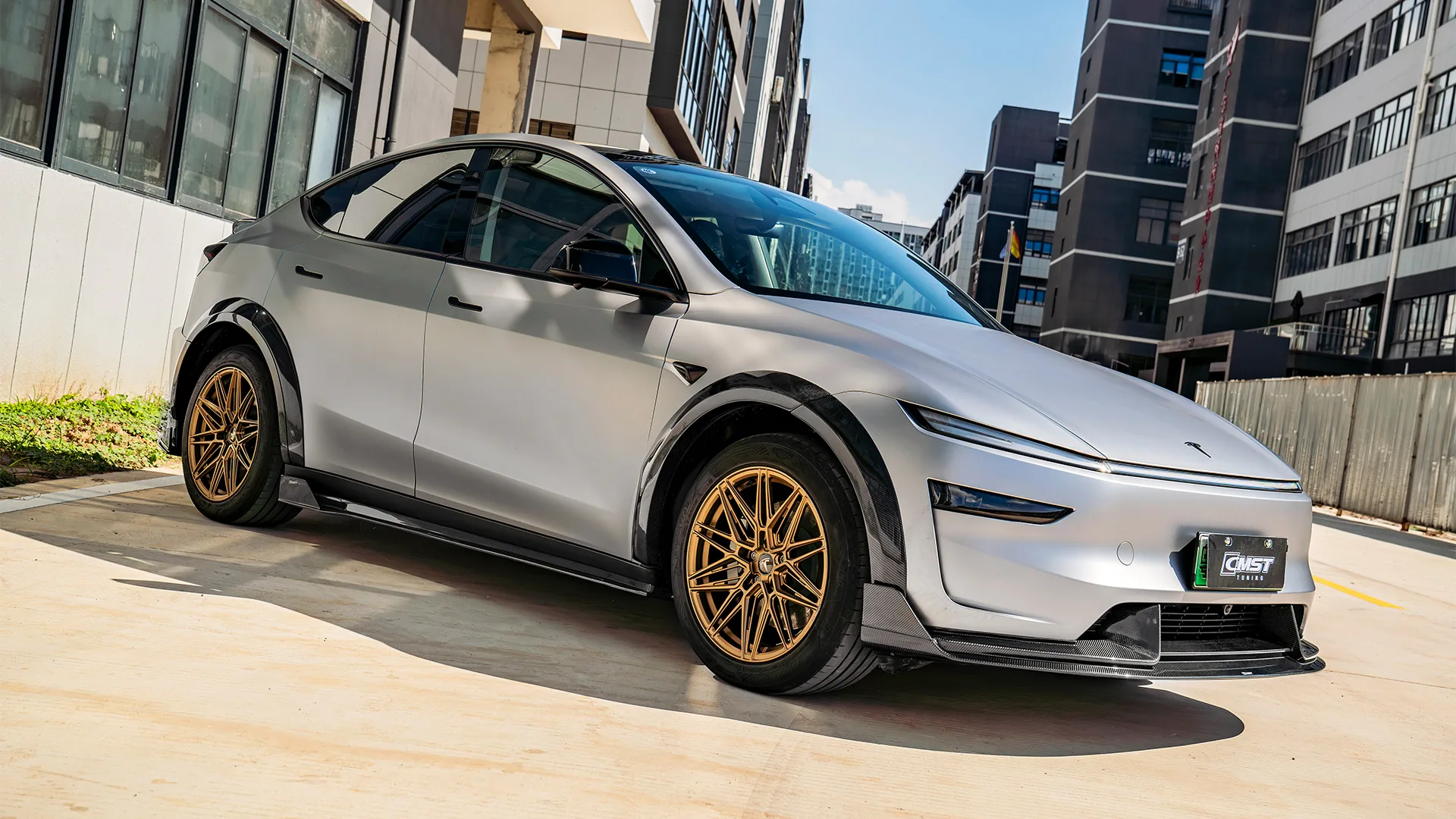
What Is a Widebody Kit? A Beginner's Guide
A widebody kit widens a car's arches so wider wheels and tires will fit. Here's what is in one, what gets cut, and how to tell if a wide build suits your car.
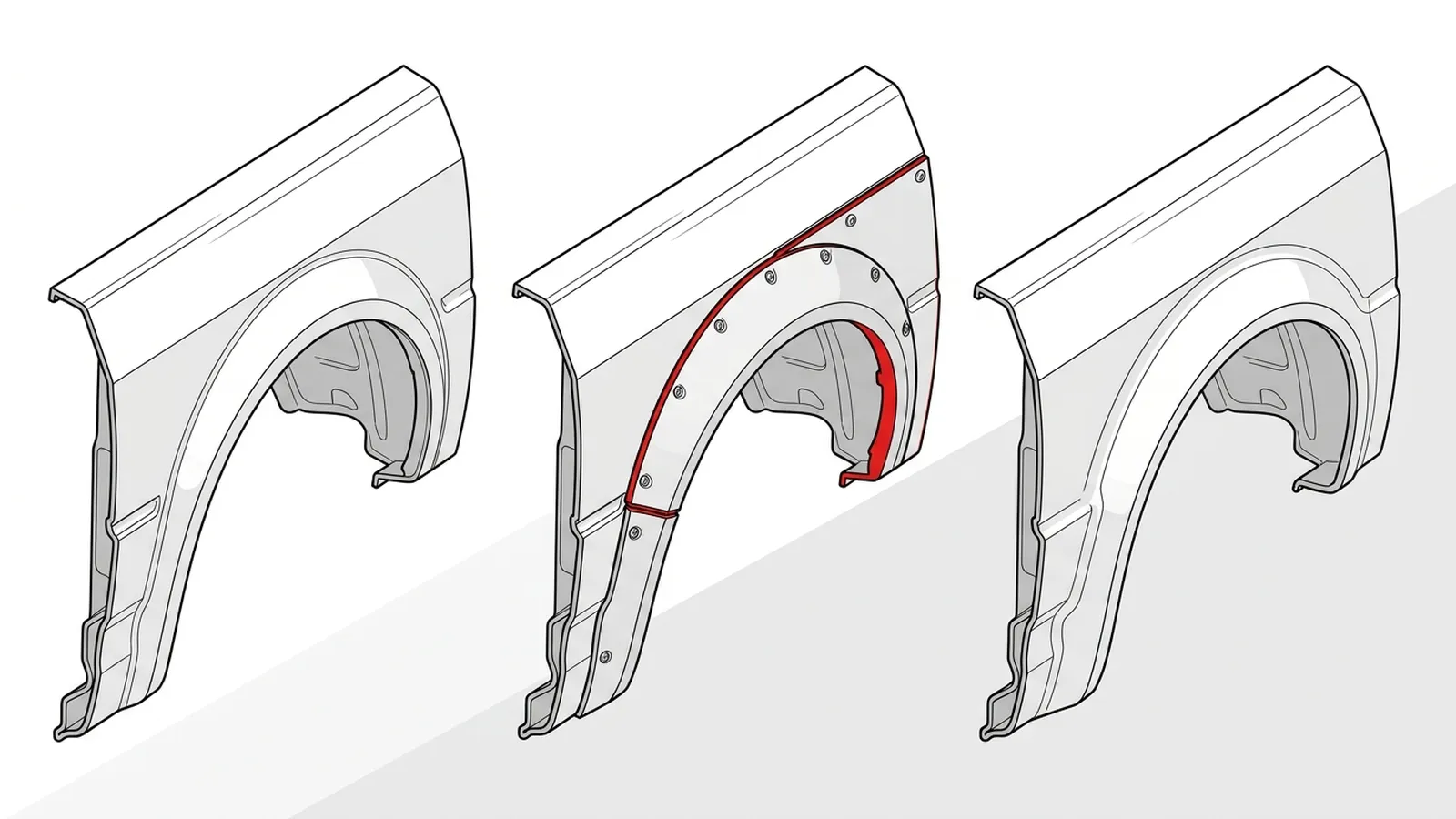
Overfenders vs Fender Flares: Which Fits?
Overfenders and fender flares are one part under two names. What each term means, the three ways to cover a wider wheel, and how to measure before you buy.