
BMW M4 Widebody Kits (G82): What to Know Before You Go Wide
Going wide on a G82 M4 is bodywork, not styling. What a widebody kit contains, what gets cut, what it costs, and the four decisions to settle before you order.
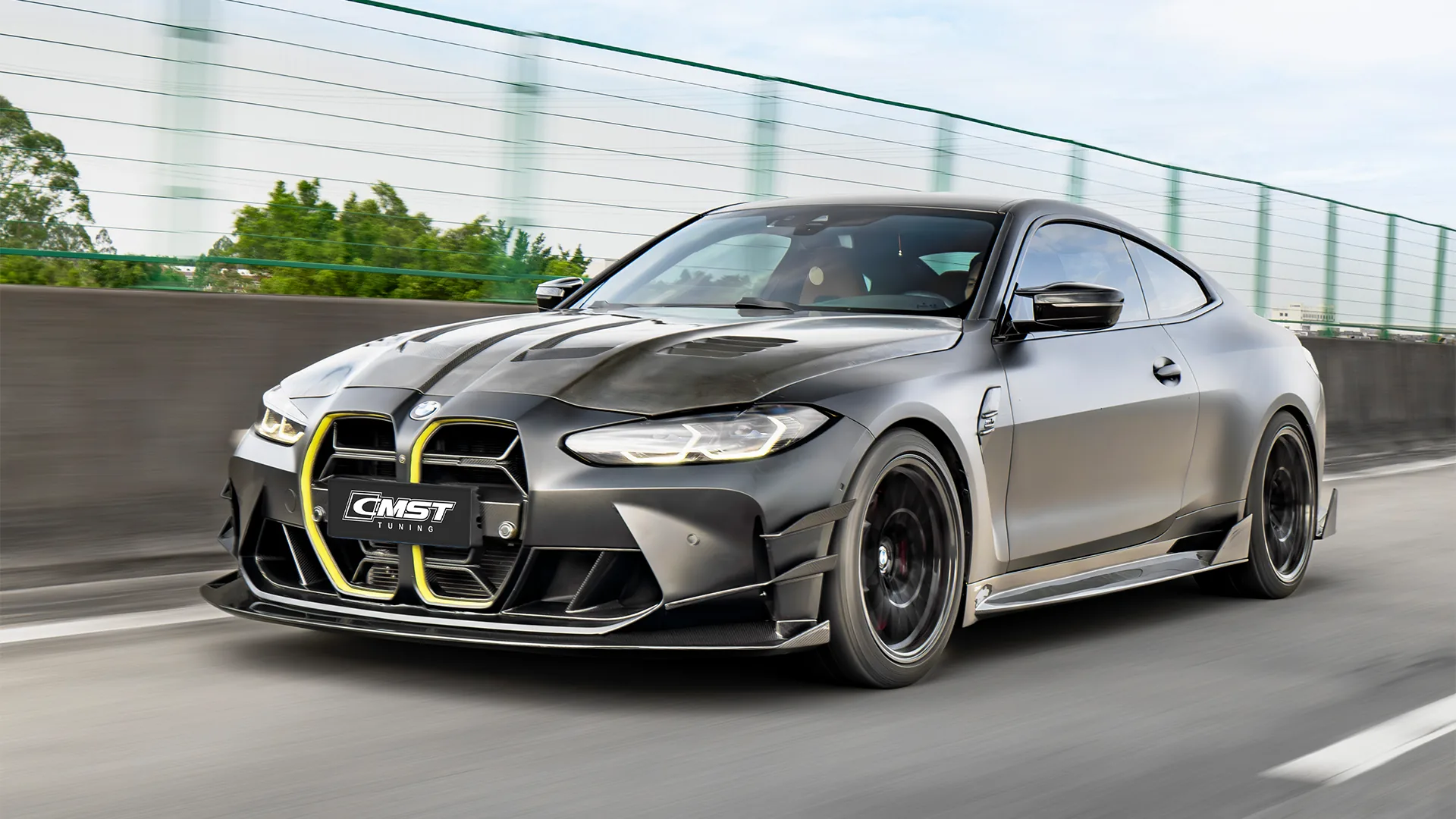
An M4 widebody kit for the G82 is a set of body panels that moves the car's arches outward so wider wheels and tires will fit underneath them. On most builds it also means the factory arch metal is cut, rolled or replaced, which is why this is the one part of a build that does not go back to standard easily.
Search the term and you will find shelves of product pages, each with a parts list, a lead time and a price. What those pages rarely tell you is the part that actually decides whether the project works: how far the arches move, what has to clear, what happens to the car's geometry and weight, and what the paperwork looks like afterwards. This guide works through those in the order the decisions arrive, and it covers the G82-generation M4 only — the 2021-on car, including the Competition and the CSL. If your M4 is an F82 or a GTS, our platform-by-platform body kit guide covers the earlier car, and its arch geometry is a different problem.
What "G82" Tells You Before You Buy
The chassis code is the first filter, and skipping it is the most common mistake made when shopping for a BMW M4 widebody conversion. The G82 is the 2021-on M4 coupe; the G83 is the convertible built alongside it, and the G80 M3 sedan shares the front structure. None of those panels interchange with the F82 generation that ran from 2014 to 2020. The M4 CSL arrived in 2022 and reached the US as a 2023 model, and it is worth being exact about what that car is: it gets its own grille inserts, a CFRP hood and a CFRP trunk lid with an integrated ducktail, model-specific wheels and tires, a lower ride height and its own camber settings — but it stays on the G82 body with the same arches underneath. A CSL widebody build therefore follows the same route as any other G82, and it answers the same four questions rather than a special set of its own.
The generational break matters more than it sounds, because a large share of the pages that rank for this term are still selling F82 parts — the arch extensions, bumpers and hood are generation-specific, and a listing that quotes a year range of "2020 – present" is telling you something about its own spec sheet rather than about your car. Most of the current crop of G82 conversions broke cover around the 2023 SEMA Show, which is one reason the parts landscape for this car still looks younger than the car does. When you compare a G82 widebody kit against anything else, check the four things that actually pin it to a car: the generation, the variant (standard, Competition, CSL), whether the kit assumes a specific wheel and tire package, and whether the parts replace factory panels or sit over them.
If the wide concept itself is still fuzzy — how a wide conversion differs from an ordinary body kit, and why the difference is structural rather than cosmetic — what a widebody conversion actually changes is the right place to start before you spend money on panels.
What an M4 Widebody Kit Actually Contains
Parts lists vary, but almost every set is built from the same short list. What separates a genuinely wide kit from a restyled one is the first row.
Part | What it does | Makes the car wide? |
|---|---|---|
Arch extensions or wide fenders | The widening itself — the extra clearance for the wheel | Yes |
Front bumper shell | Redrawn to meet the new arch line, usually with larger air openings | Usually replaced |
Side skirts | Tie the sill line together and close off the airflow along the floor | No |
Hood, often vented | Drops mass at the front and lets hot air out of the engine bay | No |
Front lip or splitter | Shapes airflow at the nose and trims the bumper's lower edge | No |
Rear diffuser | Manages the air leaving under the back of the car | No |
Rear wing (raised) or trunk spoiler (flush) | A wing adds downforce; a flush spoiler trims lift and drag | No |
Canards and trunk lid | Trim front lift; complete the rear surface | No |
One naming note, because parts lists mix vocabularies freely: this article uses the US terms throughout — hood rather than bonnet, fender rather than wing — because that is the vocabulary the aftermarket parts market here is built on.
Read that table twice and a common marketing problem becomes obvious: plenty of kits sold as widebody are a standard set of bumpers and skirts with a shallow arch trim added. They look wider without changing what the car can swallow. Two habits separate the two cases. First, ask what the kit does to the arch opening rather than to the arch's outline. Second, notice whether the parts are sold as a set or piece by piece — some suppliers will sell you a single fender, others only the complete conversion, and that tells you which side of the business they are set up for.
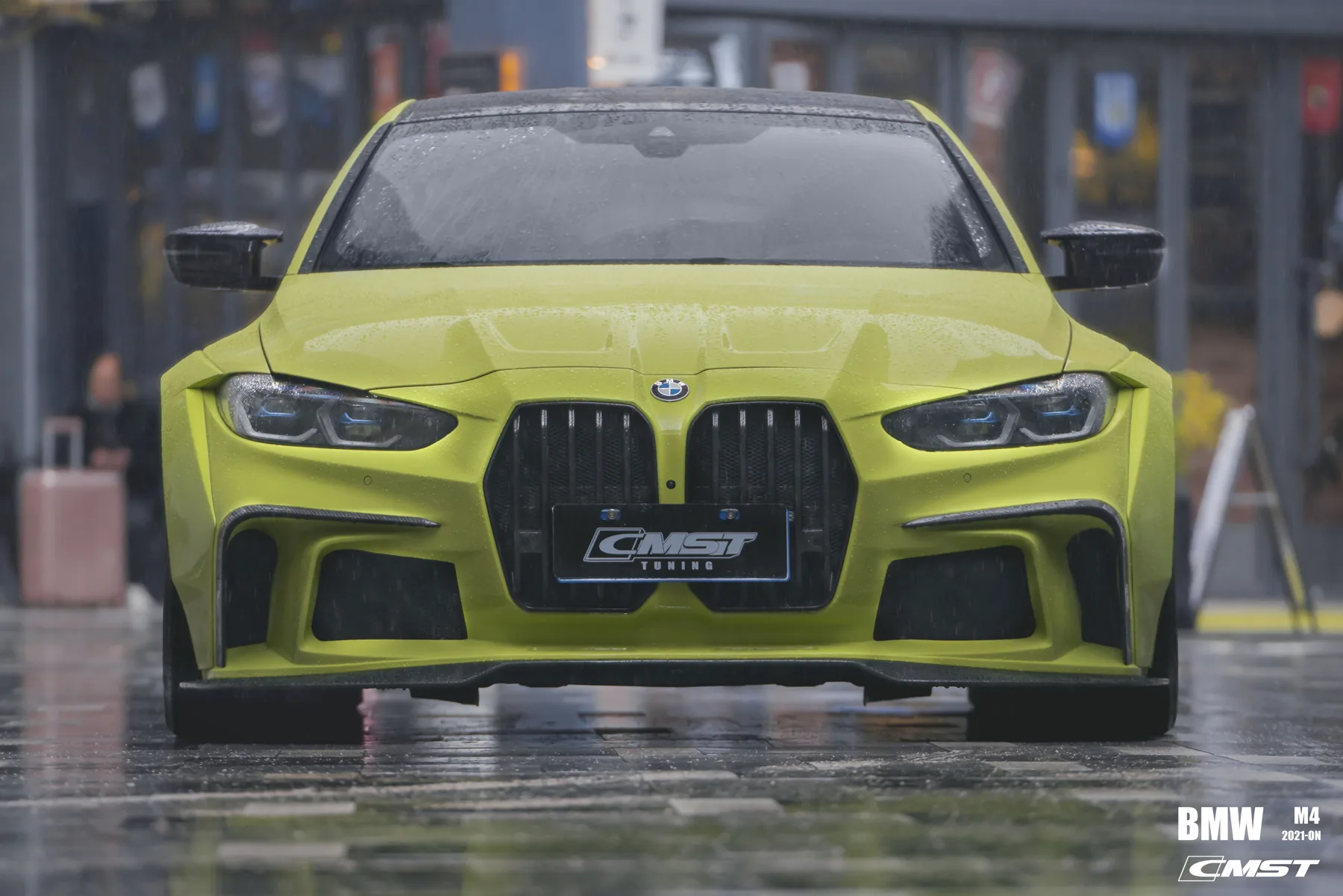
A kit on the car, not on a pallet: the bumper conversion, the grille and the front lip are what most "complete" G82 sets are assembled from.
Two Ways to Go Wide: Bolt-On Arches or Cut Metal
There are two families of widening, and the choice between them is the single biggest fork in the project.
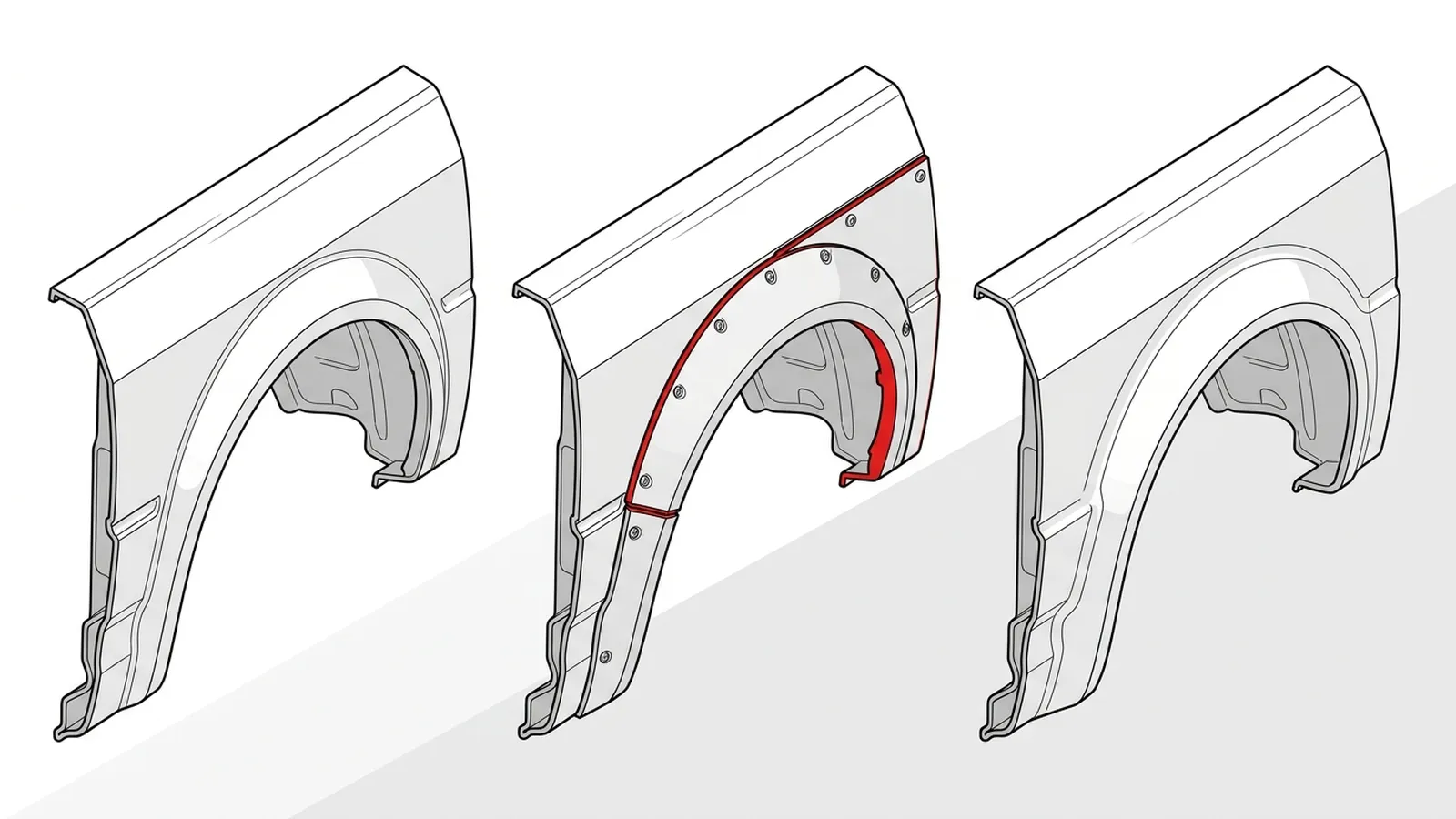
Bolt-on arches — also sold as overfenders, arch extensions or wide fenders — are shells fixed over the existing panel with rivets, bolts or structural adhesive. The original metal stays in place, and the fasteners are often left visible because that industrial look is part of the style. This is the reversible end of the market: unbolt the arches and the car is a standard car again, minus some holes.
Replacement or cut-and-bonded fenders change the panel itself. The front fender is swapped for a wider one, and at the rear, where the quarter panel is welded structure rather than a bolt-on fender, the arch is normally cut back and a wider skin bonded over the opening. The result is flush and reads as a factory shape rather than an addition. It is also permanent.
Whichever route you take, two details decide whether the result is a clean car or a project that never quite finishes. The first is clearance. Even a bolt-on arch usually needs the inner lip or the plastic arch liner trimmed, because a wider tire on a wider track still swings inwards at full steering lock, and the place it touches is behind the arch, where you cannot see it. The second is the cut edge. Bare steel at a cut arch rusts, and it rusts from the inside. A properly finished arch gets the edge ground, primed and sealed before the new panel covers it; skip that step and the failure surfaces a season or two later, underneath a panel that now has to come off. The trade-offs between the two approaches are covered in more depth in the two ways to widen a car.
One more thing belongs here rather than in the ordering conversation: the tire still has to carry the car. A wider wheel and tire must match the vehicle's load index and speed rating, and those are the ratings the vehicle's safety systems are built around — NHTSA's tire guidance sets out what the sidewall markings mean. A wide build on under-rated rubber is a downgrade wearing expensive shoes.
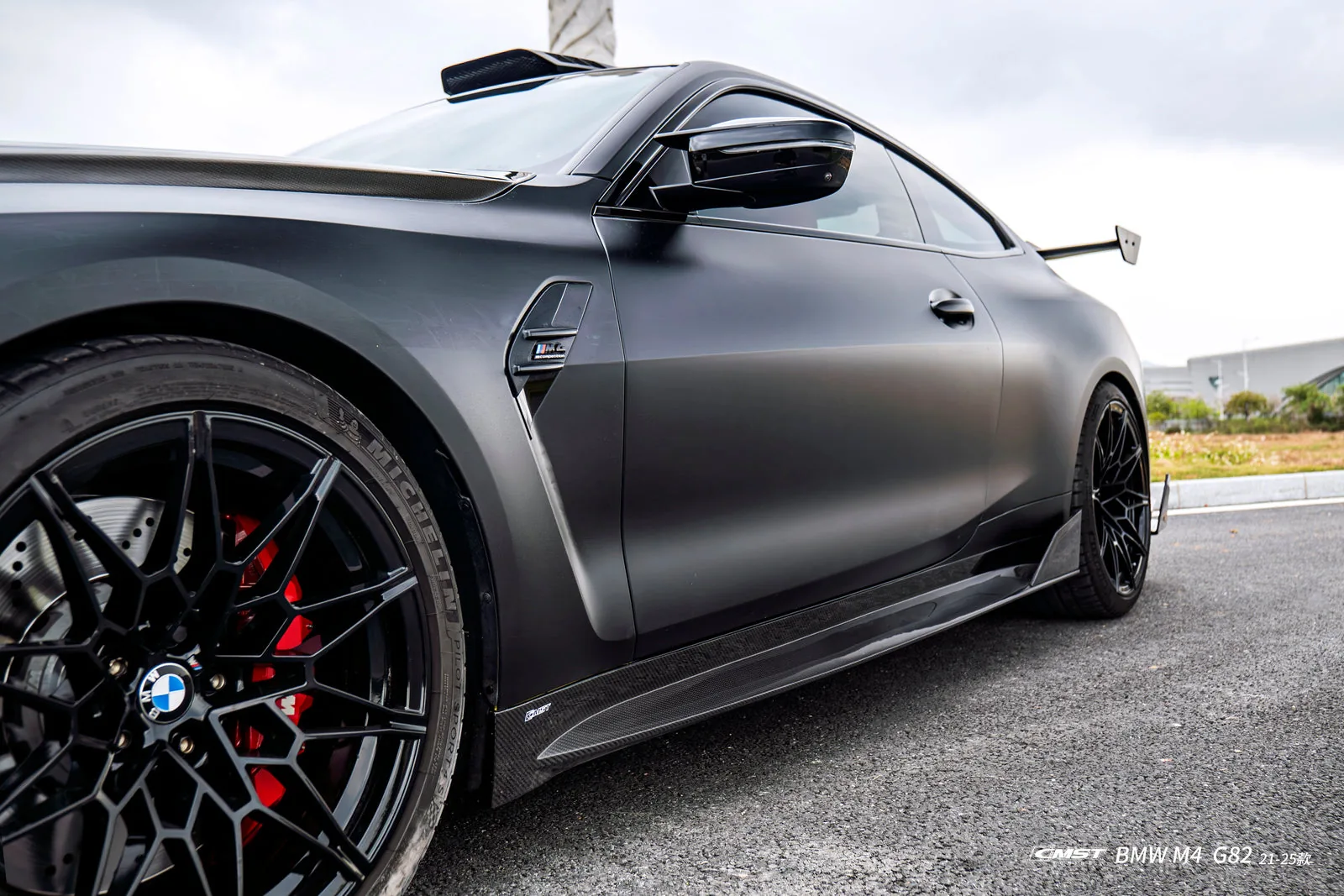
The widening is a physical part, not a paint effect. The arch moved outward, and the wheel followed it.
What Widening Actually Does to the Car
The point of all this metal is contact patch. A wider tire puts more rubber on the road, and that is where lateral grip and traction come from. Everything else is plumbing — so it is worth being precise about what the panels do and do not deliver.
They create the room; the wheel does the work. Widen the arches, keep a stock-width wheel, and you have added mass and drag without adding grip. This is the most common way a wide build ends up slower than the car it started as.
How much room is a real number, and it is not the same for every kit. The published figures for one widely documented G82 conversion quote roughly 70mm per side at the front and 80mm at the rear, paired with a wheel and tire package in the region of 265/35-19 front and 325/25-20 rear. Treat those as that supplier's claims for its own kit rather than as a specification for your car: the number that matters is the one your chosen wheel and tire combination needs, measured on the car. A G82 widebody kit that quotes no dimensions at all is asking you to find out after the panels arrive.
The geometry moves with the track. Where a wheel sits is set by offset — how far the mounting face is from the wheel's centerline — and by backspacing, how far inboard the wheel reaches. Push a wide wheel outboard on factory arches and the shoulder meets the arch lip under compression; push it the other way and the inner edge rubs at full lock. Reducing offset can look like the fix, but it also increases scrub radius, which changes how the steering feels and loads the wheel bearings. Widen the arches and those two problems get room — at the price of geometry that now needs revisiting.
More mass, in the worst place. Wider wheels and tires are largely unsprung mass: the mass the springs and dampers do not carry, which sits below the suspension rather than above it and takes in the wheels, the tires and the suspension parts directly connected to them, as the definition of unsprung mass sets out. More of it costs ride quality and grip over broken surfaces, and the rotating weight of a heavy wheel set costs acceleration directly. The arch panels are the opposite case — they bolt or bond to the body, and the body is part of the sprung mass — so the weight they add shows up in acceleration and braking load rather than in ride comfort.
Drag goes up. A wider body presents more frontal area, and drag force rises with frontal area and with the square of speed — the relationship NASA's aerodynamics primer and the drag coefficient relationship both make explicit. At city speeds you would never notice. At track speeds, or on a car that displays its remaining range, you will. A shaped arch with vents behind the wheel lets the high-pressure air out and recovers some of it; a decorative arch does not.
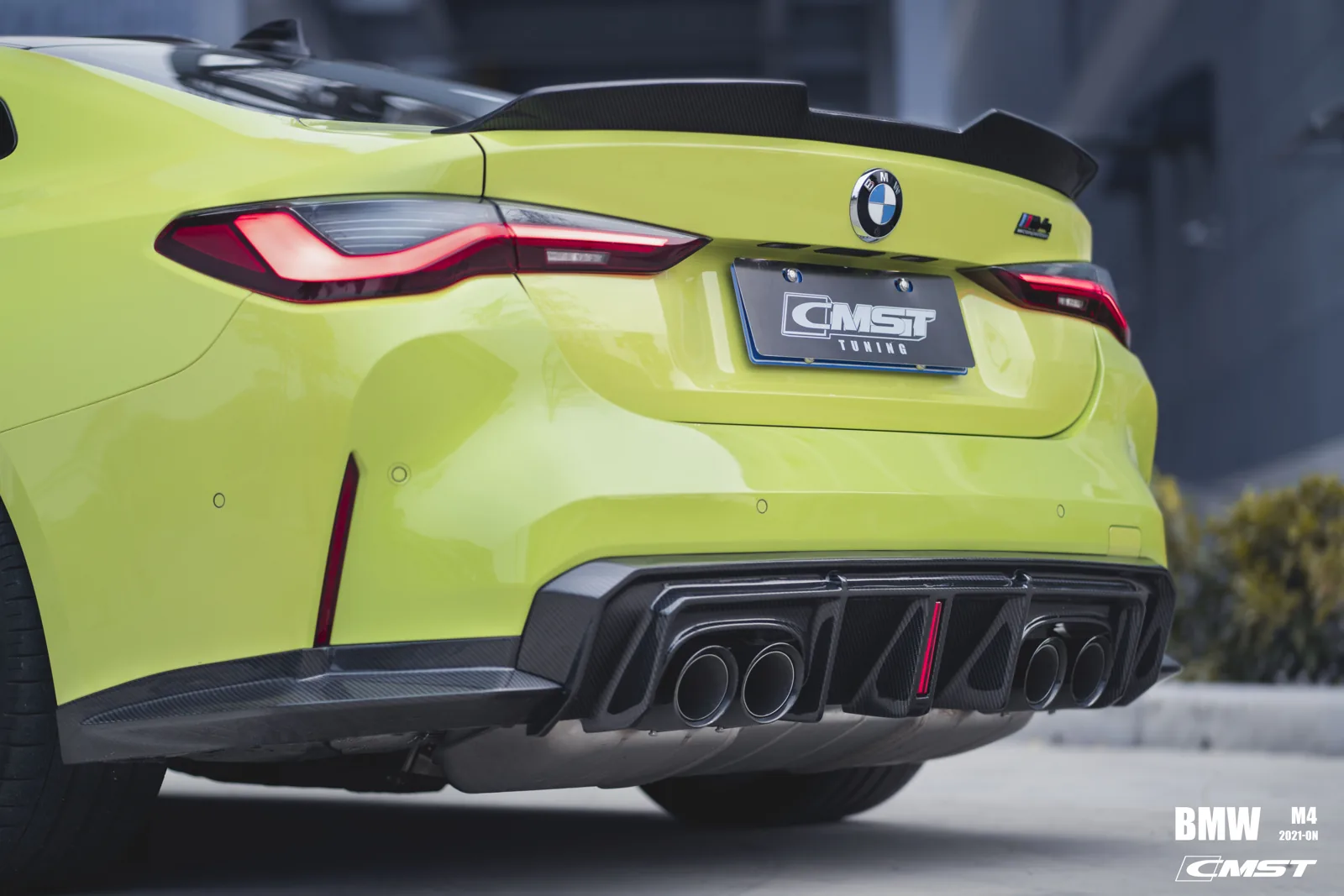
What the conversion buys at the back: room behind the arch, a diffuser managing the air underneath, and a flush spoiler cleaning up the flow the wider body just disturbed.
Choosing the Material, Panel by Panel
Walk through a G82 order and you notice something the parts catalogs hide: the same mold usually serves more than one material, and most builds mix them.
Grade | How it arrives | Where it earns its place |
|---|---|---|
Dry carbon | Prepreg layup, finished twill or forged weave, no paint needed | Parts left bare: lips, canards, diffusers |
High-temperature vacuum carbon | Gloss clear coat over a carbon surface | The carbon look at a volume price, on any part |
FRP (glass fiber) | Primed and paint-ready | Large shells and arch sets going body color |
ABS | Molded gloss or matte black | Volume kits with no paint step |
PP | Molded, heaviest and the most impact tolerant | Parts that take stone chips and curb contact |
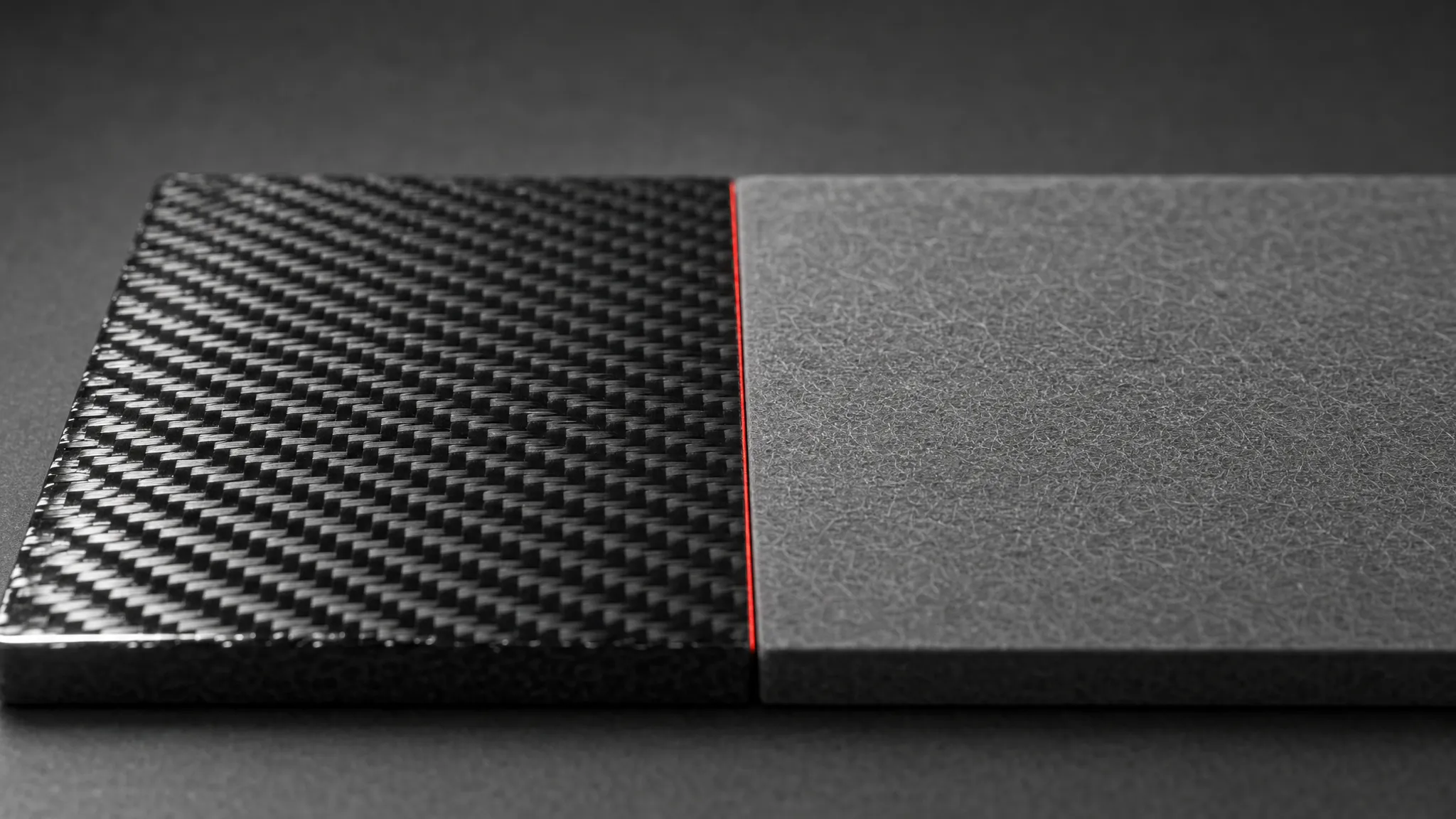
The logic behind the split is weight against visibility. Carbon earns its price where stiffness per kilogram is doing real work on a part you can see and lift, and its advantage is a specific stiffness and low mass rather than raw strength — a distinction CompositesWorld's materials coverage sets out well. On a large bumper shell that will be painted body color anyway, the same money buys weight nobody will notice.
So the common specification is mixed: a primed FRP shell and arch set going body color, with bare carbon only on the lip, the canards and the diffuser, where a buyer can see it. A full-carbon G82 widebody kit is not automatically a better kit — it is a different set of answers to the same questions. And note that carbon is not the only credible choice here, whatever an all-carbon product page implies; the FRP and thermoplastic grades exist precisely because the arch set is the largest, most paint-hungry panel in the build. If you want the five grades side by side on paper, and how each is specified for a given part, how the material grades compare on paper is the reference page.
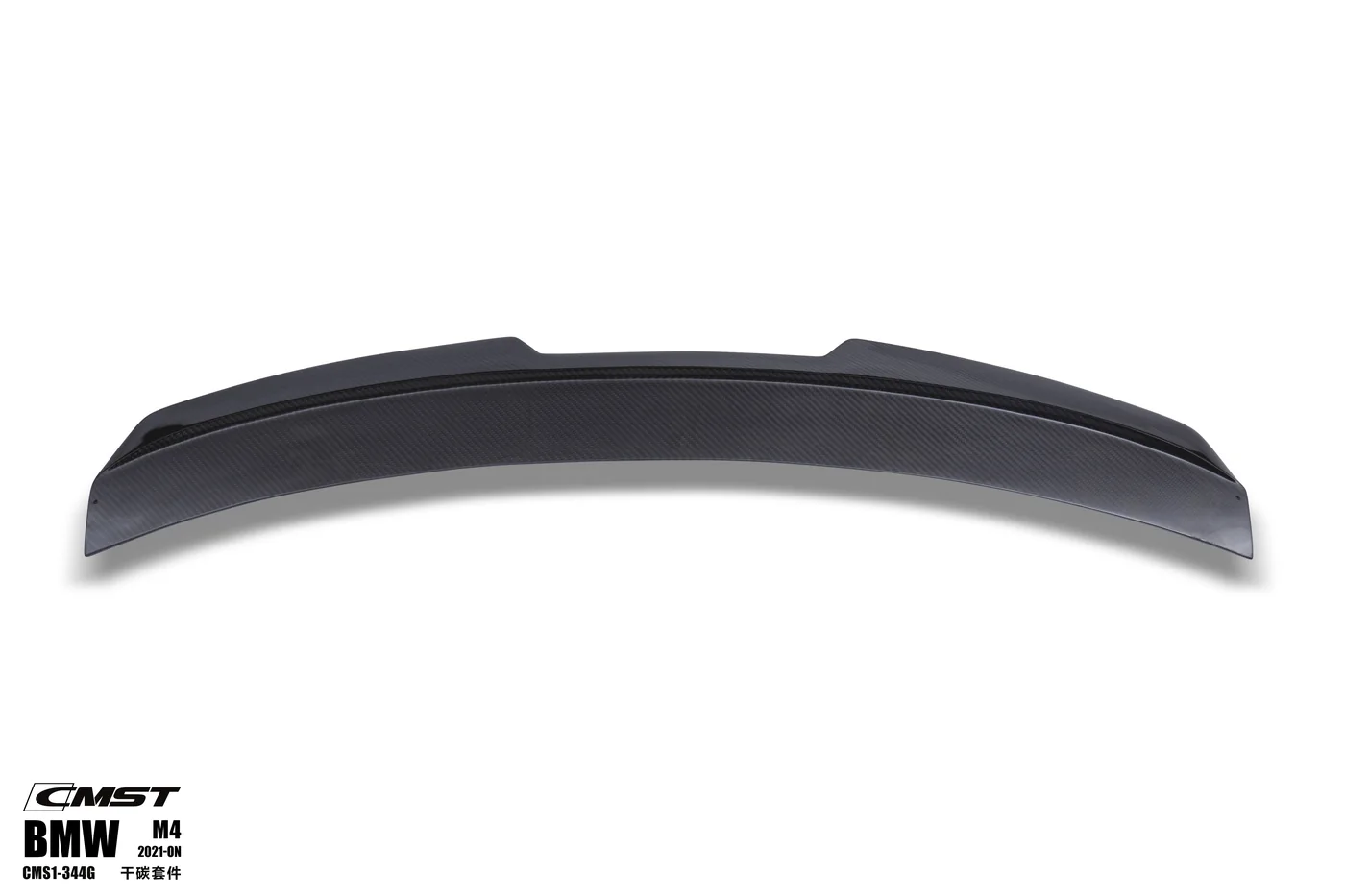
What you are paying for in dry carbon: a finished weave that needs no paint, on a part small enough that the money is visible.
Fitment: What Has to Clear, and How It Gets Proven
Fitment is where widebody projects actually fail, and where a supplier's process is worth more than its parts list. The components that have to clear each other are unglamorous: the arch, the liner, the tire shoulder at full lock, the bumper's mounting points, and the panel gaps the new fender has to match on a car that was already built to a tolerance.
The only way to answer that is to measure it on a car, which is why the sequence behind a well-developed kit puts the car before the tooling. On a molded carbon conversion the order is: CAD design, a printed master of the panel, a trial fit of that master on a real vehicle, then the mold, then the production part, then a final test fit on a vehicle before the batch ships. That is not a marketing claim in the case of the M4 panels CMST Tuning builds — it is the working order of the process, and it exists because a mold is very expensive to correct once it has been cut. how a kit gets trial-fitted before the mold is signed off explains the rest of that chain.
The corollary is a question worth asking any supplier: what happens if it does not line up on my car? A kit sold with no fitting notes, no hardware list and no stated process for a mis-fit has shifted that risk onto you. The same applies to the numbers that look reassuring but are not: "OEM-level fitment" is a claim, while "trial-fitted on a G82 before tooling" is a step someone either did or did not take. It is also worth asking how long the parts will take, because made-to-order panels are quoted in weeks rather than days, and the paint booth lands after that.
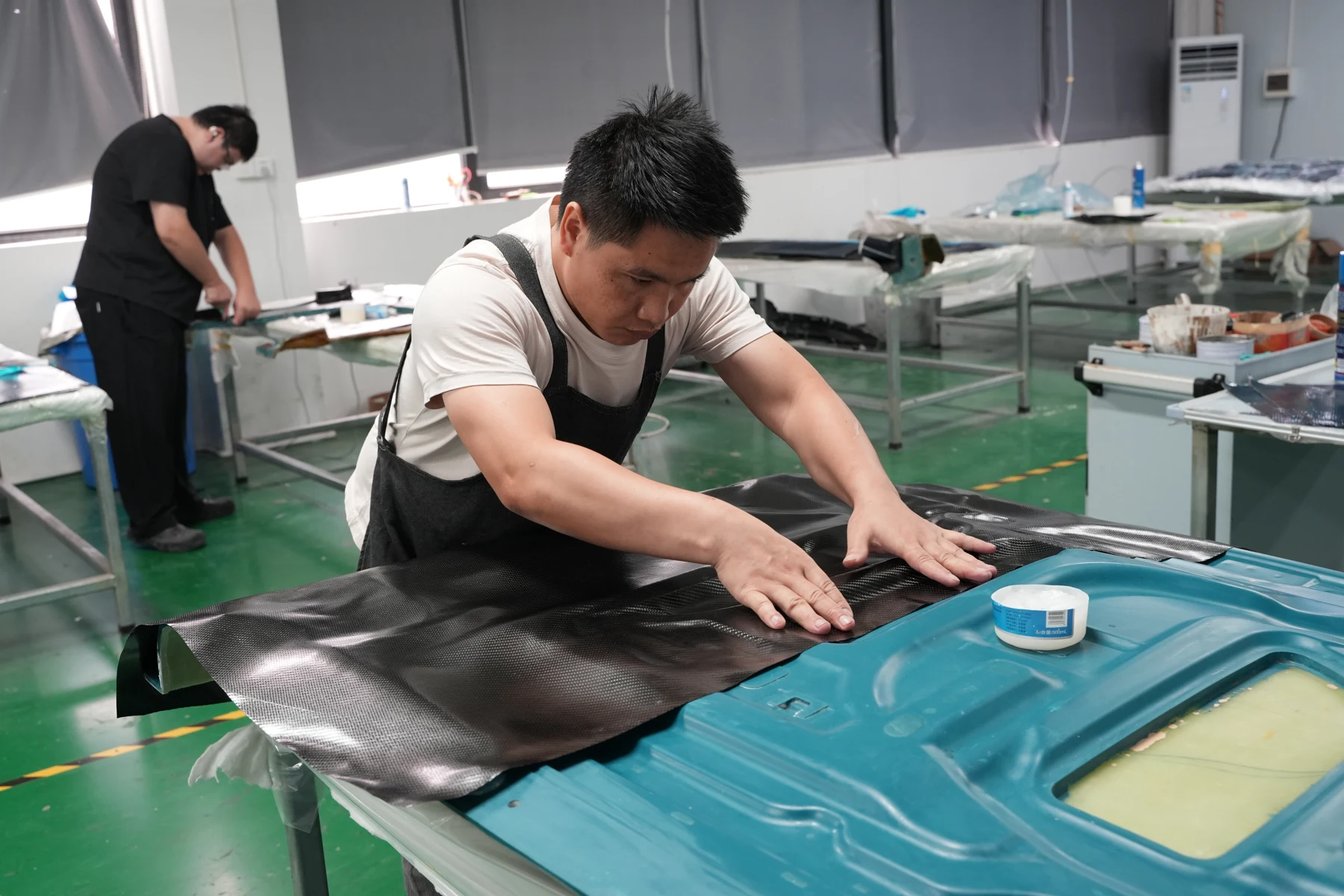
Where the fit is decided: laying and bagging are hand work, and the shape is set long before anyone sees a finish.
What It Costs, and What the Price Does Not Cover
Start with what the market asks, because the spread is wider than most buyers expect. Publicly listed prices on third-party supplier listings vary by roughly a factor of four — from about $10,000 for a complete set at the lower end, through around $15,000, to $40,000 for a flagship carbon conversion. Prices like these change with material costs and supplier policy, so treat them as a scale rather than a quote, and note that each of those figures is one listing's asking price for one specification.
The reason the numbers are so far apart is that "a kit" is not a unit of account. Five things move the price, and only the first is on the parts list:
- The panels and the grade — how many pieces, and whether they are primed FRP shells or laid-up carbon.
- The wheels and tires the arches exist to clear, which on a G82 build can rival the cost of the bodywork.
- Paint. A sprayed conversion means prep, a color match across a bumper, two arches and a quarter panel, and a booth.
- Labor, and specifically the kind that cannot be rushed: cutting, sealing, bonding, panel alignment, then a four-wheel alignment once the geometry has changed.
- Freight, which is not trivial for oversized panels.
That is the honest shape of the bill: the visible part is often the smallest line. Which is also why no serious supplier publishes one number for "an M4 widebody kit" — half the project has nothing to do with the body panels.
Two non-financial costs are worth pricing in at the same time. Modified bodywork generally has to be declared to the registration authority, and rules differ by market: in the UK, structural changes are among the things you must tell the registration authority about, as the vehicle registration guidance spells out. In Germany, changes to the vehicle that affect its type approval need an expert opinion or an approval under §19 of the Road Traffic Licensing Regulations — which is the provision behind the ABE paperwork buyers in that market ask about. Elsewhere it may be an inspection, an approval, or nothing at all, so check the rules where the car is registered. Expect an insurer to want to know as well, and expect a cut body to narrow the resale market whatever the workmanship. A bolt-on conversion can be undone; a cut one cannot, and buyers price that in.
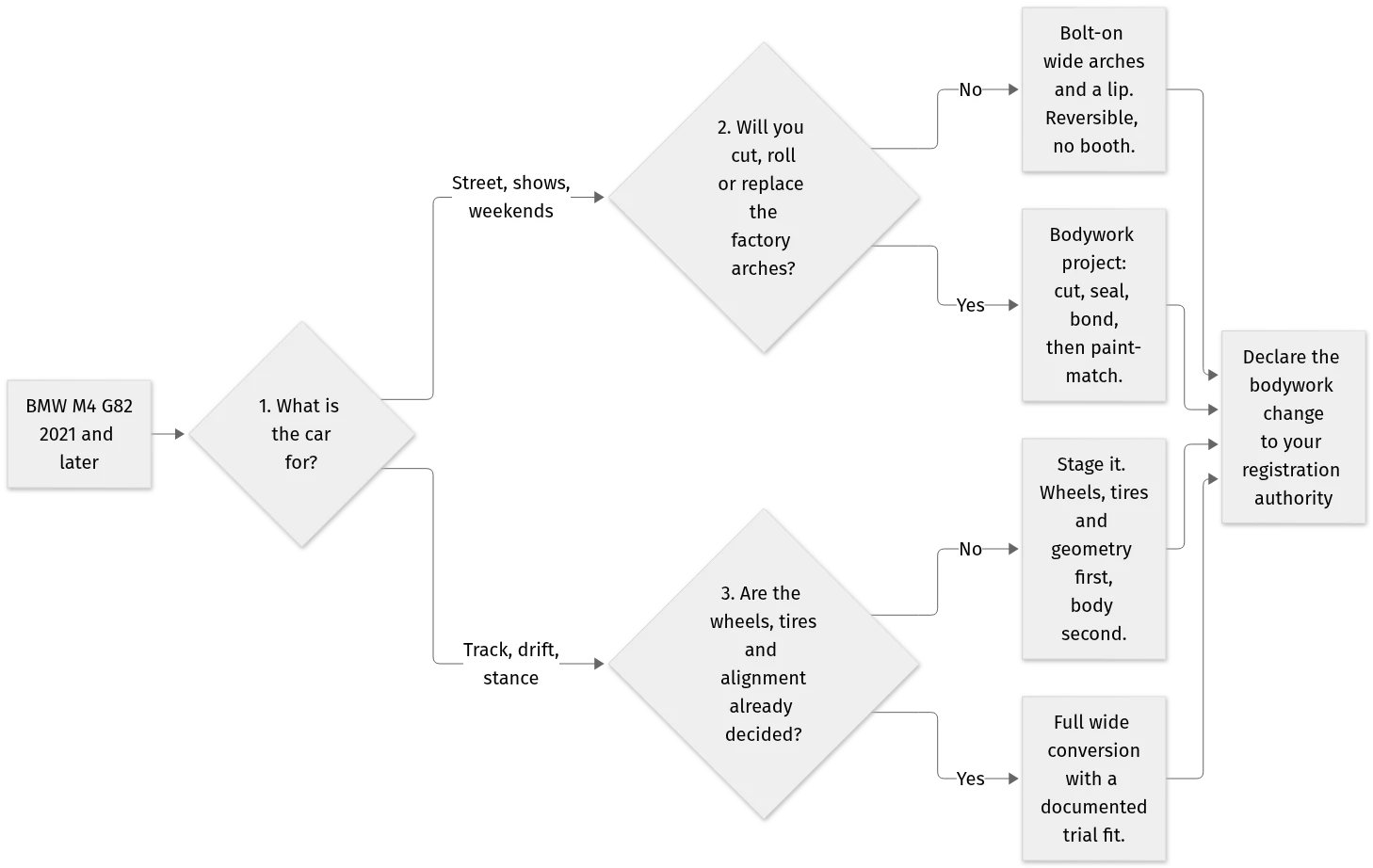
Three questions sort most G82 builds: what the car is for, whether the arches get cut, and whether the wheel and alignment package is already settled.
If you would rather look at the pieces than the principles, the shapes to study are the arch sets, the bumper conversions and the hoods and wings that hang off them — the current M4 kit and part listings lay them out panel by panel on this platform.
Where This Leaves You
An M4 widebody kit for the G82 is a bodywork decision dressed as a styling one. The arches move, the wheels follow, and the car comes back wider, heavier and harder to park than it was — better if the build was planned, worse to live with if it was not.
So settle the four things in this order, before you compare a single parts list. Decide what the car is actually for. Decide whether you are willing to cut factory metal, and accept the consequence if you are not. Decide the wheel, tire and alignment package, because the arch is only there to serve it. Decide how the change gets declared and insured where the car lives. Get those four right and the kit choice becomes straightforward, because you will be shopping for a specification rather than a look. If you want to see how a factory quotes this work — by grade, by part, and by what the set includes — the CMST wide conversion range is the place to start.
Next step
Send the vehicle, the parts you are considering and the finish you want — we reply with fitment notes and a quote.
Send an inquiryKeep reading
Related notes
What Is a Widebody Kit? A Beginner's Guide
A widebody kit widens a car's arches so wider wheels and tires will fit. Here's what is in one, what gets cut, and how to tell if a wide build suits your car.
Carbon Fiber vs Fiberglass Body Kits
Carbon fiber or fiberglass for a body kit? Part by part: carbon earns its price on hoods, wings and diffusers; FRP and molded plastic win on bumpers and arches.
Overfenders vs Fender Flares: Which Fits?
Overfenders and fender flares are one part under two names. What each term means, the three ways to cover a wider wheel, and how to measure before you buy.