
Factory Tour: Eight Workshops and Where Your Carbon Fiber Kit Is Checked
Eight workshops, more than ten thousand molds, and a surface check that fails a panel for five named defects. What a buyer sees walking a real factory.
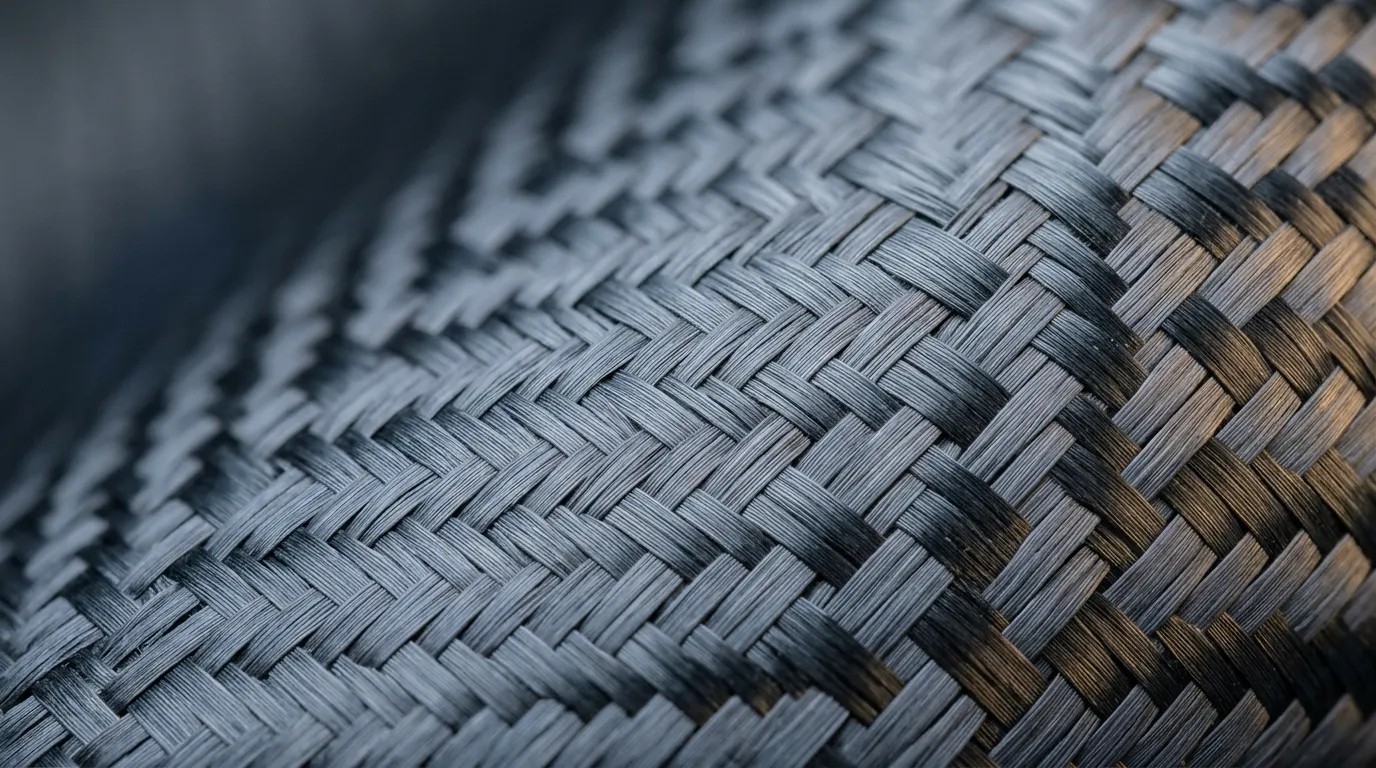
A factory visit is worth the trip for one reason: it is the only place you can see where a part can be stopped, and who is allowed to stop it. A finished car on a stand tells you what a kit looks like. It tells you nothing about who looked at the panel before it was packed, or what they were allowed to reject it for. Those two facts decide whether the part still fits in three years — and they are the only things a factory visit is really for.
This is the walk we give buyers who ask to see the floor where custom carbon fiber parts are made: eight workshops on a 6,999 m² site, more than a hundred people on it, and a sequence that starts with a car being measured and ends with a wrapped panel going into a crate. Along the way we will point out the four places where a part can be stopped, and what it looks like when a supplier has removed one of them.
If you are placing a first order — as a dealer, a shop or an importer — read it as a checklist you can carry into any factory, ours included.
What a factory visit shows that a photo does not
Two complaints account for most of the trouble in this trade, and neither one is visible in a product photo.
The first is fitment. A panel that sits proud at the wheel arch, or a shut line that wanders by a few millimeters, was decided long before anyone bolted it on: it was decided by whether the shape was checked against the actual car before tooling was cut. The second is surface quality. Pits, cloudy patches and waves along a reflection usually appear after the clear coat goes on, which means the cause is upstream in the layup, the vacuum or the mold — not in the finishing shop where it becomes visible.
Both failures share a property that makes a visit worthwhile: they are cheap to catch inside the building and expensive to argue about after shipping. So the useful question on a tour is not "what machines do you have". It is "where in this building can this part be stopped, and who has the authority to stop it".
That question has four answers in our shop, and they sit in the order the part moves.
How custom carbon fiber parts move through the workshops
The site runs eight workshops across 6,999 m², with more than a hundred people on it. The company started in 1993 as an automotive accessories business, became a design-and-manufacture exterior brand under the CMST name in 2011, and moved to its current site in Sihui, Guangdong in 2023. Along the way it accumulated more than ten thousand molds — a library, not a stock, and the reason a repeat order is a production job rather than a new project.
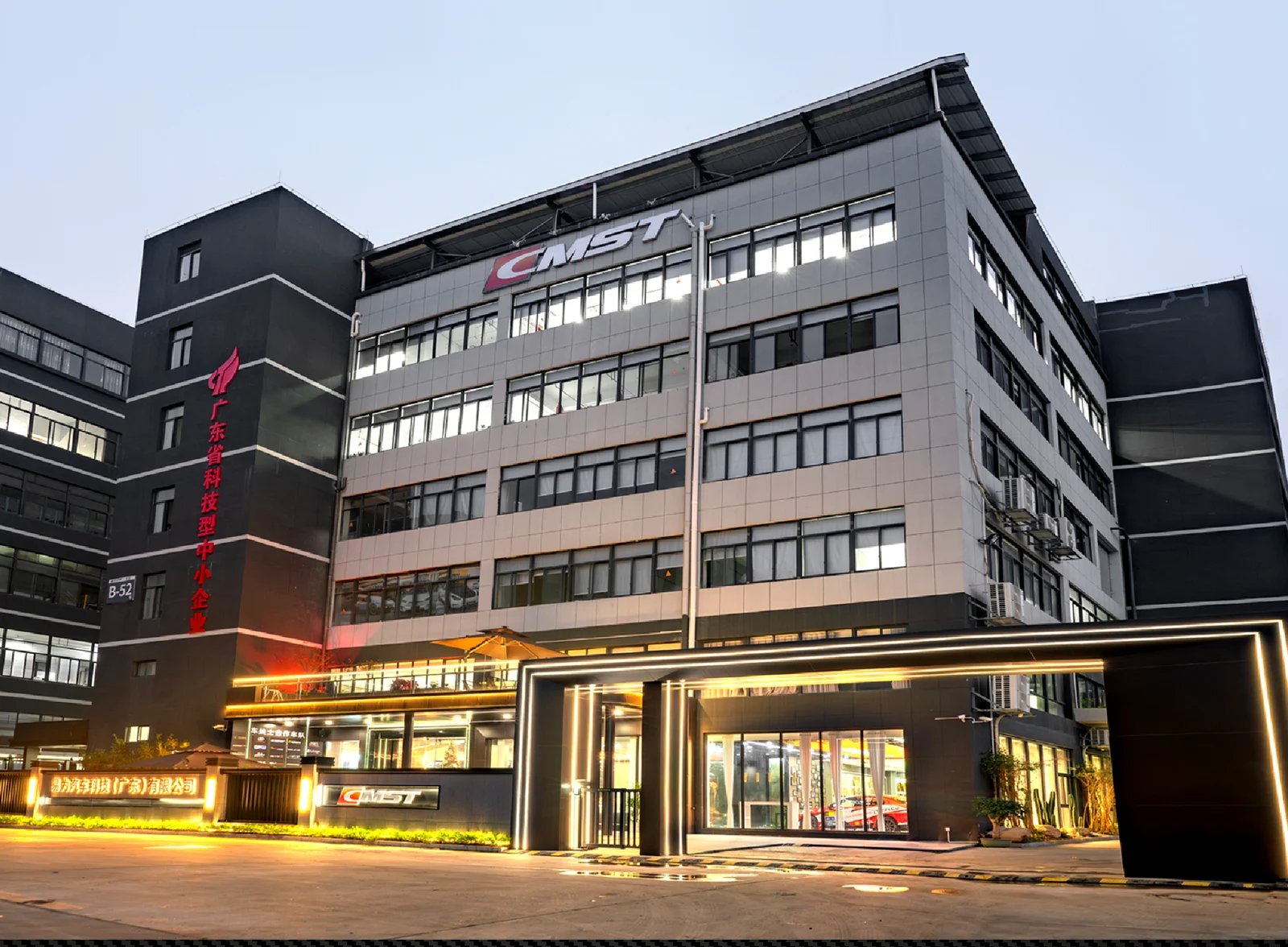
Eight workshops share the site, and the sequence this article follows is the order the work moves in: design and tooling, then cutting and layup, then cure, then trim and finish, then a second trial fit and packing. The first trial fit happens earlier than any of those — before the tooling exists, which is why it is the next section. A custom order touches most of these stages; a catalog part whose tooling already exists starts further down the line, which is why the same site can run a one-off and a repeat batch in the same week.
This is the manufacturing half of a longer path — the whole route from first sketch to a delivered car is mapped in the custom aero hub, and the company history behind the floor is on the about page.
Before any tooling: a printed master and a trial fit on the car
The first stop is the only one where a mistake is still free to fix.
A custom carbon part starts as geometry taken from the car itself. We keep one 3D scanner in house; optical systems capture the body as a full-field surface rather than a set of touched points (optical 3D scanning systems such as GOM), and the result is a mesh the designers build against instead of a blank file. The design team is twelve people, and this is the stage that decides how much of the rest of the project runs to plan.
Then the shape becomes physical. A master is 3D printed in sections — printing goes to a partner with a large-format machine, because owning one for occasional work is not a sensible use of capital — glued on a jig, filled and sanded back to the CAD surface. And then it goes on a car. Not a jig, not a photo: the car, with bumper covers, arch liners and lights fitted, because those are the parts the kit has to clear.
This trial fit is where a design stops being a proposal. Gaps at the headlight come back wrong by a few millimeters. The arch clears the tire at rest and touches it on lock. A bracket needs a relief nobody modeled. Each finding goes back into CAD and the affected section is reprinted, and two or three loops on a new shape are normal.
The stop rule is simple: the shape does not get signed off until it has been on the car. A mold cut for an unproven shape reproduces that shape's errors many times over, and every one of them arrives at a customer as a gap that cannot be adjusted out. If a supplier quotes a custom shape without ever mentioning a physical trial fit, the question to ask is what happened between the CAD file and the tool. The stage-by-stage version of this sequence, for a single kit, is in how custom body kits are made.
Layup, vacuum, and the two autoclaves
Past tooling, the work becomes material handling, and the carbon fiber fabrication process splits by grade — autoclave carbon fiber for the lightest panels, vacuum-and-oven for the volume carbon work, and molding and layup for FRP, ABS and PP.
We work in five: dry carbon from prepreg cured under heat and pressure, high-temperature vacuum carbon cured under vacuum in an oven, FRP, ABS and PP for the volume end of the range. Weight is usually why a buyer starts this comparison at all. Dry carbon comes out lightest, high-temperature vacuum carbon is a step heavier and carries the volume carbon work, FRP and ABS sit in the middle, and PP — the most impact-resistant of the five — is the heaviest. On a large exterior panel that difference is not academic: it is mass carried at the outside of the car, at the far end of the suspension, which is where weight saving actually pays. Carbon is also stiffer than glass at the same thickness, so a carbon panel and an FRP panel are not the same part in a different finish. The material grades page sets out the differences part by part. What all five share is that none of them tolerates a sloppy layup.
Plies are cut to templates taken off the flattened CAD surface, each with a direction, and the stacking sequence is written down before anyone touches cloth.
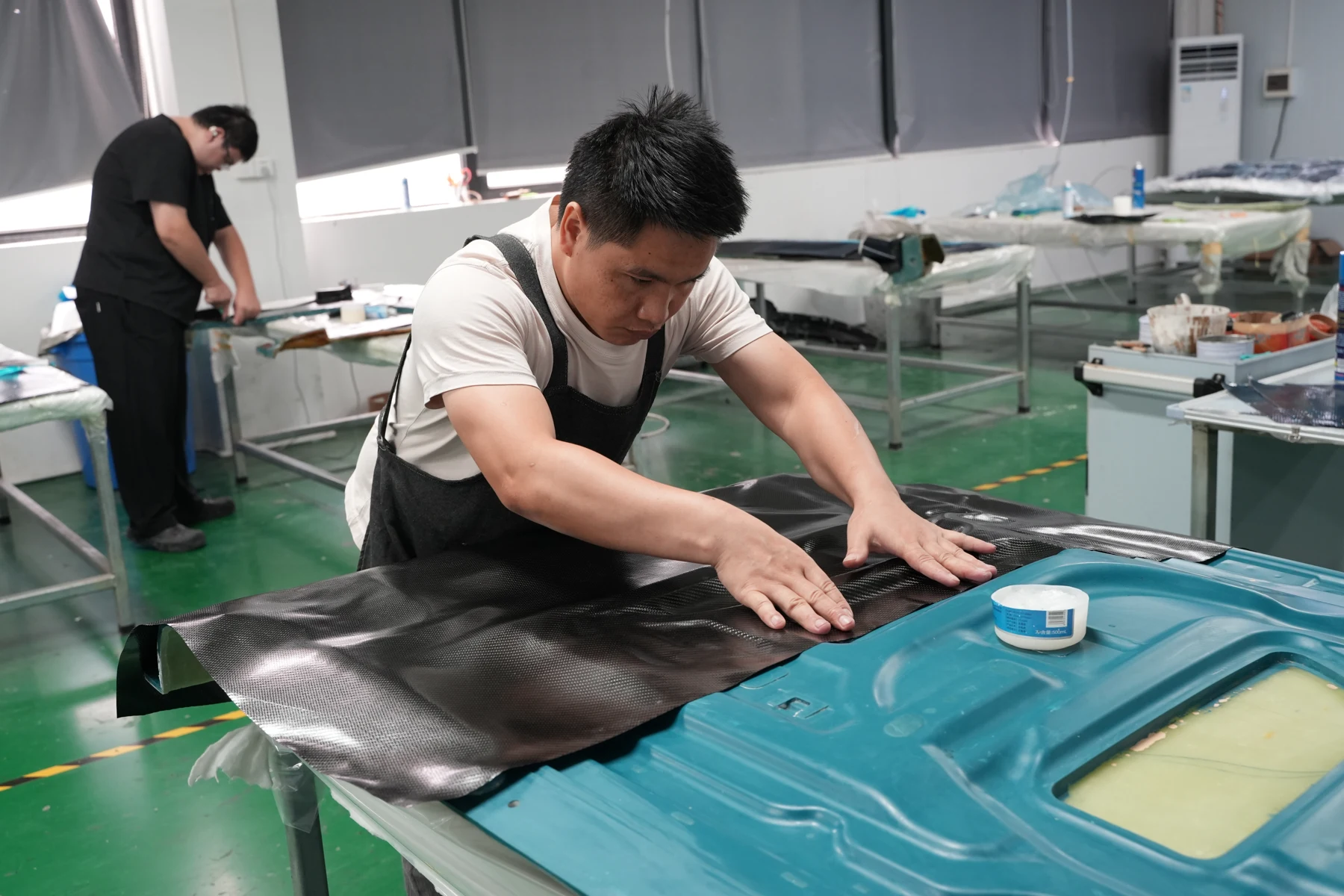
The stack then disappears under a bag: peel ply against the laminate, breather cloth to carry air out, bag film sealed to the mold flange, vacuum ports through it. Pull a vacuum and the atmosphere does the pressing.
Two things go wrong here often enough to be worth naming. Thick sections have to be debulked between plies — bag it, pull vacuum, let it compact, then keep laying — because air trapped between layers cannot be removed later. And the bag has to hold. A slow leak rarely ruins the part outright; it leaves a pale, resin-starved patch that reads as a dry corner once the clear coat is on.
Cure is where capacity lives. In an autoclave, pressure and heat reach the laminate through the vessel atmosphere while the vacuum bag adds local pressure and keeps the gases off the part (CompositesWorld). A structural prepreg cycle is typically a two-stage ramp with an intermediate hold, so the resin drops in viscosity and lets trapped air out before the final cure; a traditional autoclave reference is around 85 psi at 177 °C, against vacuum-only oven cure at much lower pressure and temperature (CompositesWorld).
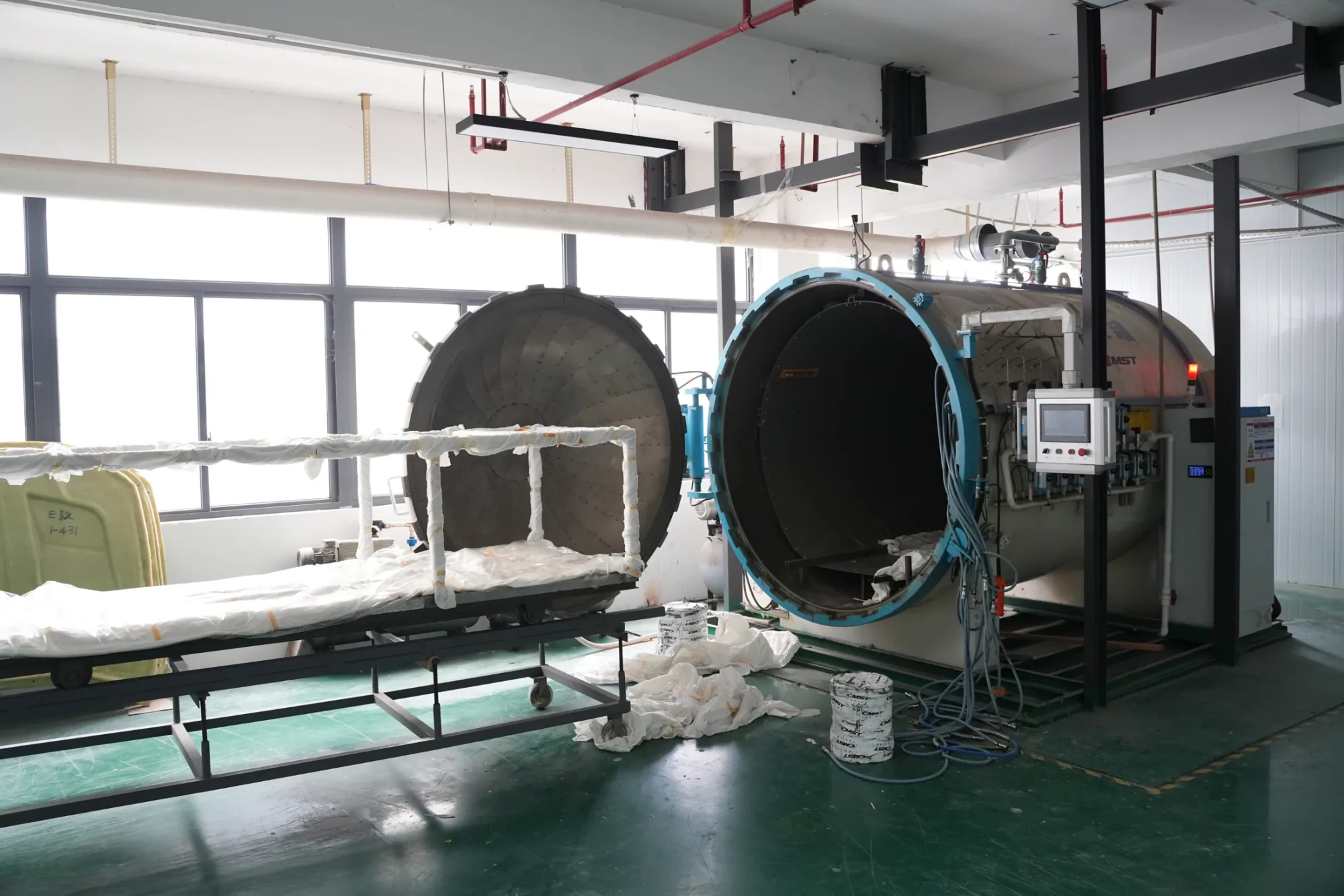
We run two. That number, not the size of the layup bench, sets what a day can produce, so the cure schedule is usually the first thing a production planner looks at. Cooling is part of the recipe too: the temperature is ramped down in steps rather than dropped, because uneven contraction between tool and laminate warps a part that was flat when it came out of the mold (CompositesWorld).
Finishing: where a defect stops being invisible
Out of the mold, a part is close to finished and not finished. The edge is trimmed to the trim line, the surface is wet sanded, and if the part is staying bare, the clear coat goes on.
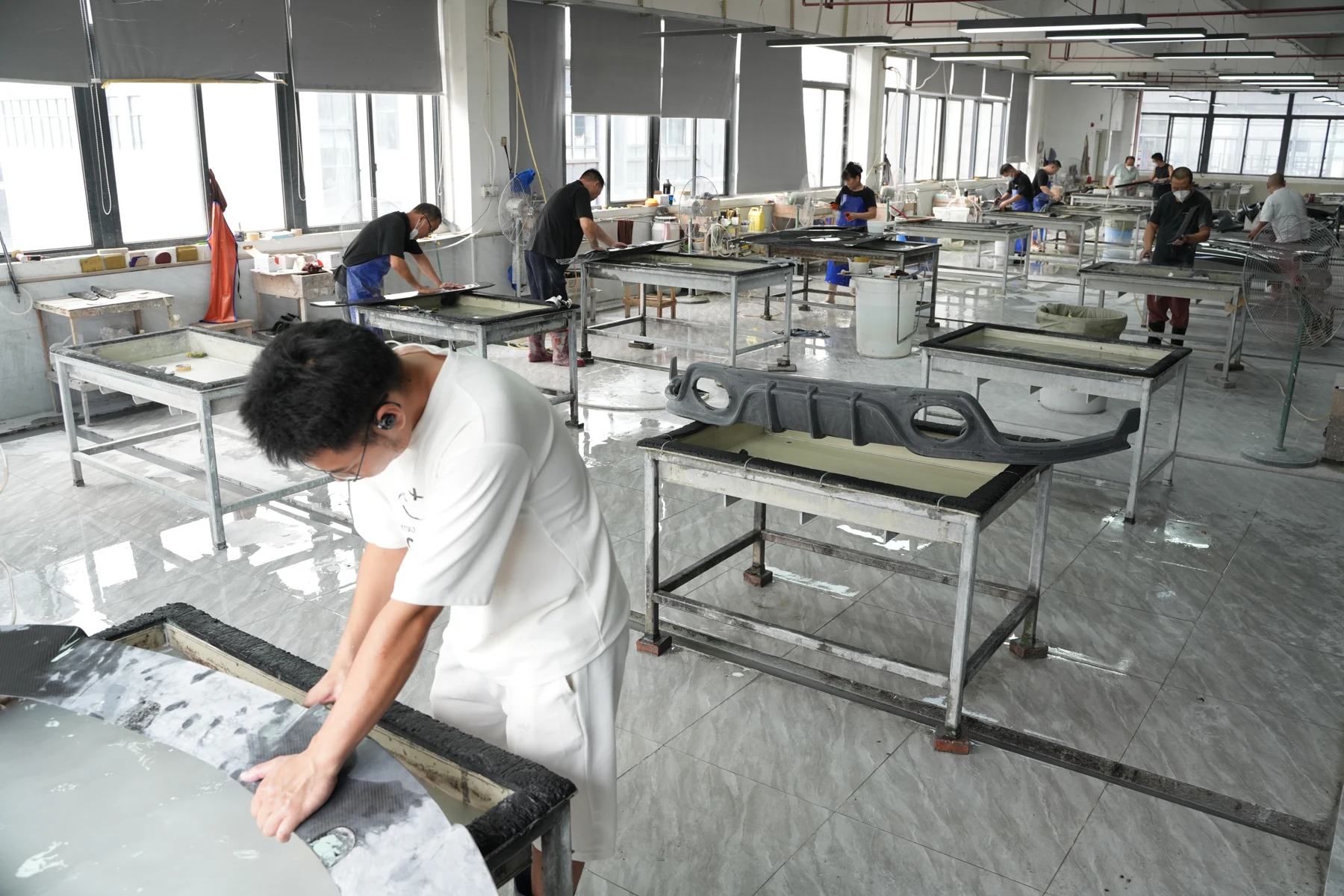
This is the least glamorous area on the site and the one that decides what a buyer actually judges. On a bare carbon panel the finish you see is the finish of the mold, transferred through the resin: pits, scratches and polish marks in the tooling come back as pits, scratches and polish marks in the coat. Wet sanding does not create defects, it reveals them — which is why a part can look acceptable in primer and be obviously wrong under clear coat ten minutes later.
For a buyer walking the floor, the useful observation here is not the equipment. It is whether the person doing the sanding is also the person who signs the part off. If the same hands finish and approve, the check is a formality.
The surface check: five reasons a panel gets failed
Ask a supplier how they define carbon fiber quality and you tend to get an adjective. The acceptance list here is short and specific: a panel is rejected for any of these five, and each one has a cause several stages upstream.
What fails the part | What it looks like | Where the cause usually sits |
|---|---|---|
Pits | Small craters in the coat that hold dirt | Mold surface, or voids that opened at sanding |
White or cloudy patches | Milky areas instead of a deep weave | Bag leak, or resin that did not wet out |
Waves | Ripples that move as you walk past the panel | Mold flex, or a laminate that was never consolidated |
Wrinkles | Creases in the weave under the coat | A ply that did not follow the surface |
Touch-up printing | A repair sanded and painted over | A defect that was found and hidden, not fixed |
The last row is the one that matters most, and it is the reason this list is written down rather than left to judgement. A repair that has been painted over will pass a glance and fail in service, because a filled area does not age like the laminate around it. Naming it as a rejection reason removes the option.
None of the five requires an instrument to see. They require daylight, an angle rather than a flat-on look, and someone whose job is to say no. That is worth testing on a visit: ask to see a part that was rejected this month, and ask what it was rejected for. A factory that cannot produce one is either very new or not checking.
What gets checked between stages, not only at the end
Most factory audits stop at end-of-line inspection. That catches the parts that are visibly wrong. It cannot catch a shape that was never fitted, because by then the tool exists.
So the checks that matter are attached to stages, and there are four of them in this sequence.
Before tooling: the printed master on the real car. This is the only check that can change the shape at no cost.
Before the run: a production sample, built from the finished mold and trial-fitted again. The mold, the layup and the cure each move the surface a little, so the part that comes out is not identical to the master that went in. This second fit is where a stack-up that only appears on a real part gets caught, and it is the difference between a kit that fits and a kit that nearly fits. What a correct trial fit looks like, and what an installer can and cannot correct afterwards, is covered in how fitment works and in the fitment notes.
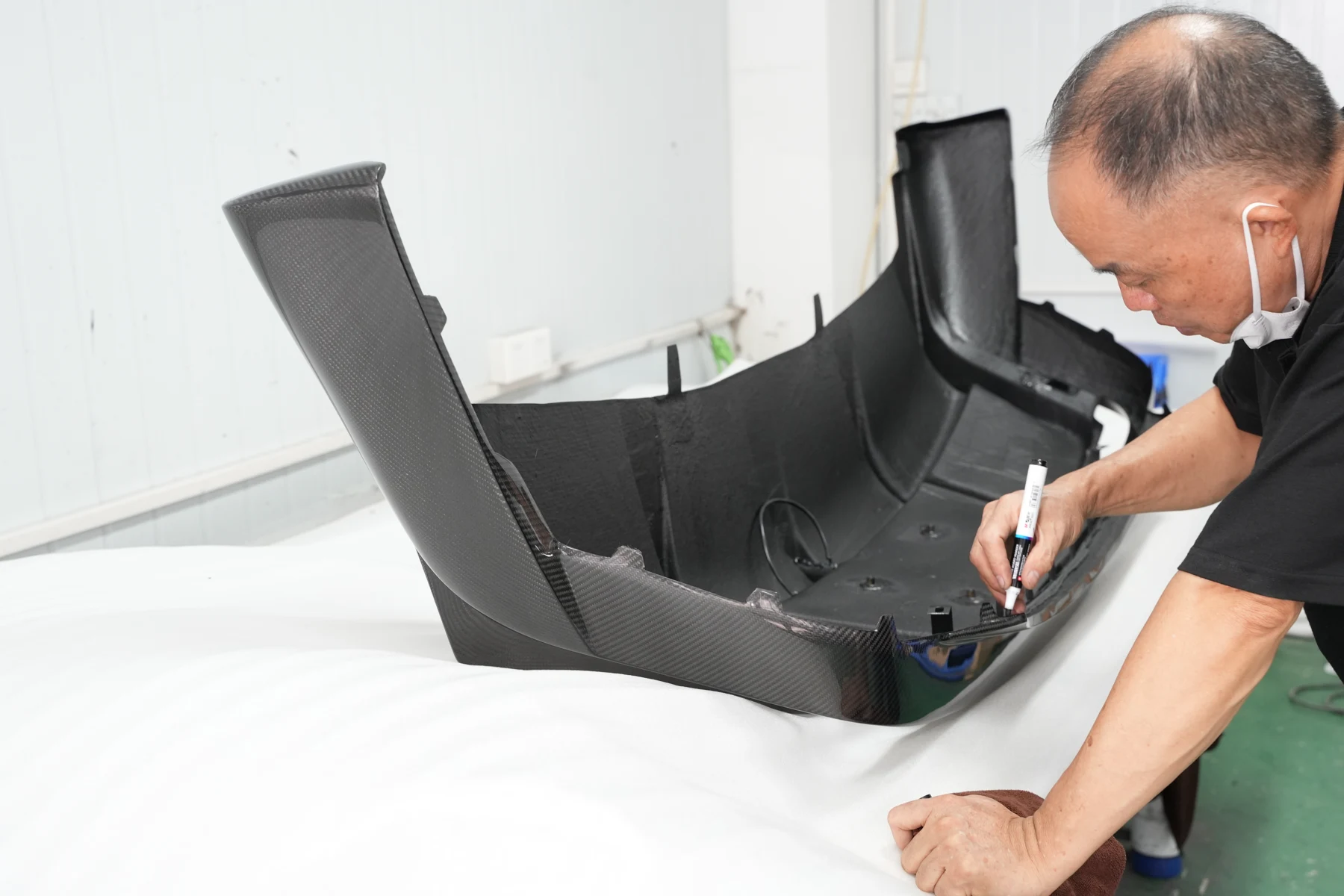
Before packing: the surface check above, plus a completeness check on the kit itself — brackets, hardware and the parts that are easy to forget because they are small.
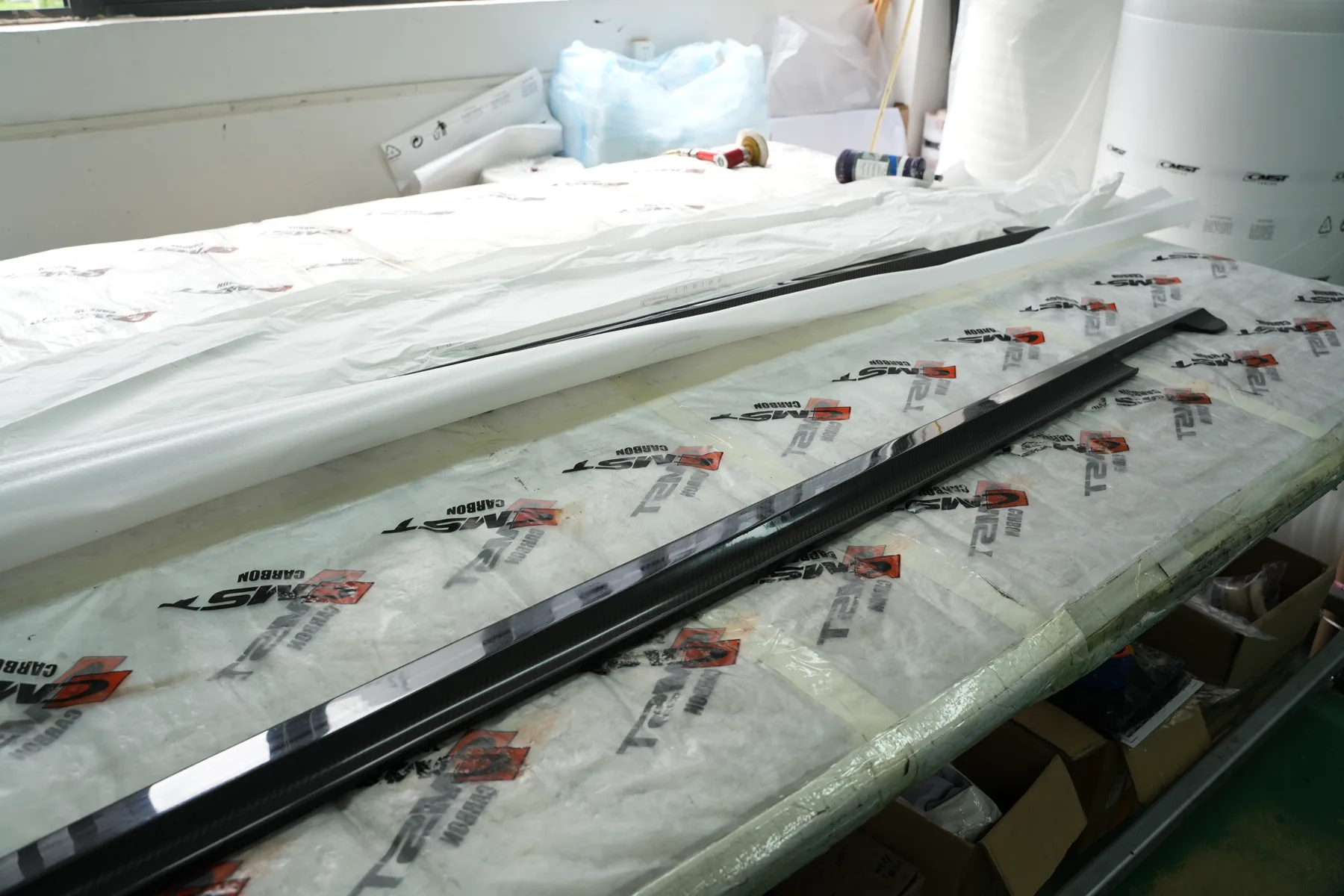
At packing: each panel wrapped in protective film and staged, since a part that survives the workshop can still be ruined in transit. More than one "factory defect" arrives as a shipping mark.
The honest limit of all this: a check is only as good as the record behind it. Which mold did this panel come from, which batch, who signed it off — if a supplier cannot answer that for a part in your hand, the process exists on paper only. Ask it as a question on the day and see whether the answer arrives in seconds or in a week.
What to ask on the day you visit
Most of the questions that make a factory audit useful have short, checkable answers. The vague ones are the ones that matter.
Ask | A good answer | A vague answer |
|---|---|---|
Will the shape be fitted to a car before tooling? | Yes, a printed or built master, on the vehicle | "Our engineer checks the CAD" |
What is the part fitted to — my car or a sample? | A car of the same specification, named | "Same model, it's fine" |
How many trial-fit rounds are included, and what does an extra one cost? | A number, and a rule for revisions | "As many as it takes" |
Who builds the mold, and how is its surface finished? | In-house tooling, with the surface spec stated | A description of the part, not the tool |
How is the part consolidated and cured, per grade? | Bag plus autoclave, or bag plus oven, stated per material | "High quality carbon fiber" |
What are the surface acceptance criteria? | A written list — pits, clouding, waves, wrinkles, touch-ups | "We check every part" |
Can I see a part you rejected this month? | Yes, with the reason | A change of subject |
Which mold and batch did this specific panel come from? | An answer within minutes | "We'd have to look into it" |
The pattern behind the table is that a supplier who has run the front half of the sequence can describe it in specifics, because they have paid for it. One who has not will describe the material instead, which is the easy half and the last part of the job.
If you are commissioning custom carbon fiber parts for a shop, a collection or a dealer program, the OEM and ODM page sets out how a project runs from first measurement to delivery, and the build gallery shows finished cars rather than components.
On the credentials question buyers often ask about at this point: we publish what we can document. The company has been a council member of the China Auto Modification Accessories Association since 2013, and was named among the China automotive aftermarket top 100 brands by the CIAACE organizing committee in 2018. Both are domestic industry awards, and we present them as that.
Short answers
Can I order a single set? Yes. Minimum order is one piece, and mixed orders are accepted. Wheels are the exception at four pieces, because a set is four.
Do I have to send my car? Not necessarily, but a car of the same specification has to be available for the trial fit at some point — yours, one at the factory, or a first article sent out and checked before the run. What does not work is skipping the fit and hoping the model was right.
How do I judge surface quality myself? Take the panel into daylight, look along it rather than straight at it, and check the five items in the table above. If the panel is already wrapped, ask for one that is not.
When is the schedule fixed? At quotation, against the work in front of the shop — the tooling, the trial-fit rounds and the cure cycles your order needs, not the layup bench. Ask for the fit rounds to be scheduled explicitly; that is the part of the plan that moves.
The carbon is the easy part to describe. What you are really buying on a factory visit is the right to stop a part at four points in a building, and a supplier willing to show you where they are. If you want to test that, send us the vehicle it has to fit, or the spec you are working from, and ask for the fit rounds to be scheduled before the tool is cut.
Next step
Send the vehicle, the parts you are considering and the finish you want — we reply with fitment notes and a quote.
Send an inquiryKeep reading
Related notes
How Are Body Kits Made? From 3D Scan to Mold
A custom body kit is a fit problem before it is a design problem. Eight stages, from scanning the car to cutting the mold, decide whether it fits at all.

Dodge Challenger Widebody: A Buyer's Guide
A Challenger widebody is either the factory package or a conversion a shop builds. What the factory changed, and what a narrowbody job really takes from you.

What Is a Body Kit? Parts, Types, Full Kits
A body kit is a set of exterior panels and aero parts, not one product — so what a full kit includes depends on the seller. Types, parts and what is left out.