
Dodge Charger Widebody Kits: What Fits, What to Expect and Options Compared
A dodge charger widebody kit is really three different products. What fits your model year, what the factory Widebody changed, and what each route costs.
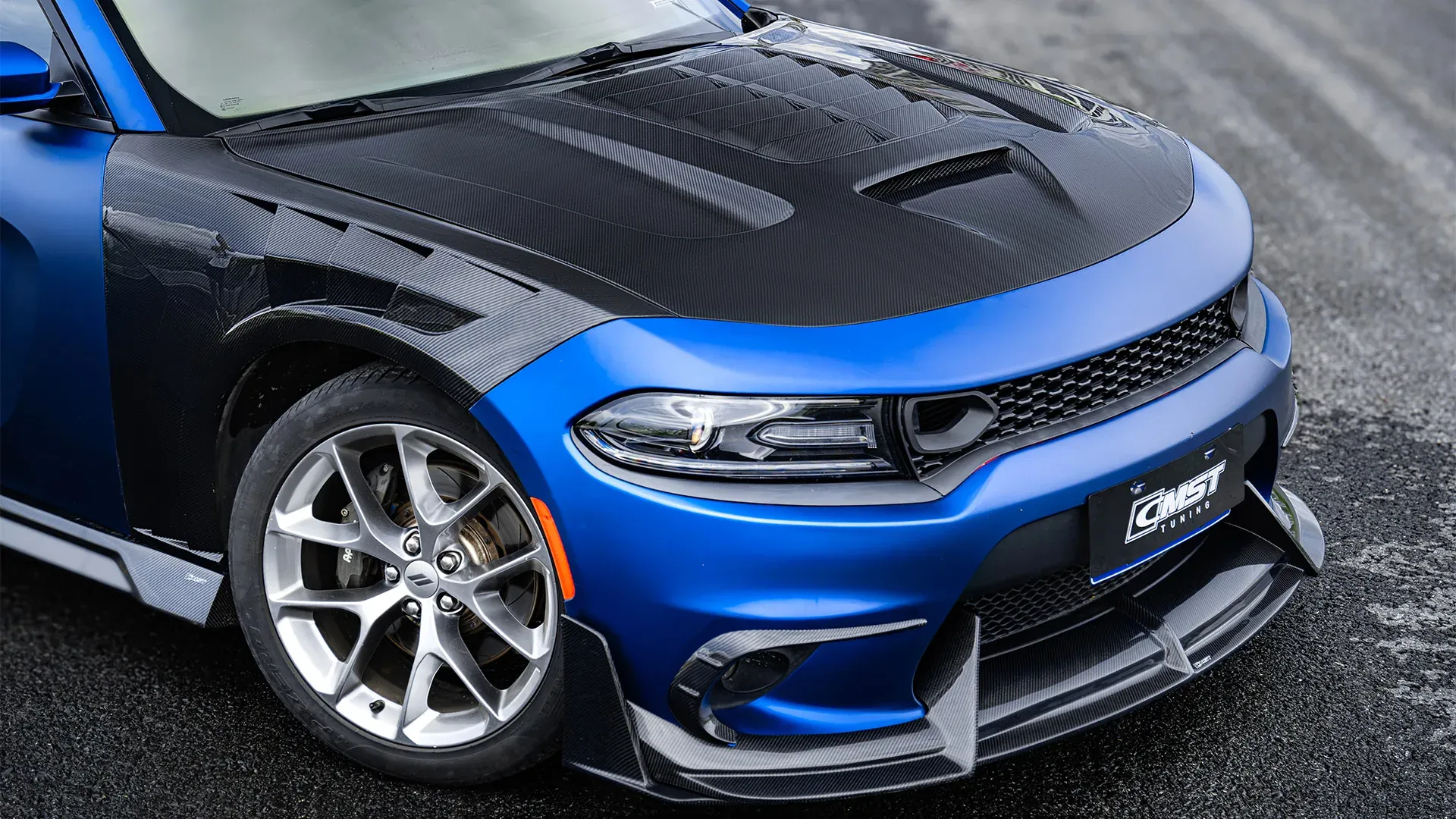
A Dodge Charger widebody kit is three different products wearing one name. One replaces the factory fascias and bolts on flares so the car genuinely gets wider. One adds flares to a narrow-body car and leaves the bumpers alone. One changes nothing about width and only sharpens the front, sides and rear. Which one you want comes down to two facts you already know: the model year, and whether the car left the factory as a Widebody. Get those wrong and the best-made kit in the catalogue is still the wrong part.
What Dodge's Own Widebody Actually Adds
The factory Widebody arrived on the Charger for the 2020 model year, standard on the SRT Hellcat and available on the Scat Pack. Dodge's own figures: the integrated fender flares add 3.5 inches of body width, and the car rides on 20-inch-by-11-inch forged wheels with 305/35ZR20 Pirelli tires (Stellantis press kit, 2020 Dodge Charger).
The package contents are the more useful half of that release, because they spell out what "OEM-style" actually means in parts. The same source lists Widebody front and rear fascias, a mail-slot grille, body-color fender flares, new side sills tying the two fascias together, an SRT-specific rear spoiler, six-piston Brembo brakes, a retuned adaptive suspension, the 20x11 wheels and the 305 tires.
Read that list twice. The flares were not an accessory bolted to a finished car — they were drawn together with new bumper moldings and new sills, and the track grew to fill them. That is why a factory Widebody Charger doesn't read as a narrow-body car with arches stuck on: every panel that meets the arch changed at the same time, in the same studio, in the same color.
This is also why "OEM style" and "factory style" appear in almost every aftermarket Charger listing. The phrase is shorthand for one specific silhouette — the 2020-2023 Hellcat and Scat Pack Widebody — and it is the benchmark every aftermarket kit gets measured against, fairly or not. The first question to ask about any kit is whether it changes the arch or only the trim. Kits that do change it — bolt-on arches, replacement fenders and quarter panels — are catalogued by car on the widebody conversion range. If you already know your car is a 2020-2023 factory Widebody, skip ahead to the fitment table below — the conversion half of this article does not apply to you.
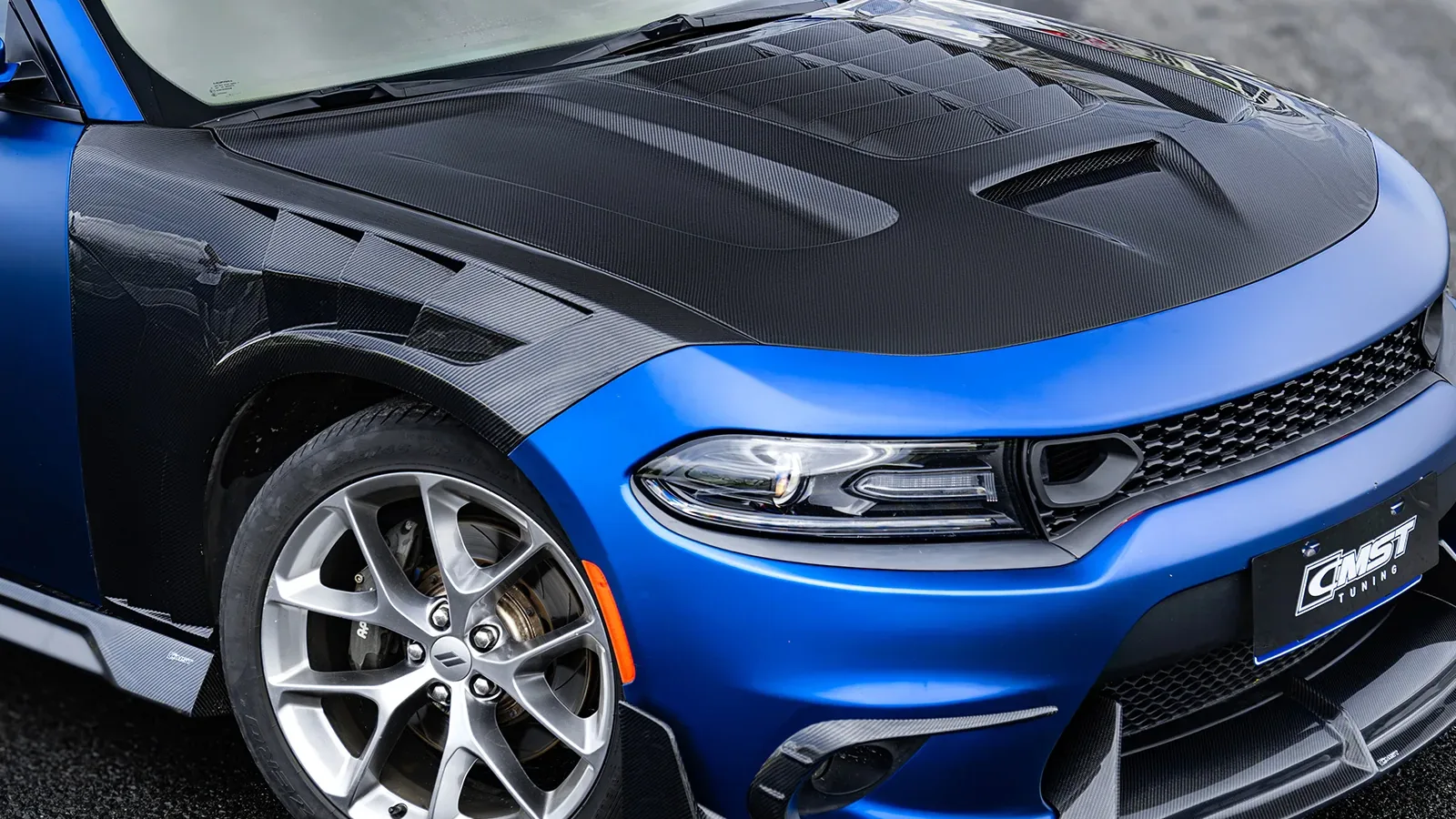
Carbon front fender, hood and lip on one of our Charger builds. Parts like these change the look; whether the arches get wider is a separate decision.
What Fits: Charger Widebody Kits by Year and Trim
Year is the first filter, and it is not negotiable. Dodge resculpted nearly every body panel for the 2015 model year — new hood, new fenders, new front and rear fascias, new front doors (Stellantis press kit, 2015 Dodge Charger). A kit tooled for one side of that line does not become the other side with persuasion and shims. That is why a 2015 Charger widebody kit and a 2011–2014 kit are different products, not different listings.
Model years | Body | What a widebody kit can realistically do |
|---|---|---|
2015–2023, narrow body (SXT, GT, R/T, Scat Pack, and the pre-2020 Hellcat) | The generation every aftermarket Charger kit is tooled against | Fascia swaps, bolt-on or bonded flares, full aero sets, arch work |
2020–2023, factory Widebody (Hellcat Widebody, Scat Pack Widebody) | Already flared, already on 20x11 and 305s | Trim, lips, diffusers and spoilers that clear the wider track — not arch kits |
2006–2014 | Two earlier bodies, each its own bracket | Kits exist but are tooled year by year; check the listing names your exact year and that the seller can show a trial fit |
2024 and later | New-generation Charger on the STLA Large platform, revealed in March 2024 (Stellantis) | Nothing from the 2015–2023 cars carries over |
Two practical consequences follow, and they matter more than any product detail on this page.
The narrow-body 2015–2023 car is where the volume is. It covers nine model years and every trim from the V6 SXT up to the pre-2020 Hellcat, and it is the only group where a widebody kit is adding width that wasn't there. Real Charger builds in this bracket are catalogued by year on the Charger model page, and the kit part lists are what you compare, not the hero photo.
A factory Widebody car is a different job. Its flares already carry the extra 3.5 inches of width and its wheels already fill the arches. Fitting a narrow-body flare kit to it is not a styling choice, it is a fitment error; what that car needs is trim, a lip, a diffuser or a wing. Any listing that doesn't say which body it was tooled for is a listing you should ask about before paying.
One more date that changes the arithmetic: Charger production ended on 22 December 2023, when the last LD car left Brampton (Car and Driver). The pool of 2015–2023 cars is now fixed. Nobody is adding to it, which is exactly why part availability and repeatable tooling matter more on this platform than on a car still in production.
Three Routes, and What Each Asks of the Car
Almost every argument about Charger widebody kits is really an argument between three routes, and the routes differ in one thing: how much of the original body they are willing to disturb.
Aero kit | Flare and fascia kit | Factory-style conversion | |
|---|---|---|---|
Body width | Unchanged | Arch width added | Roughly 3.5 inches, per Dodge |
Bumpers | Original | Often replaced or extended | Replaced front and rear |
Paint | Bare carbon or gloss black, or painted | Usually painted body color | Body color, no alternative |
Wheels | Original offset usually fine | Wider wheels or spacers needed | 20x11 and 305-class tires |
Typical spend | Per part, published on the product page | Kit price, then a full paint and fitting bill | The highest of the three: panels, paint, wheels, tires |
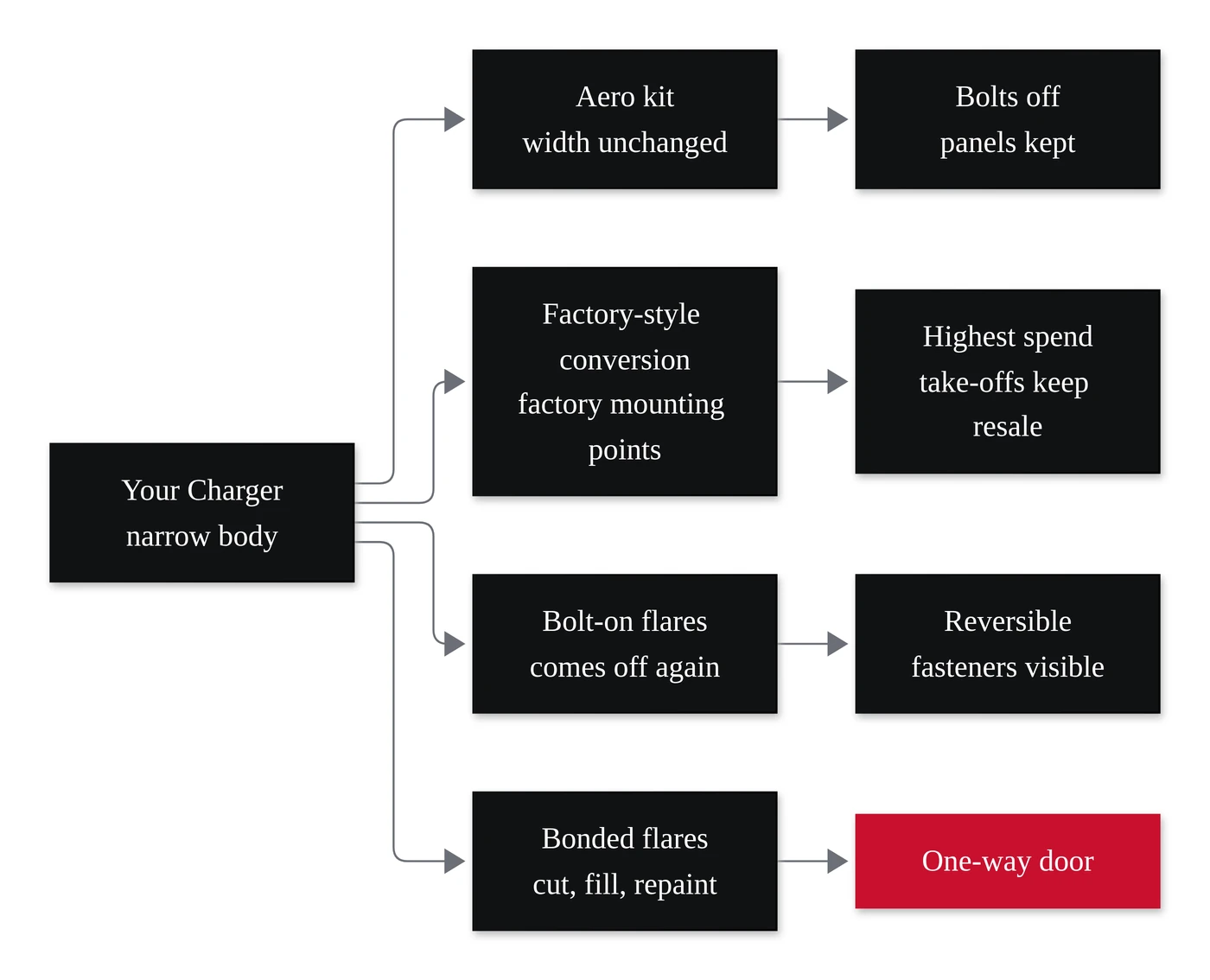
The table above compares what each route does to the car. This is the other half of the decision: whether the kit can come off again.
Route 1: The Factory-Style Conversion
This is the route that produces the silhouette everyone recognizes, and it is the most expensive per panel by a wide margin. The Hellcat Widebody is the car people are copying, which is why "hellcat widebody kit" usually means this route rather than a trim kit. You are buying factory body panels: two fascias, flares for all four corners, side sills, the grille, and a spoiler if the car is an SRT. They arrive finished in body color because that is how they were designed — there is no bare-carbon version of a factory fascia.
The wheels are not optional. Dodge built the Widebody around a 20x11 wheel and a 305-section tire, and a conversion that stops at the bodywork leaves the car sitting on a narrow track inside wide arches, which reads as unfinished from twenty feet away. Budget the wheel and tire package as part of the conversion, not as a later upgrade.
What you get for the money is fit. Factory panels locate on factory mounting points, gaps are what the assembly line produced, and the car looks like a car Dodge built. What you don't get is character: every completed conversion looks like every other completed conversion, because the parts are identical. For a dealer reselling the car, that is a feature. For an owner building something of their own, it usually isn't — and the same arithmetic plays out on the Challenger version of this decision.
Route 2: Aftermarket Flare and Fascia Kits
The middle route. A flare and fascia kit widens the arches without pretending to be a factory part, and it is where most of the market sits. Materials split three ways: injection-molded PP for impact tolerance and OEM-style parts, ABS sheet for volume kits that ship black and need no paint, and FRP for large painted surfaces.
Three things decide whether this route goes well.
Whether the bumper comes with it. A flare that ends where the original bumper begins leaves a step, and a step is the single most common reason a converted car looks converted. Kits that include front and rear fascia extensions solve that in the mold; kits that don't are relying on the installer.
How the arch attaches. Bolted flares with exposed fasteners are honest about what they are and can be removed. Bonded and blended flares disappear into the body and look factory — until someone leans on them, and until the car needs paintwork. Bonding also means cutting and filling in most builds, and that is a one-way door. If the difference between a flare and an overfender isn't clear yet, bolt-on flares versus overfenders settles it before you choose an attachment method.
Wheel offset. Widening the arch without moving the wheel out leaves a gap; moving the wheel out with spacers changes scrub radius and can push the tire into the liner at full lock. This is the part of the job that gets skipped and then blamed on the kit.
Route 3: The Kit That Leaves the Body Alone
The third route doesn't widen anything, and it is the right answer more often than the internet suggests. A Charger aero kit adds a front lip, canards, side skirts, a rear diffuser, a wing and often a hood — bolt-on parts that change how the car sits in a photograph without touching a single mounting point.
Our own Charger kit is an example, and its part list is worth reading as a specification rather than a sales sheet: eight pieces — front lip, front canards, side skirts, rear bumper vent trim, rear diffuser, rear wing, hood and front fender — in high-temperature vacuum carbon, with per-part pricing published on the 2017 Charger kit's part list at roughly $210 to $1,280 USD depending on the piece.
Each of those pieces does a specific job, and the job tells you what to check when it arrives. The front lip is the piece that takes the first hit on a driveway or a speed bump, so its mounting depth and the gap to the undertray matter more than its finish. The side skirts are the longest single part in the kit and the one that shows a bad gap first — clamp them to the sill line before anything is drilled. The rear diffuser has to clear the exhaust and the bumper's lower edge, and on a car with an aftermarket exhaust that clearance is the first thing to verify.
Be clear about what that kit is. The included front fender is a replacement panel, not a rear-arch flare; the part list contains no rear quarter work. It is listed for the 2017 car and priced by the piece, so confirm your year and trim before ordering rather than assuming the listing covers nine model years of Charger. It is a full aero set, not a substitute for the 3.5-inch Widebody conversion — and anyone selling you an eight-piece aero set as a "widebody conversion" is selling you a look, not a dimension.

The aero route in one frame: hood, lip and skirts. Nothing on this list changes the width of the body.
What Actually Drives the Cost
Anyone comparing quotes on a Charger widebody kit is usually comparing the wrong numbers. The part price is one line of five, and it is rarely the biggest.
Two published figures give the range a shape. A 14-piece widebody flare kit listed by an American custom shop — front lip, flares, side skirts, rear diffuser — carries a retail price of $6,650 (West Coast Customs, checked November 2026), and that is parts only — paint, fitting and wheels sit on top. The eight-piece aero set described above is published per part at $210 to $1,280, because a canard and a hood are not the same purchase. Read together, the two numbers say what the route table implies: an arch conversion is a different order of spend from an aero kit, and neither number is the price of a finished car.
Parts. Flares, two fascias, sills, grille, hardware. This is the number on the invoice, and the only one that is easy to compare.
Paint and prep. Bare plastic needs adhesion promoter, primer, base and clear; carbon needs clearing if it isn't already coated. A multi-piece kit in body color is a real paint job, priced in panels, not in parts.
Labor. Trial fitting, drilling, bonding, aligning gaps, then dismantling for paint and reassembling. This is where a "cheap" kit becomes expensive, because a part that doesn't fit costs hours, and hours are billed.
Wheels, tires and spacers. Either you buy wider wheels with the right offset, or you buy spacers and accept the compromise. Neither is free, and both change how the car drives.
Freight and duty. Fascias are bulky and light, which is the worst combination to ship. A kit crossing a border adds duty and brokerage on top of a freight bill that is charged on volume, not weight.
The honest comparison is not "kit A versus kit B". It is "finished car versus finished car" — and the two finished cars are usually closer in total than their part prices suggest. If you want that bill itemized line by line first, what the full bill actually contains takes the same five lines apart in more detail.
Carbon, FRP or Plastic
Material choice gets treated as a status question. On widebody work it is mostly a painting question.
Grade | Process | Arrives as | Where it makes sense on a Charger |
|---|---|---|---|
Dry carbon | Prepreg, heat and pressure cure | Finished twill or forged weave under clear coat | Lips, canards, diffusers, hoods that stay bare |
High-temperature vacuum carbon | Vacuum formed at temperature | Gloss clear coat | The volume carbon grade for aero parts |
FRP | Glass fiber with resin primer | Primed, paint-ready | Large arch sets and bumper shells that will be painted |
ABS | Vacuum-formed sheet | Gloss or matte black, molded in | Volume kits that get fitted and invoiced the same day |
PP | Injection molded | Gloss or matte black, molded in | Impact-tolerant OEM-style parts |
The logic is simple once you accept it: if the part is going to be painted body color, carbon is money spent on a weave nobody will see. Arches, fascias and sills are almost always painted, which puts them in FRP, ABS or PP territory. Carbon earns its price where the part stays bare and the weave is the point — lips, canards, diffusers, a hood. There is a longer version of this on the material grades page.
Fitting It: What to Check Before You Commit
Fitment is not a quality claim, it is a process, and the process is the same whether the kit costs four figures or four hundred.
Trial fit before paint. Every panel goes on the car bare, gaps are checked, mounting points are aligned, and only then does anything go to the booth. Painting first means paying twice for the same discovery.
Check the panel it meets. A flare is only as good as the panel it lands on. If the factory fender has been bumped, filled or repainted, the flare will show it.
Check wheel clearance at full lock and full compression. Static clearance in a driveway tells you nothing. Turn the wheel, load the corner, and look at the liner.
Plan the hardware. Riv-nuts, brackets and sealant are not in most boxes and are not optional; a flare held by self-tappers will crack the gel coat at the first speed bump.
Keep the factory parts. Whatever route you take, the original fascias and fenders are the resale value of the car. Store them.
A supplier that tooled a printed master, bolted it to a real car and only then cut the mold is telling you something about the part you are buying. That sequence is written out stage by stage on the fitment page, and it is the same list a shop should be able to answer for any kit it quotes you — including what happens if a piece arrives damaged.
Buying for a Shop, a Dealer or One Car
The three buyers want different things from the same catalogue, and mixing them up is how people end up with the wrong kit.
A shop wants repeatability: the same part number fitting the same way on the fifth car as on the first, and a supplier who will replace a single damaged flare instead of a whole set. Ask what happens when one piece arrives cracked, because it will — and ask how fast the answer comes. A supplier who asks for photographs of the packaging and confirms liability inside a working day is quoting you a process, not a promise.
A dealer or distributor wants coverage and mixability: one supplier covering the year ranges the local market actually drives, kits that can be combined in a container, and spare parts that can be ordered separately from the kits. A margin on a kit that can't be completed is not a margin.
An owner wants reversibility and a car that still looks like a Charger. That usually points at route 3, or at route 2 with bolted rather than bonded flares.
There is one more buyer worth naming: the person who bought a used 2015–2023 Charger because the Widebody was out of reach. For them the question is not which kit is best, it is whether the car is worth the conversion at all — and the answer depends on the condition of the panels the flares have to sit on, not on the kit.
FAQ
Can you widebody a Charger?
Yes, and there are three ways to do it. Replace the fascias and flares with factory-style parts and you get roughly the 3.5 inches Dodge built into the Widebody cars. Fit an aftermarket flare and fascia kit and you get arch width without the factory part numbers. Fit an aero kit and the body stays the same width — sharper, not wider. The year and the existing body decide which of the three a dodge charger widebody kit can realistically be.
How much does it cost to install a widebody kit on a Charger?
More than the kit, in most cases. The install is trial fit, drill, bond or bolt, align, disassemble for paint, paint, reassemble, then wheels and alignment. Any quote that gives you a single number without listing paint and labor as separate lines is estimating the parts, not the job. Ask for the paint and labor lines in writing before you compare two kits.
Will a widebody kit fit a factory Widebody Charger?
Not a narrow-body flare kit. A 2020–2023 Hellcat or Scat Pack Widebody already carries the wider fascias, flares and sills, and its wheels already fill that track. What fits that car is trim — lips, skirts, diffusers, spoilers — sized for the wider bodywork. If a listing doesn't state which body it was tooled for, ask before ordering.
Do I need wider wheels after fitting flares?
Usually, yes. Flares move the arch outward; the wheel doesn't follow on its own. Either you fit wider wheels with a lower offset, or you use spacers — and spacers change scrub radius and can cause rubbing at full lock. Measure the clearance with the car loaded, not parked.
Is a widebody conversion worth it on a daily driver?
If the car is a keeper, yes — the conversion is the most visible change you can make to a Charger, and factory-style parts hold their fit. If you might sell within a couple of years, the aero route is the safer bet: it bolts off, it doesn't need paint matching across several panels, and it doesn't narrow your buyer pool to people who want a wide car.
Is a widebody conversion legal in Europe?
That is a question for the country the car is registered in, not for the kit. Bodywork that changes the vehicle's dimensions can require individual approval in some EU markets, and the process differs between them. Nothing in this article is a compliance opinion — ask the inspection body that will actually test the car before you paint anything, because the answer can change the parts you buy.
Whichever route you take, decide it before you buy anything. The platform-by-platform guide covers how the same decision plays out on other cars, and if you want a dodge charger widebody kit quoted part by part, send us the year and trim and we will price the list rather than the photo.
Next step
Send the vehicle, the parts you are considering and the finish you want — we reply with fitment notes and a quote.
Send an inquiryKeep reading
Related notes
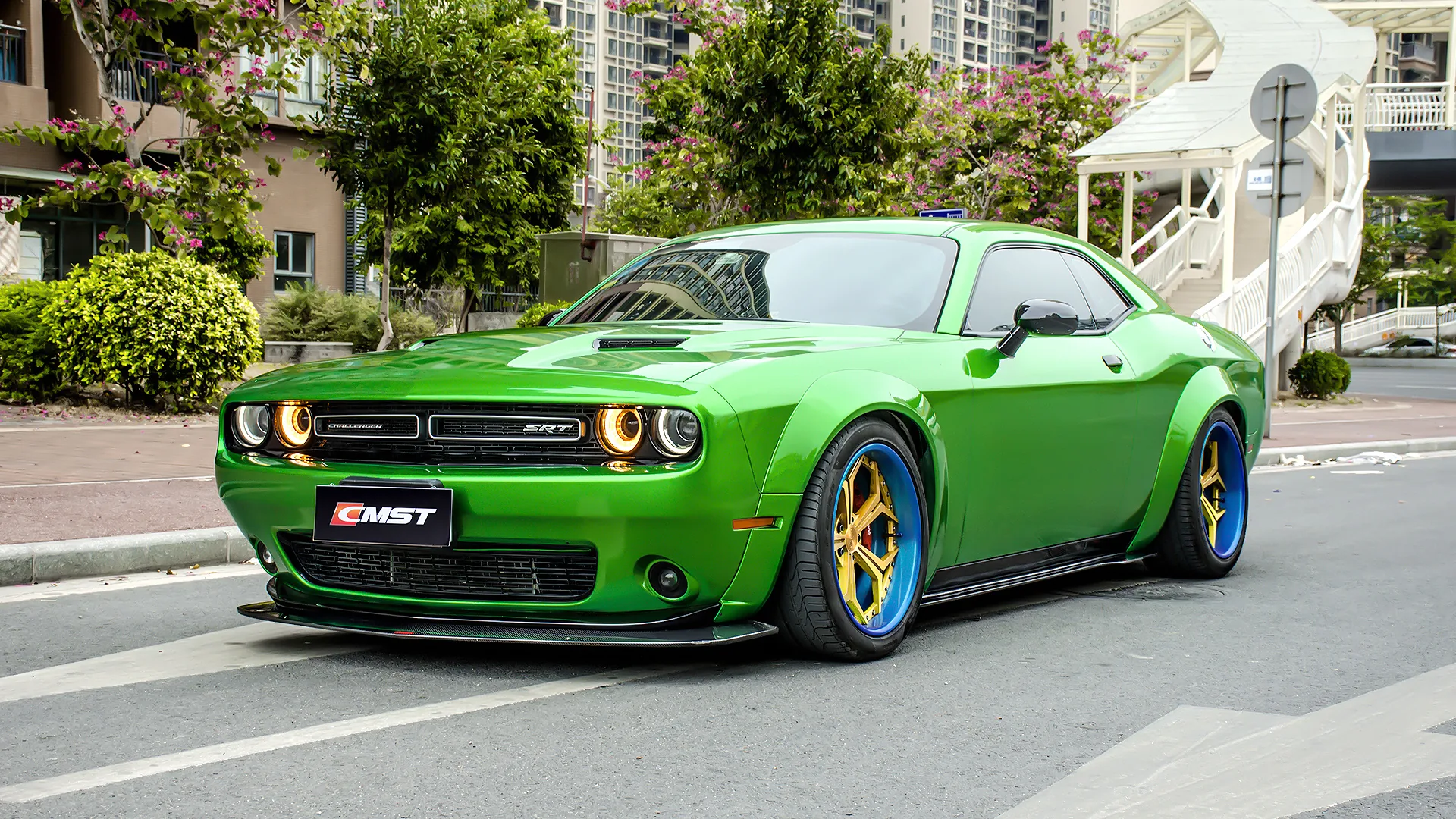
Dodge Challenger Widebody: A Buyer's Guide
A Challenger widebody is either the factory package or a conversion a shop builds. What the factory changed, and what a narrowbody job really takes from you.
BMW M4 Widebody Kits (G82): A Buyer's Guide
Going wide on a G82 M4 is bodywork, not styling. What a widebody kit contains, what gets cut, what it costs, and the four decisions to settle before you order.
Is Widebody Worth It? A Shop's Answer
Is widebody worth it? For one customer yes, and for the next a money pit. What shops should ask at the counter, what the bill really is, and what to say.