
How to Become a CMST Distributor: Requirements and What You Get
What a carbon aero factory actually checks before it appoints a distributor, what the appointment includes, and the terms to settle before you commit stock.
Becoming an auto parts distributor is not a scale question. A shop with one van and a rented unit can be appointed. A warehouse with a million dollars of stock can be turned down. The difference is whether you can do three jobs a factory in Guangdong cannot do from the other side of the world: hold stock in your market, answer fitment on the spot, and stand behind the install when a panel arrives wrong. Everything else in this guide sits on top of that one test.
Two clarifications before we start, because they decide whether the rest is useful to you. This is about becoming an authorized distributor for a manufacturer's line — not about opening an auto parts store, and not about the career called parts specialist. Those are different questions with different answers, and mixing them is how people spend three months on an application that was never going to fit.
What CMST Is Actually Looking For
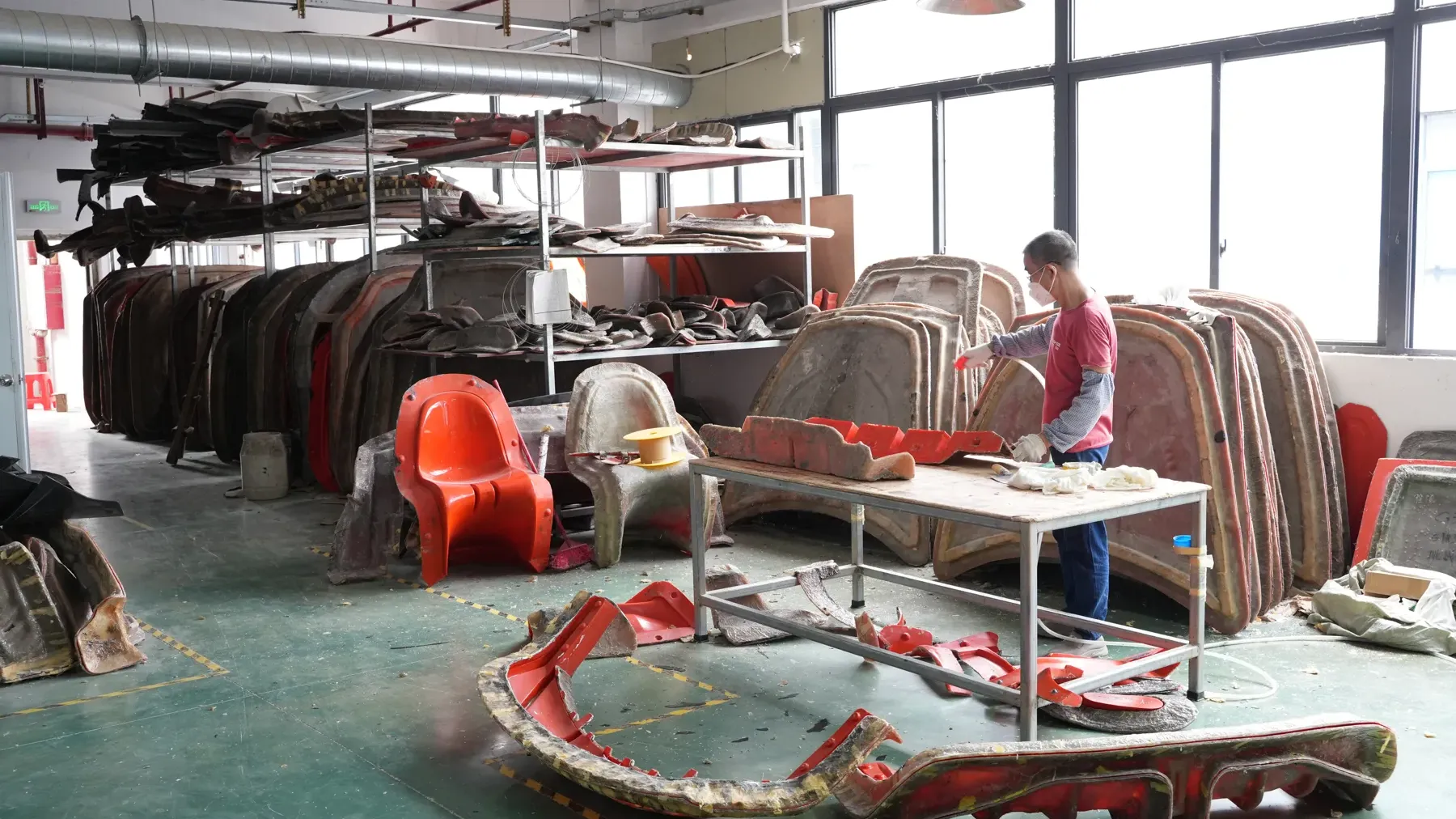
CMST has been in the auto-parts business since 1993, and the manufacturing side as it exists today dates from 2011 — carbon fiber exterior parts cut on its own tooling in Sihui, Guangdong: eight workshops, roughly 7,000 m² of floor, around 15,000 parts a year and more than 10,000 molds accumulated across the product line. That matters for one reason only — a factory with its own molds can tell you what a part fits, and a trading company with a supplier list usually cannot. The US Commercial Service makes the same point from the other side: an overseas distributor is expected to be familiar with local regulations, logistics and after-sales service, because those are the things the exporter cannot do remotely (trade.gov).
So the screening question is not "how much can you order". It is closer to: when a customer walks into your shop with a 2021 BMW 4 Series and a photo from Instagram, can you tell him whether that lip fits, get it in ten days, and deal with him if it does not?
The network today covers seventeen markets and ships to more than eighty countries. That is coverage, not a menu — the dealer's guide to working with a carbon aero factory explains why territory status is settled per application instead of published as a list.
The Requirements: What Becoming an Auto Parts Distributor Actually Takes
The requirements are shorter than most applicants assume, and every line is something that can be checked before you send anything. Search for how to become a distributor and most of what comes back is written for supplements, drinks or clothing — markets where the product is light, the margin is recurring and nobody has to answer a fitment question. Car parts are the opposite: the product is bulky, the sale is one-off, and the technical question arrives after the invoice.
Requirement | What it looks like in practice | What happens without it |
|---|---|---|
A registered trading entity | A company that can import, invoice and hold title to goods in your market | Goods cannot clear customs in your name, and no trade price can be issued |
A market you can name | "Metro Manila and two provinces", not "Southeast Asia" | Territory gets discussed in generalities, and generalities never turn into an appointment |
Stock, or a credible stock plan | Racks, a unit, or a documented plan for the first three months | Every order becomes a one-off quote, and your price never settles |
Someone who can fit and answer | An installer in-house, or a partner shop you trust | Fitment questions reach the factory instead of the customer, and the delay lands on you |
A product mix that matches the catalog | You already sell exterior parts, wheels or body work; a car accessories distributor moving into carbon has a shorter ramp than a shop that has never fitted one | A carbon hood is a hard first item for a shop that has never fitted one |
Working capital for goods plus freight | The order value, the freight, and the duty — not just the order | The order ships and sits, and the second order never happens |
Note what is not on that list. You do not need a container, a showroom, or a five-year business plan. Minimum order is one piece, four for forged wheels, and orders can be mixed across vehicles and categories — so the first order can be built around what you can actually sell rather than what fills a pallet.
The one line that gets argued about is the fourth. A distributor who cannot answer fitment is really a reseller with a warehouse, and the returns land back at the factory gate with freight attached. CMST confirms fitment against the actual car before anything is quoted — the fitment process describes what that means for a part that has never been made before.
How the Application Runs, Step by Step
Five steps, and only the fourth one costs you money.
- Send the five facts. Company, the market you cover, the brands and vehicles you sell most of, whether you hold stock or ship to order, and the account type you are applying for. That is enough to start; a deck is not required.
- Get a market answer. CMST replies within twelve hours. What comes back is either a quote path or an honest "this territory is already covered" — the second answer is worth more than a slow maybe.
- Receive a quote by account type. Distributor, wholesale and retail are three different price bands, and the band depends on material grade and kit content as well as volume.
- Order a sample. Samples can be supplied at a discount; freight on samples is paid by the buyer. This is where you find out whether the surface finish and the fitment are what your market expects.
- Sign the appointment, then stock. Coverage, appointment scope and term are confirmed in writing before either side commits stock. That document is what it means to become an authorized distributor, and it is the only thing worth pointing at later.
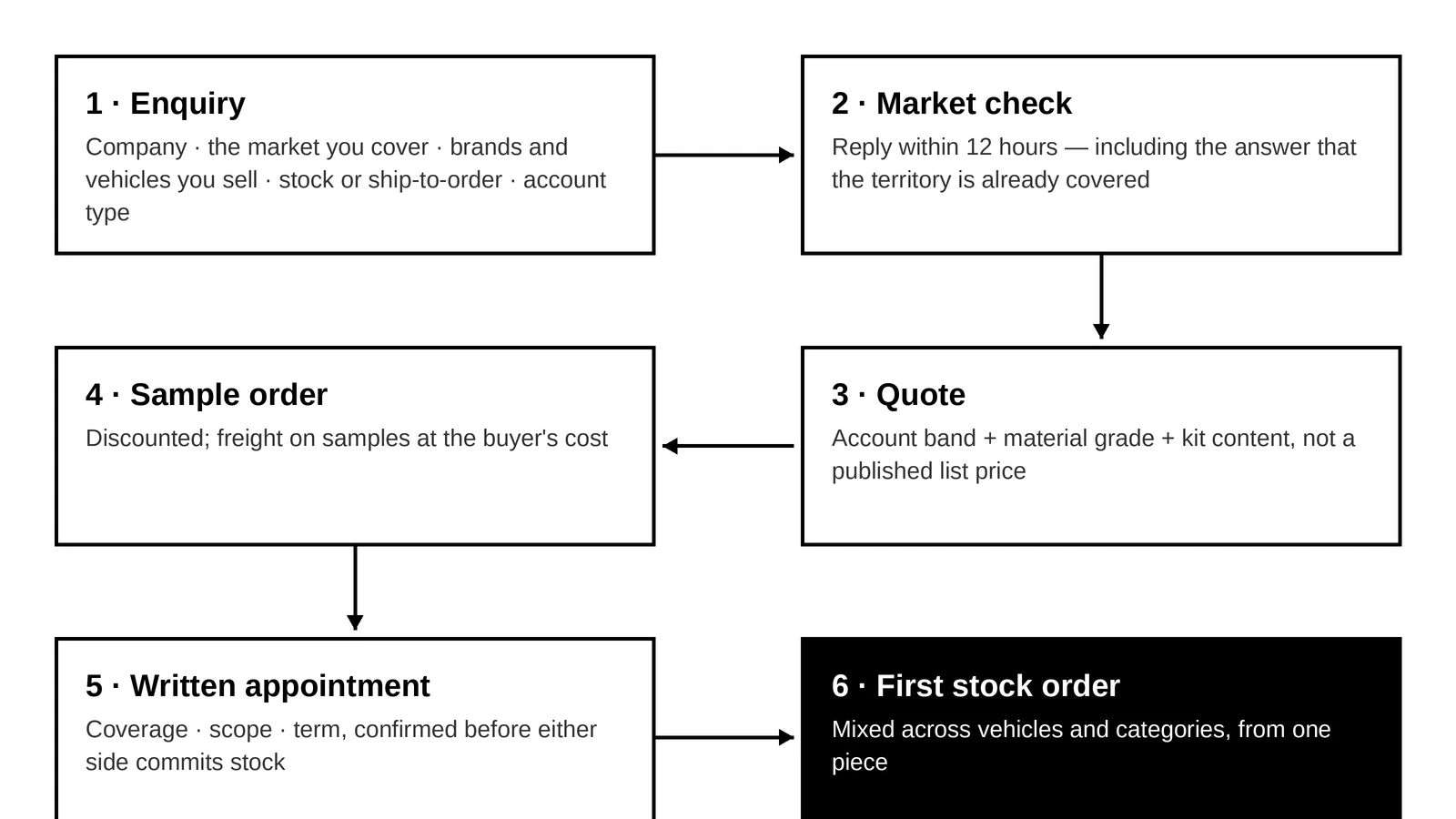
A first order can follow the appointment. It does not have to precede it — that ordering is what makes a small market testable.
The distributor program page carries the same sequence in shorter form, which is useful to send to a partner who wants the one-page version.
What You Get as a Distributor
Four things arrive with the line, and none of them is a logo pack.
A catalog you can sell from. Every kit the factory has tooled, with exploded views, piece counts and the material grade used on each part. For a distributor this is the difference between building product pages from scratch and building them from drawings that already exist — the kit catalog is the same source the factory quotes from.
Fitment answered with evidence, not assurances. Before a mold is cut, a 3D-printed master is fitted to a real car and adjusted. That is why a fitment question gets an answer with a photograph behind it rather than "should be fine". It is also the answer to the question every distributor hears most: what happens if it does not fit.
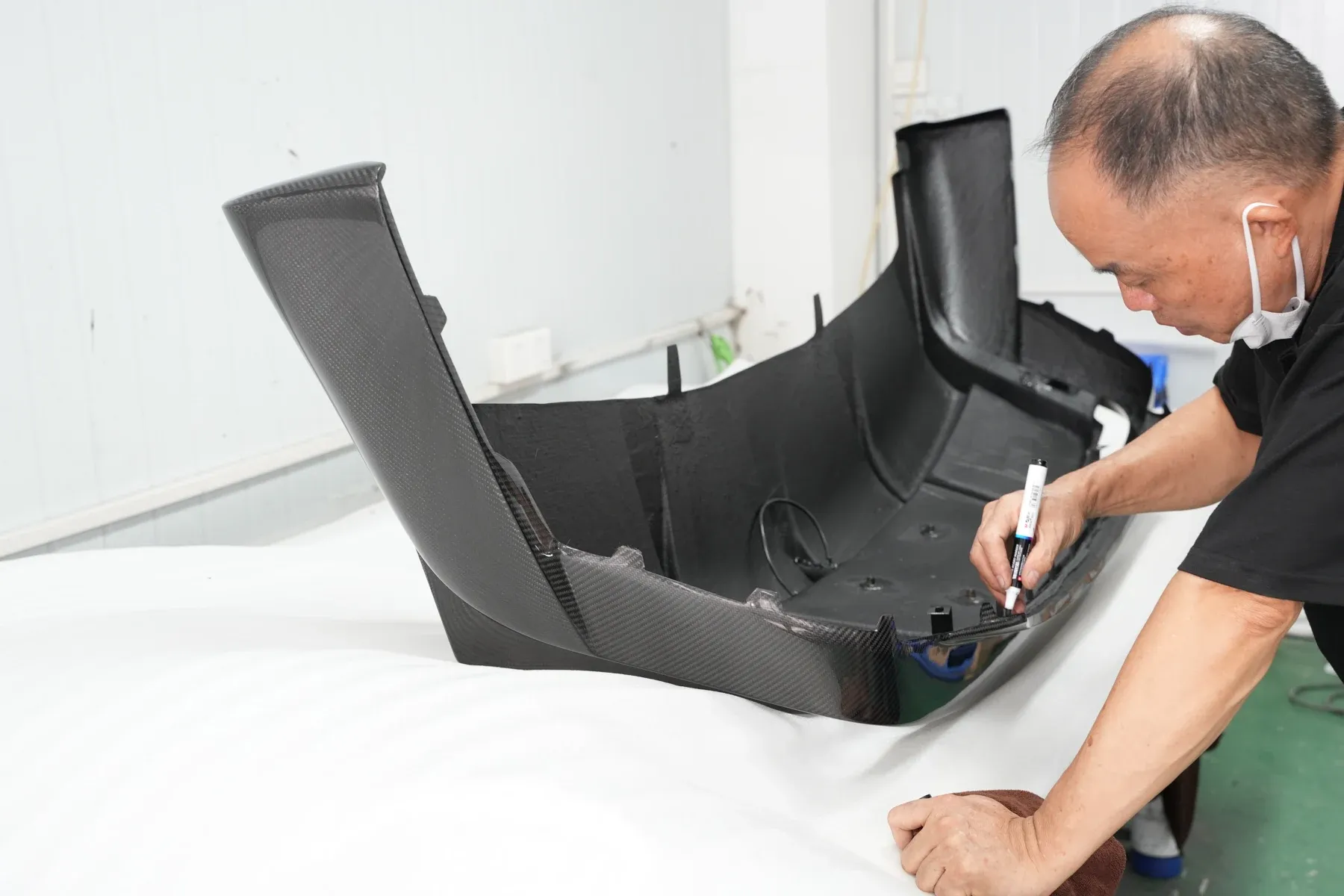
A master part being marked up on the bench. The adjustment happens here, before the mold exists — which is why the answer to a fitment question can carry a photo instead of a promise.
Packaging that proves originality. Kits ship in CMST-branded packaging with labels and a parts pack, so a customer can tell an original from a copy. This is not a marketing detail in markets where counterfeits circulate — it is the thing that protects your margin. The Thai partner Flinestone Auto Parts has been on the line since 2014, and the case record for that account names exactly this: branded packaging and labeling as the answer to both online price erosion and copy parts in the local market.
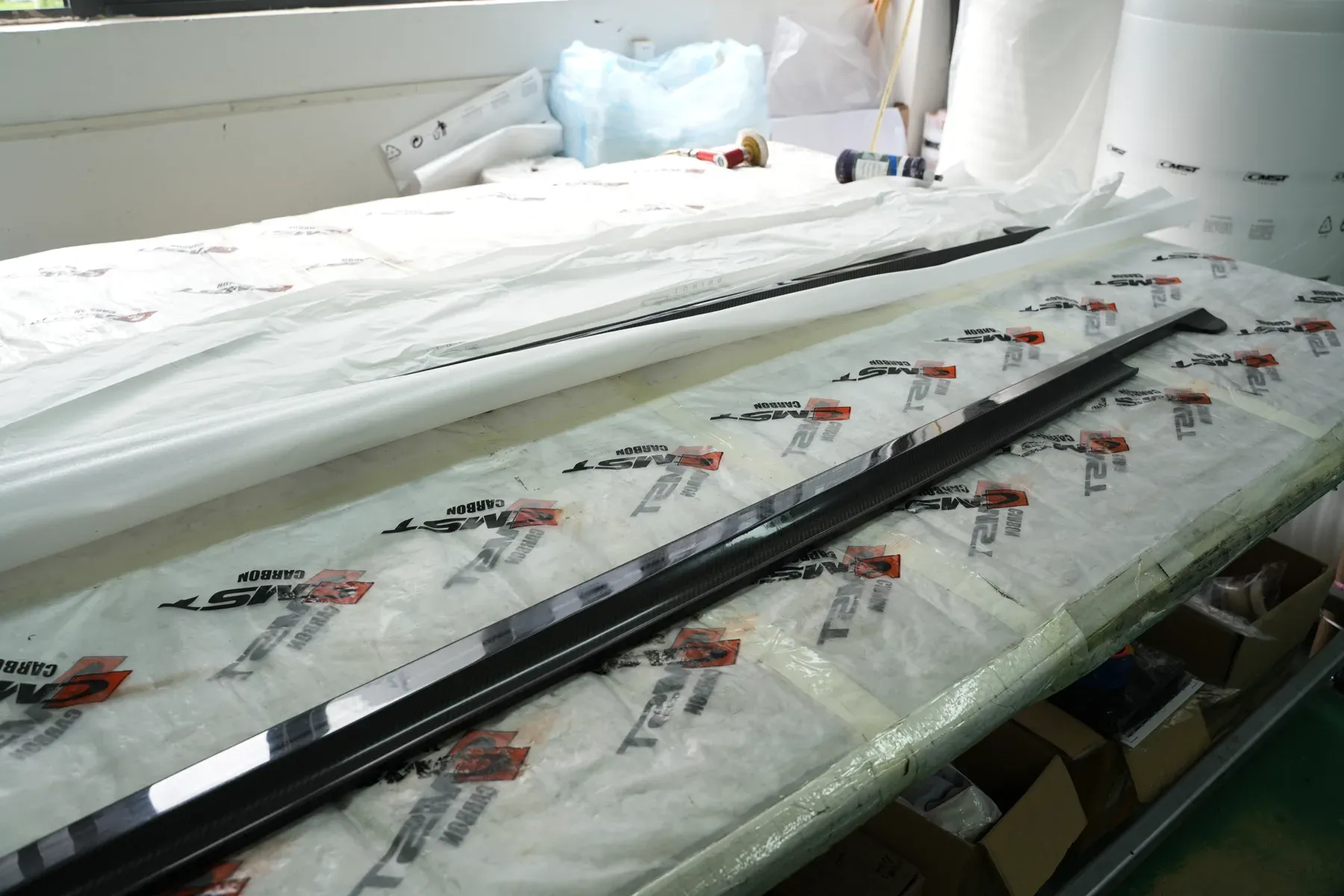
Every kit leaves in branded film, labels and a parts pack — the physical evidence a distributor needs when a customer asks whether a part is genuine.
Install support and a custom route. Fitting instructions and installation videos travel with the kits, which shortens the gap between "sold" and "fitted". And because the factory tooling is in-house, a part your market wants but nobody catalogs can be developed from one piece — the same custom and OEM capability the factory sells under its own name.
The Terms to Settle Before You Sign
Most of what goes wrong between a factory and a distributor goes wrong here, and almost all of it is avoidable by asking one question: what is written down?
Term | What CMST publishes | What to get in writing |
|---|---|---|
Minimum order | One piece; four for wheels; mixed orders across vehicles and categories | Whether the minimum applies per order or per shipment |
Price | Three bands — distributor, wholesale, retail — quoted per account by grade and kit content | Which band, which grades, and what triggers a re-quote |
Samples | Discounted; freight paid by the buyer | The discount rate, and whether it is credited against the first stock order |
Coverage | Agreed before appointment; territory status not published | Scope, term, and what happens if you under-perform on volume |
Payment | Settled on the order | Currency, bank charges, and what a repeat order looks like |
Lead time | 7–20 days standard, confirmed against the production schedule at order confirmation; wheel builds run from 3D design (3 working days) to about 3 weeks single-piece or 5 weeks two-piece, plus a week for plating or 10 working days for carbon wrapping | What happens in peak season, and how far ahead you are told |
Freight terms | Adjusted to what the buyer needs | The Incoterm, and therefore where risk and cost change hands — ex works leaves everything after the factory gate to you (ICC) |
Defects and returns | Handled case by case, agreed at the order | Who inspects, who pays freight, and what a replacement looks like — settled before the first shipment, not after it |
Road-use approval | Not covered by CMST certification in the EU | Whether your market needs type approval at all, before you order |
The road-use row deserves a plain sentence. CMST does not hold European type approval for these parts, and in Germany that approval runs through the Federal Motor Transport Authority's system — an ABE or a parts report is what an inspector asks for (KBA). If your market requires it, that is a conversation to have before an appointment, not after the first container. A factory that tells you this up front is doing you a favor; one that stays quiet is selling you a problem.
What the First Order Should Look Like
The instinct is to buy breadth: one of everything, so the catalog is covered. It is almost always the wrong first move, because breadth is funded by cash you will need in month three.
Buy narrow and deep instead. Pick one platform you already sell — the model your customers actually drive — and order the pieces that make a complete visual change: front lip, side skirts, a diffuser, a spoiler. That is one photograph, one fitment answer and one price conversation instead of six. Then repeat it on the second platform once the first has sold through.
Three practical rules from the orders that work:
- Mix the order, not the message. Mixed orders are allowed across vehicles and categories, so use that to test demand across two platforms rather than to hedge inside one.
- Order wheels in fours. A wheel set is four pieces; a single wheel tells you nothing about fitment or stance.
- Leave room for one custom piece. If your market keeps asking for a part nobody lists, a one-piece custom run is a cheaper test than a container of the wrong thing — the custom and OEM program is built for exactly that conversation.
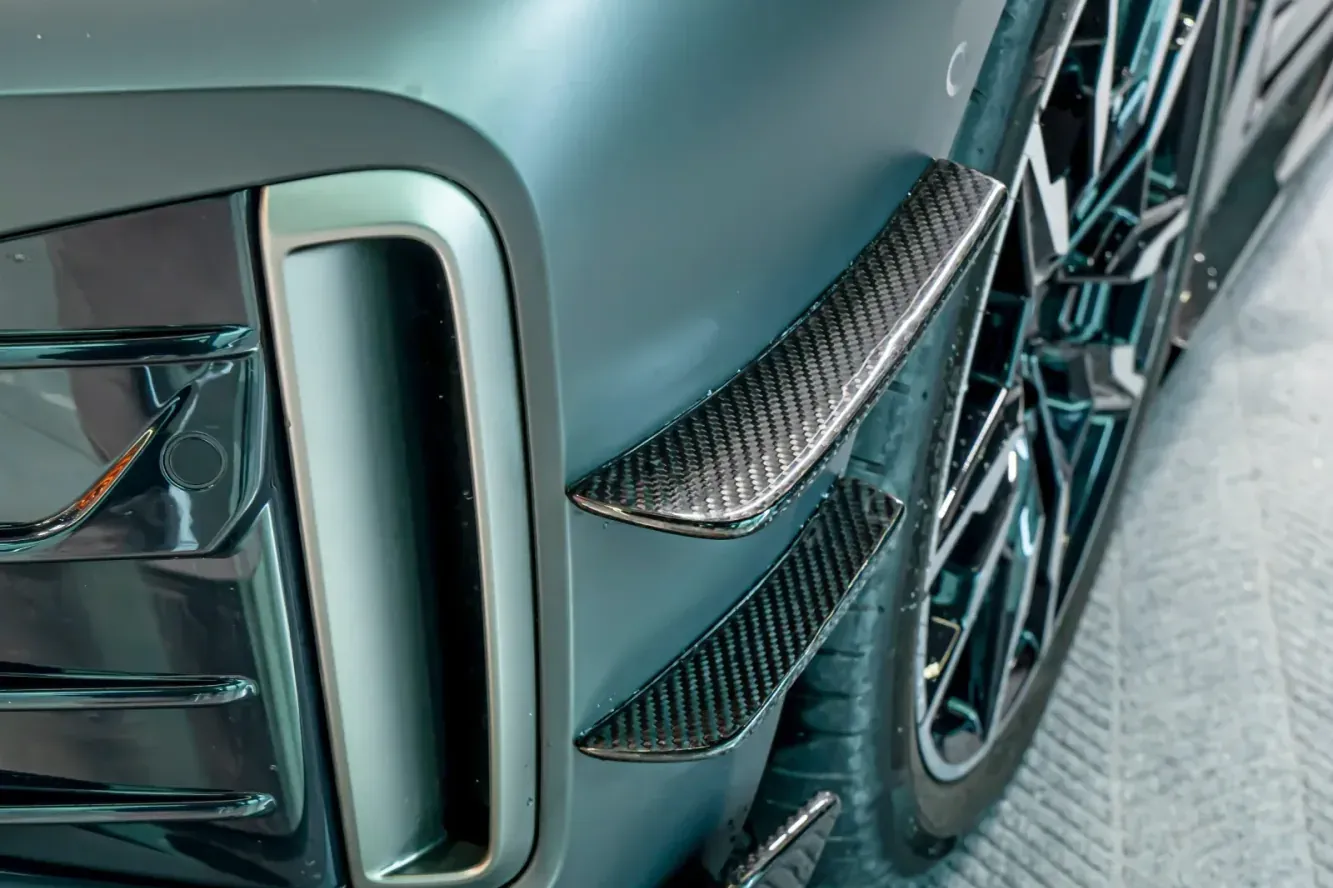
Canards and lip edge on one front corner — two of the pieces a kit adds. The complete set, skirts and diffuser included, is what a first order should be able to photograph and sell.
Why Applications Stall
Five reasons show up again and again, and none of them is about being too small to start.
The market is a continent. "We sell worldwide" reads as "we have not decided". Name two cities, or one country and the channel you sell through.
There is no stock plan. A distributor without stock is a reseller asking for distributor pricing. Even a small unit with a documented first quarter is enough to change the conversation.
Nobody can fit the parts. The factory can answer what a part fits. It cannot answer what your customer's car needs on a Tuesday. Without an installer, the technical questions come back to you late and unpaid.
Exclusivity is the opening ask. Coverage can be part of an appointment, and it is confirmed in writing when the appointment is made. Asking for a territory before a single order is a signal that the volume conversation has not been thought through yet.
Factory price is compared with a distributor's landed price. The quotation is ex works or FOB: the part is made, packed and handed to a forwarder, and freight, duty, insurance and local delivery come after that. Comparing that number with what an auto parts wholesale distributor charges in your market and calling the gap profit is the most expensive arithmetic in this business — what buying direct actually costs you works through the rest of it.
Send These Five Things
Becoming an auto parts distributor starts with five lines, not a business plan. An application that moves is five lines long:
- Your company, and what it is registered to do.
- The market you cover — cities or regions, not continents.
- The brands and vehicles you sell most of.
- Whether you hold stock or ship to order.
- The account type you are applying for.
Send that through the contact form and you get an answer within twelve hours, including when the answer is no. If the fit is right, the next email is a quote; if it is not, you have lost a day rather than a quarter.
Next step
Send the vehicle, the parts you are considering and the finish you want — we reply with fitment notes and a quote.
Send an inquiryKeep reading
Related notes
Supplier vs Manufacturer: Who Owns the Mold?
A trading company can quote like a factory. Five checks - mold ownership, fitment answers, custom programs, remedies, cost - and where CMST stands on each.
Buying Direct From a Manufacturer: The Catch
Buying direct from a manufacturer swaps a distributor's margin for its work: stock, fitment answers, support. What a dealer takes on, and how to test it.

Carbon Fiber Quality Control, Explained
Carbon parts fail at the surface, at the seam, or in year two. What a factory should check, what you can verify yourself, and the records worth demanding.