
Why Buy Direct From a Manufacturer? What the Dealer Takes On
Buying direct from a manufacturer swaps a distributor's margin for its work: stock, fitment answers, support. What a dealer takes on, and how to test it.
Buying direct from a manufacturer does not delete a layer of profit — it deletes a layer of work. The distributor's margin pays for stock you can collect today, credit you did not have to fund, and someone local to blame when a panel will not fit. Cut the layer out and those jobs do not vanish. They move to you. Whether that is a good trade depends on one thing: which of those jobs you are already set up to do.
What Buying Direct From a Manufacturer Actually Removes
Four parties stand between a mold in Guangdong and a spoiler on a customer's car, and each is paid for a job rather than for the goods.
A factory makes the part and, if it is a real one, owns the tooling that shapes it. A trading company consolidates: it buys from several factories, handles the paperwork, and sells you one shipment instead of five. An importer or distributor buys in volume, holds the stock in your market, extends payment terms, and takes the first call when something arrives wrong. A dealer or tuning shop — you — holds a smaller stock, fits the parts, and owns the local relationship.
Layer | The job it is actually paid for | What you take on if this layer goes |
|---|---|---|
Factory | Making the part, owning the mold, controlling the process | You cannot skip it — the only question is whether you can reach it directly |
Trading company | Consolidation, export documents, one invoice for several factories | Several orders, each with its own minimum and its own shipping date |
Importer / distributor | Volume buying, local stock, credit terms, first-line technical answers | Funding the stock yourself, and answering the fitment questions yourself |
Dealer / tuning shop | Fitting, local trust, small quantities for walk-in customers | Nothing — this is the layer you already are |
Rows two and three are the layers a direct account removes, and neither of them is a parasite: one consolidates, the other carries stock and credit. Remove them and the parts still arrive — but the consolidating and the carrying become your own work, unpaid. Rows one and four stay either way: somebody still makes the part, and somebody still fits it. What comes after this decision — terms, the first order, the support that has to travel with a direct account — is worked through in the dealer's guide to working with a factory.
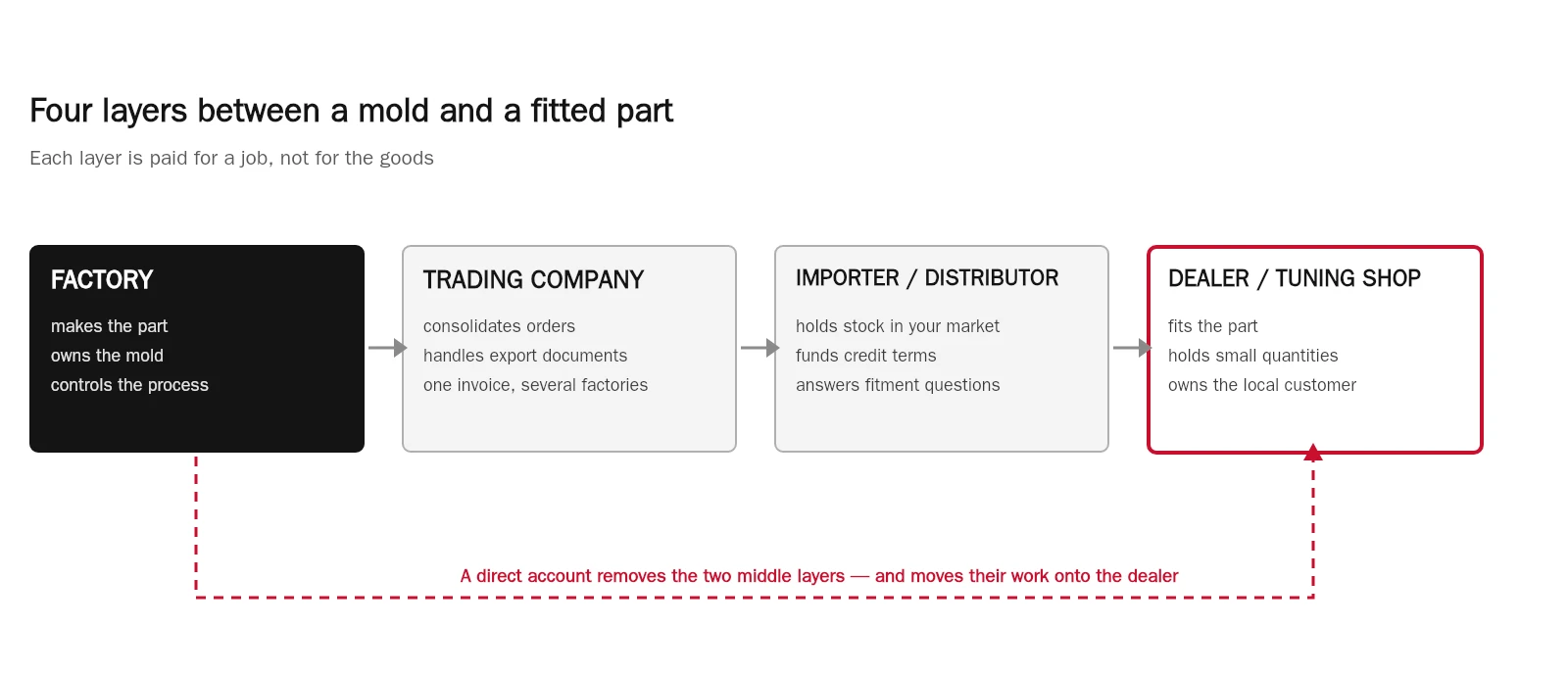
Remove the two middle layers and the parts still arrive — but the stock, the credit and the local answers now come from you.
Where the Money Goes Between the Factory Gate and Your Shelf
The number on a factory quotation is not the number you will be competing against. It is usually an ex-works or FOB price: the part is made, packed and handed to a forwarder, and everything after that is yours to arrange. The first error is comparing that number with a distributor's landed price and calling the gap a saving.
Between that price and a part on your shelf, five costs accumulate: ocean freight and insurance; duty and clearance in your market; warehouse space you pay for whether or not the part sells this month; the working capital tied up in stock that used to be the distributor's problem; and the person who answers the phone when a customer says the gap on the left fender is wrong.
None of that makes direct supply a bad deal. It makes the comparison the wrong one. Thomasnet's procurement guide puts the trade-off plainly: buying direct tends to give the lower unit cost and the greater control, while distributors exist because they buy in bulk, hold stock and sell in smaller quantities (Thomasnet). The invoice falls, the responsibility rises, and the two move together.
So the first question to ask any factory is not what the price is, but what it includes. The same part quoted ex-works, FOB and DDP is three different numbers.
The quote says | The factory pays for | You pay for |
|---|---|---|
Ex-works (EXW) | Making and packing the part | Export clearance, main freight, insurance, duty, delivery |
FOB | Making, packing, export clearance, loading at origin port | Main freight, insurance, duty, delivery from destination port |
DDP | Everything to the named address, duty included | Nothing beyond the invoice — and you cannot see what the freight actually cost |
The same part can be quoted three ways and the three numbers are not comparable. Ask which term the quote uses before you put it in a spreadsheet.
Supplier, Manufacturer, Trading Company: Three Different Businesses
The words get used interchangeably in sourcing conversations, and they should not be. Three questions separate them, and none of them requires an audit.
Can they change the mold? A manufacturer with its own tooling can adjust a mounting point, run a variant for a model year, or replace a damaged mold. A trading company has to ask someone else, and the answer arrives as a lead time rather than a decision.
Can they name the grade? Not "carbon fiber" — which grade, made which way, with which finish out of the mold. A supplier who cannot describe the difference between a prepreg part cured under heat and pressure and a wet-layup part is not selling you a specification. It is selling you a photograph.
Who walks to the workshop when something is wrong? If the answer is "our QC team will send a report", ask who employs the QC team. The distance between the person answering your email and the person who can stop a production run is the real measure of how direct your relationship is.
A trading company is not a dishonest business. Its product is convenience, and for a dealer ordering four unrelated items a month it can be the right product. It becomes the wrong product the moment you need something changed, explained or replaced — which, in exterior parts, is most weeks.
If you want to see what the difference looks like in practice, how a kit goes from sketch to mold walks the process from scan to finished panel, including the stages a reseller usually cannot describe.

Laying up by hand at a bench. A reseller can quote this work; only the factory can show you who is doing it and how the surface is checked afterwards.
What Only the Factory Can Show You
Four things separate a factory from a company that forwards your email to one. Each is checkable before you place an order, and none of them is a certificate.
The molds are in the building. Tooling is the asset that makes a parts range real. If the molds are stored on site, a variant is a conversation; if they are at a subcontractor, it is a project. In CMST's own workshop the mold store and the layup floor sit in the same building, which is why a mounting-point change can be discussed and cut rather than quoted and scheduled.
Something was trial-fitted before the mold was cut. The most expensive failure in exterior parts is not a bad finish, it is a part that does not fit — and it is expensive on the other side of an ocean, where the return freight can exceed the part. Our process prints a master, trial-fits it to a real car, finalises that trial-fit master, and only then cuts the mold; the same sequence — printed master, trial fit, master finalised, mold cut — is set out in how the trial fit is done before tooling. Ask any factory what happens between the drawing and the mold. The answer tells you whether they have ever paid for a bad fit.
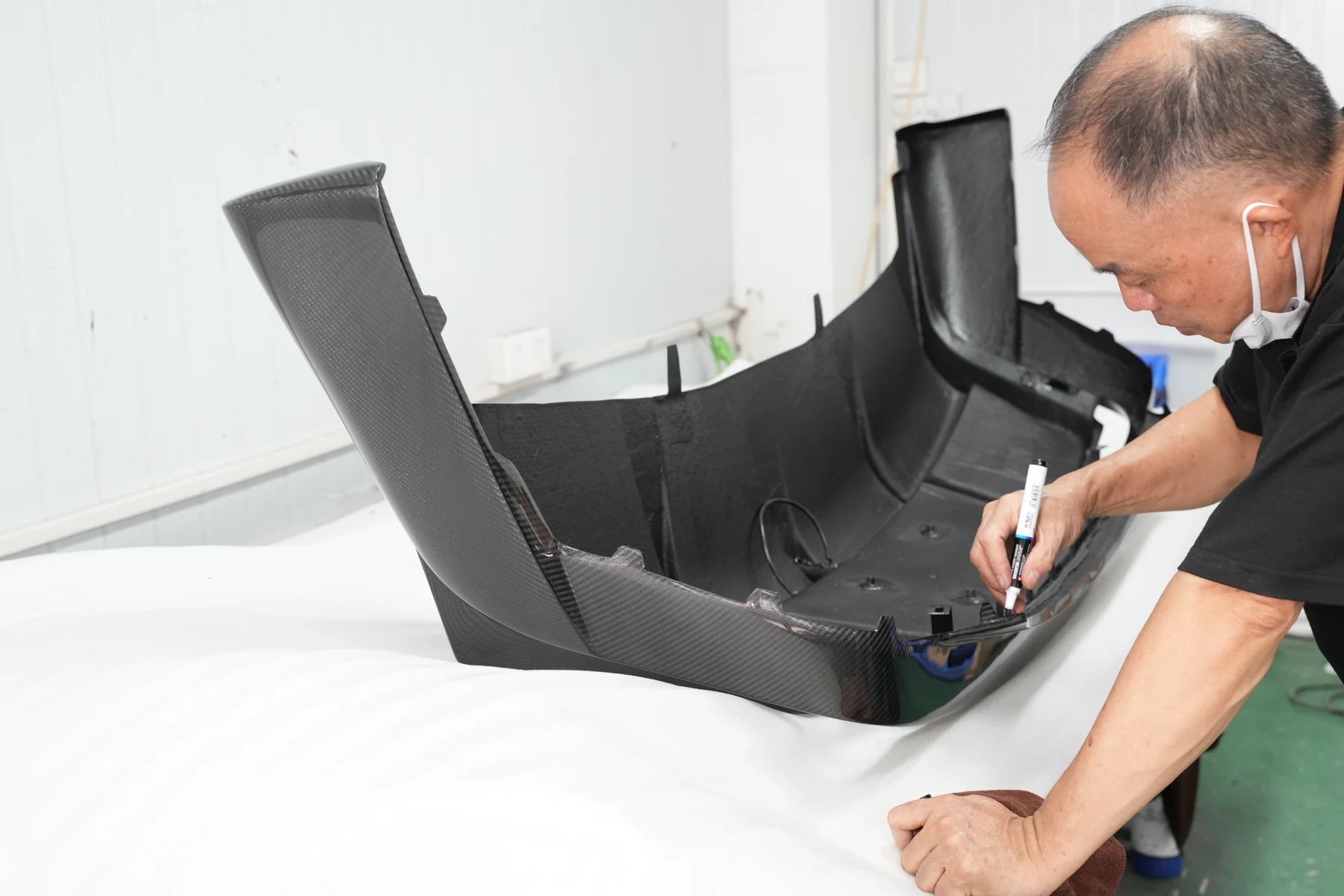
Marking mounting points on a molded carbon part — the twill weave and gloss show it has already come out of a mold. The trial fit that decides whether that mold was right happens earlier, on the printed master.
The grade is a specification, not an adjective. Carbon fiber is a fiber in a resin matrix, and the fiber is only half of what you are buying. The fiber itself starts as a precursor that is heated and stretched until it becomes a stiff, strong filament (CompositesWorld on high-performance fibers). Whether a part is dry carbon, high-temperature vacuum carbon, FRP, ABS or PP changes the weight, the finish, the paint step and the price — and glass-fiber parts follow their own process rules, with E-glass the grade most of them are built from (CompositesWorld on glass fibers). A factory that quotes one grade for every part is either over-specifying the cheap parts or under-specifying the expensive ones.
The surface standard is stated before you find it. "Good quality" is not a specification. A factory that can tell you what it rejects — pits, whitening, waviness, wrinkling, print-through — has a standard you can hold it to. Ours is written down, and those five words are rejects, not negotiables.
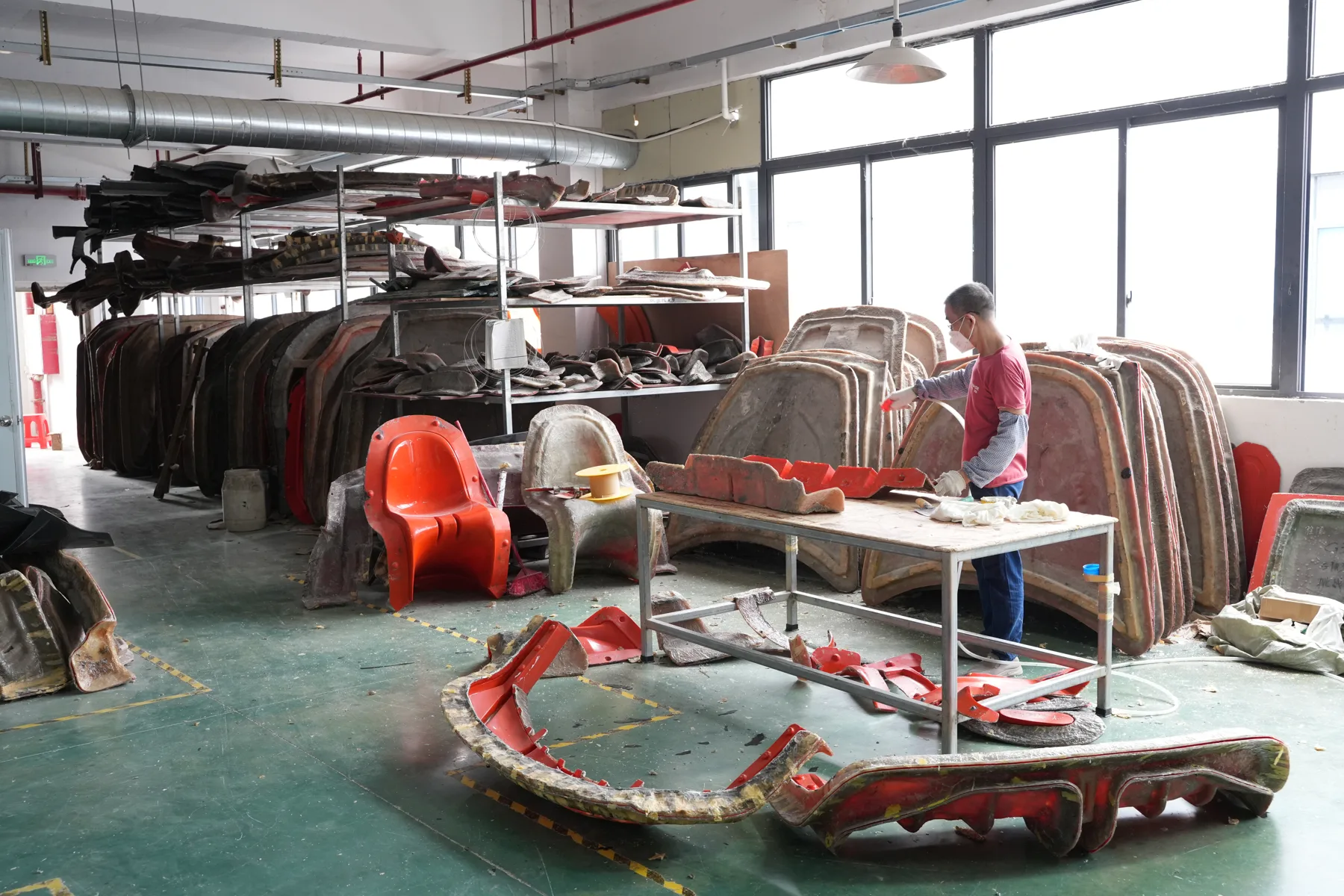
Molds on the racks. Owning the tooling is what turns "we can make that" into "we can change that".
What Direct Supply Costs You
Two different things get called cost in this decision. The section above counted what stacks onto the invoice; this one counts the jobs that stop being someone else's. Five of them land on your desk, and each has a way to handle it.
1. You become the warehouse. A minimum order of one piece is a genuine advantage — it lets you test a new platform without betting a container on it — but it is not the same as needing no stock. A customer who wants a lip this week does not care that your supplier will ship in seven to twenty days. Either you hold the fast movers or you lose the urgent sale to whoever does.
2. Fitment risk moves to your counter. The distributor's technical line used to absorb "will this fit my 2021 model". Now it is your counter staff, your message thread, and your reputation. That is manageable if you sell a narrow range of platforms and can talk about the five material grades without reading off a sheet; it is a real cost if you sell twenty.
3. You are the first line of after-sales. When a part arrives with a defect, the customer phones you, not the factory. What happens next depends on terms you agreed before the order: who inspects, who pays return freight, whether a replacement is resent or credited. Get that in writing. Verbal goodwill does not survive a bad shipment.
4. One factory is not a catalog. A carbon aero manufacturer may cover 65 models and still not make the exhaust or the coilovers your customer wants in the same order. Direct supply narrows your range unless you stack several factories — and stacking factories rebuilds, by hand, the consolidation job the trading company was doing for you.
5. The paperwork is yours. Incoterms, customs classification, duty, and whichever approval your market requires for exterior parts. Homologation rules differ by country, and a part that is legal in one market may not be legal in the next. None of this is difficult; all of it is yours, and none of it is included in a factory quotation.
The honest version of the direct-supply case is not "cut out the middleman and keep his margin". It is "take over his work and keep the margin as payment for doing it". If you skip the work and keep the margin anyway, the margin is borrowed, and it gets called in on the first bad shipment.
A Fit Test: When Direct Wins, and When the Distributor Does
Six questions, answered honestly, will place most dealers on one side or the other. This is the dealer-versus-distributor question in its practical form — not which channel is better, but which one your operation is shaped for.
The question | Direct supply suits you if… | The distributor suits you if… |
|---|---|---|
Order size and rhythm | You order often enough to fill a shipment, or you can consolidate | You need two pieces now and four next month |
Storage | You have racking and can carry fast movers | Your stock room is a shelf behind the counter |
Fitting capability | You fit in-house and can diagnose a bad gap | You resell and rely on someone else's technical line |
Platform coverage | You specialize in a handful of models | You sell whatever walks in |
Market compliance | You already know what your country requires | You would rather buy from someone who has cleared it |
Cash | You can fund stock and wait for it to turn | You would rather pay more per unit and keep the cash |
A dealer who answers "direct" to four of the six and "distributor" to two is not a confused dealer. That is the normal shape of a mixed model: direct supply for the models you specialize in, a distributor for the long tail, and no ideology about either.
The Questions to Ask Before You Commit
Take this list to the first call. A factory that answers all eight without hesitating is a factory worth a sample order; one that deflects three of them is telling you something useful.
- Who owns the mold, and where is it kept?
- What happens between the drawing and the tooling — is there a trial fit on a real car?
- Which grade will this part be made in, written on the quotation?
- Is the lead time a stock figure or a production slot, and when is it confirmed? A quote of seven to twenty days should come with the date it was confirmed against.
- How is the part packed, and is it labeled so a customer can tell it from a copy?
- What are the sample terms, and who pays sample freight?
- Which Incoterm are you quoting, and can I book an inspection before shipment?
- What is agreed in writing on territory — and does the factory offer any price protection?
If the answers hold up, the next step is a sample rather than a container. Start with the models you sell most of — the full kit catalog shows the model and grade spread — and treat the first order as a test of the relationship rather than a bet on it. When you are ready to talk terms rather than parts, apply to distribute and say which market you cover.
FAQ
Is buying direct from a manufacturer always cheaper?
No. On the invoice it is cheaper than a distributor's delivered price. Per part you actually sell, it often is not — you absorb freight, duty, storage and the time spent answering fitment questions. Compare landed cost plus your own handling against the distributor's delivered price: on fast movers direct usually wins, on slow movers the distributor often does.
Can a small shop buy direct if the minimum order is one piece?
Often yes, and a minimum of one piece is worth asking about, because it lets you test a platform without committing to a container. What it does not do is remove the freight maths: one piece shipped alone can cost more in freight than the part costs to make, so most small shops still consolidate several lines before ordering.
Who handles warranty claims and fitment problems after a direct order?
Whoever agreed to. That is not a dodge — it is the term most often left out of a direct-supply conversation. Before the first order, settle who inspects a defective part, who pays return freight, and whether a replacement is resent or credited. A factory that will not put that in writing is telling you how the first claim will go.
Do I have to handle importing myself?
Not necessarily, but somebody does — and the practical question is who. The term on the quotation decides who is the importer of record in your market, who books the main carriage, and whose name sits on the customs entry if the shipment is stopped. Under ex-works, both the booking and the entry are yours; under FOB, the factory clears export and loads, and the carriage is still yours; under a delivered term, the factory arranges the whole move and you cannot see what the freight actually cost. Ask which term the quote uses, then ask who files the entry — without those two answers, a comparison against a distributor's delivered price is a comparison of different things.
Is it better to buy direct from a manufacturer or through a marketplace?
They answer different questions. A marketplace answers "who has this in stock and can ship it this week"; a manufacturer answers "what is this made of, will it fit, and can it be changed". For one urgent part, a marketplace listing is usually the right answer. For a range you intend to support, reorder and stand behind, a listing cannot give you the mold, the trial fit or the channel terms.
Next step
Send the vehicle, the parts you are considering and the finish you want — we reply with fitment notes and a quote.
Send an inquiryKeep reading
Related notes

How Are Body Kits Made? From 3D Scan to Mold
A custom body kit is a fit problem before it is a design problem. Eight stages, from scanning the car to cutting the mold, decide whether it fits at all.

BMW M4 Widebody Kits (G82): A Buyer's Guide
Going wide on a G82 M4 is bodywork, not styling. What a widebody kit contains, what gets cut, what it costs, and the four decisions to settle before you order.

What Is a Widebody Kit? A Beginner's Guide
A widebody kit widens a car's arches so wider wheels and tires will fit. Here's what is in one, what gets cut, and how to tell if a wide build suits your car.