
Spoiler vs Wing: What's the Difference and Which One Do You Need?
A spoiler vs wing comparison comes down to what the part is: an airfoil that makes downforce of its own, or bodywork that manages air the body already sheds.
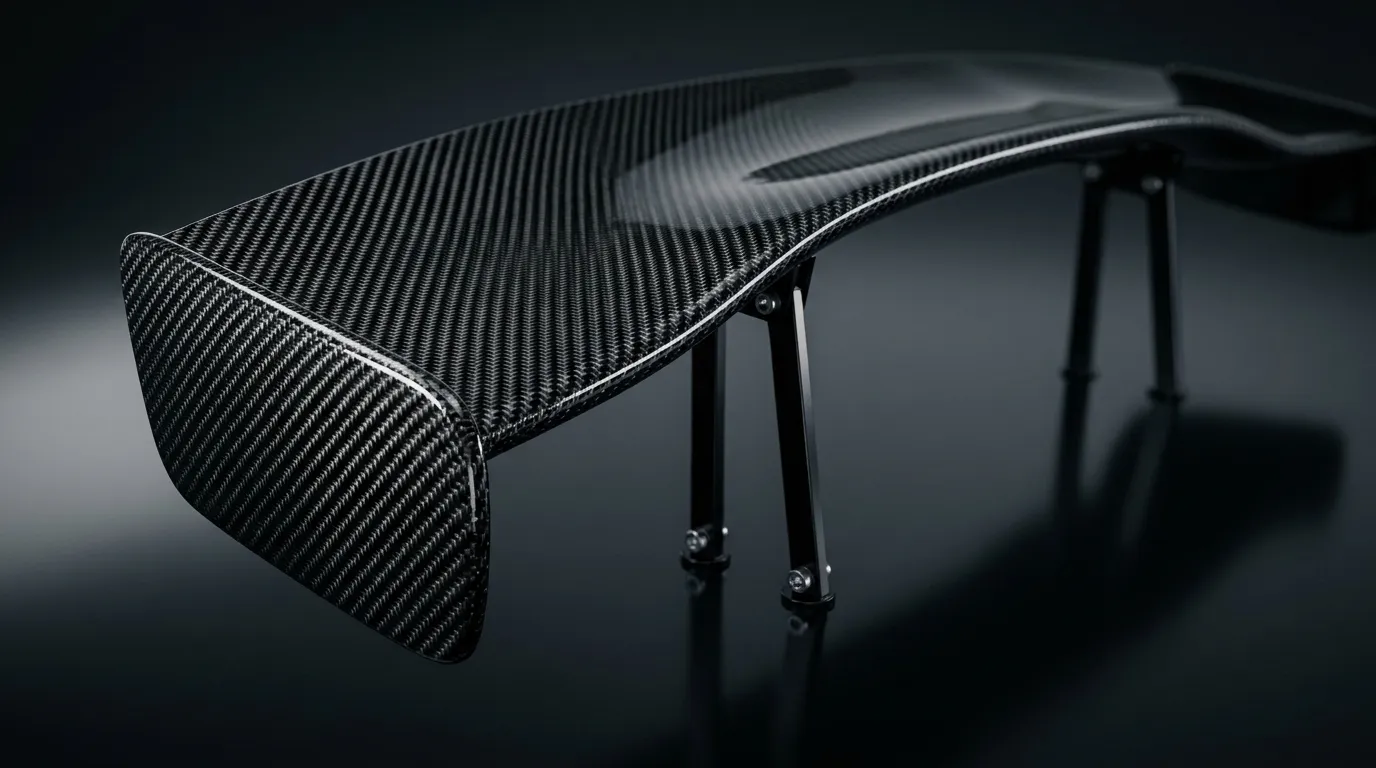
A spoiler and a wing do different jobs, and the difference is not the shape — it is whether the part is part of the body or an airfoil of its own. A spoiler is bodywork that sits on the trunk lid or the roof and spoils the air leaving the car, so the rear axle stops generating lift. A wing stands off the body on struts, works as an inverted airfoil, and creates downforce of its own. That single difference — a surface of the body, or an airfoil that makes its own load — decides what each part can do, what it costs you in drag, and whether your car is ready for it. The rest of this article is about making that call for a specific car rather than in the abstract.
Spoiler vs Wing: The One Difference That Decides Everything
Look at the part from behind the car and follow its surfaces. A spoiler continues the body's surface and manages air that is already leaving it. A wing is a separate airfoil held off the body that makes load of its own.
The gap underneath is not the test. Pedestal spoilers stand a few centimeters off the trunk lid and air passes under them, yet they are still spoilers: the element is a blade shaping the flow over the deck, not an airfoil carrying load of its own.
The wing vs spoiler distinction sounds like a technicality until you follow the airflow. A spoiler works on the air that is already leaving the car's surface — it changes how that air separates, and separation is what turns a smooth roofline into a low-pressure pocket that lifts the rear of the car. A wing does not work through the body at all: it is a separate lifting surface with its own upper and lower faces, and it needs good air arriving at both of them. The difference is where the load comes from, not whether the body matters.
What counts as a spoiler
The family is wider than most people expect, because almost anything that manages separation on a body surface is doing a spoiler's job:
- Lip spoiler — a low blade along the trailing edge of the trunk lid or hatch. The least intrusive option, and the one most often fitted at the factory.
- Ducktail — a taller, upswept lip that turns the end of the deck into a ramp. The name comes from a duck's tail; the 1973 Porsche 911 Carrera RS 2.7 is the car that made it famous.
- Trunk spoiler — the general term for a trunk-lid mounted piece, including pedestal-style spoilers that sit a few centimeters up on short pedestals. The gap underneath is what gets them called wings.
- Roof spoiler — mounted at the top of the tailgate or roof, aimed at the airflow over the rear glass rather than at the trunk lid.
All of these are attached to a body surface. Our own body-mounted carbon spoilers are built this way: bonded or bolted to the trunk lid, with the load spread along the panel edge rather than concentrated into two points.
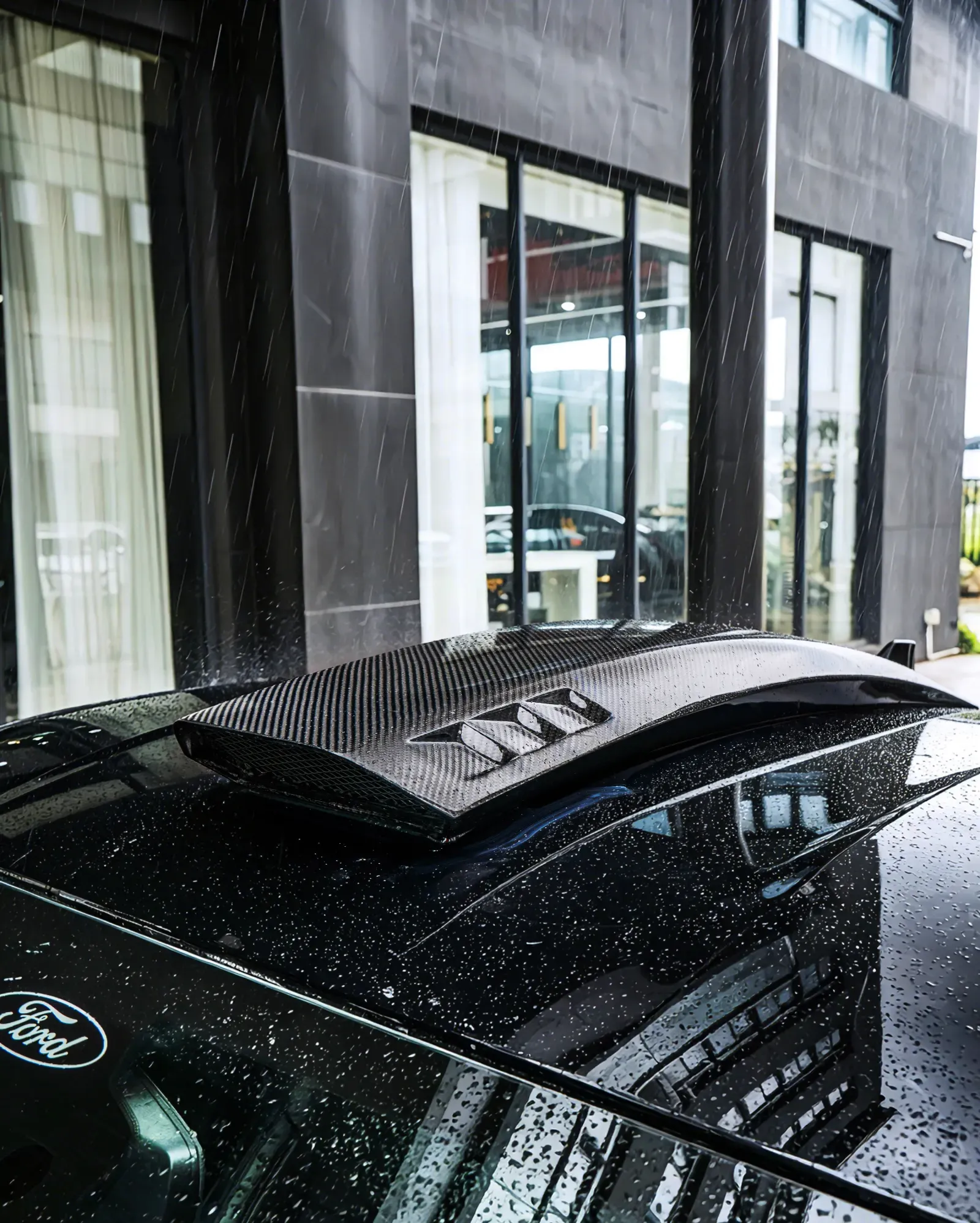
A roof spoiler is still a spoiler: it changes the air leaving the top of the car rather than adding a lifting surface of its own. The car pictured is an OEM hatchback, included to show where a roof spoiler sits.
What counts as a wing
A wing is a separate element held away from the body:
- GT wing — the classic flat or mildly curved element on two uprights, usually with an adjustable angle.
- Swan neck wing — the element is hung from above by brackets that curve over the leading edge, so the underside stays clean. It is the layout used on the current Porsche 911 GT3 and on GT racing cars.
- Pedestal or strut-mounted wing — the general case, mounted either to the trunk lid or, on serious track cars, through it to the chassis.
Our strut-mounted rear wings follow the same split, in GT and swan-neck layouts, with trunk-lid or chassis mounting. The distinction matters commercially as well as aerodynamically: a wing is a structure, and structures have to be mounted to something that can take the load.
One language trap before we go further. In British English a wing can also mean a fender, and the boot is the trunk, so an older UK forum thread about "wings" may be about wheel arches. Check whether the poster means the part on the rear deck or the panel over the wheel.
What a Spoiler Actually Does to the Air
Air traveling over the roof of a car arrives at the back with a job half done. On a sedan or a fastback it leaves the body at the point where the rear glass meets the deck, and the way it leaves determines whether a low-pressure region forms behind the car. That region pulls upward on the rear of the body — lift — and lift is what makes a rear axle feel vague at speed.
A spoiler interrupts that transition. By putting an edge or a ramp at the separation point, it changes where and how the flow leaves the body, which raises the pressure acting on the rear deck and reduces the lift the shape was generating. It is managing air the car has already moved, not adding a new lifting surface.
The part that surprises people: a spoiler can reduce drag at the same time as it reduces lift. Porsche's own account of the 911 Carrera RS 2.7 is the cleanest example on record. The car, developed in 1972, was the first series-production model with front and rear spoilers, and the ducktail was refined in the wind tunnel to cut lift at the rear axle. Porsche reports that the effect came without any increase in drag — top speed went up by 2.8 mph, or 4.5 km/h — and that the engineers kept raising the tear-off edge millimeter by millimeter until they found the point where drag started climbing again (Porsche Newsroom, 2022).
That is the honest description of what a spoiler does: it mainly removes lift, and it can take drag with it. What it does not do is generate large downforce of its own. If a product page promises a ducktail that "adds 60 kg of downforce", be skeptical — the geometry is not doing that, and nobody publishing such a figure tends to say at what speed it was measured.
Why removing lift is worth money at all comes down to grip. A tire makes its grip from the load pressing it into the road, so an axle that was being lifted has less of it than the same axle with that lift taken away. A spoiler does not add load the way a wing does, but it stops the car from giving load away.
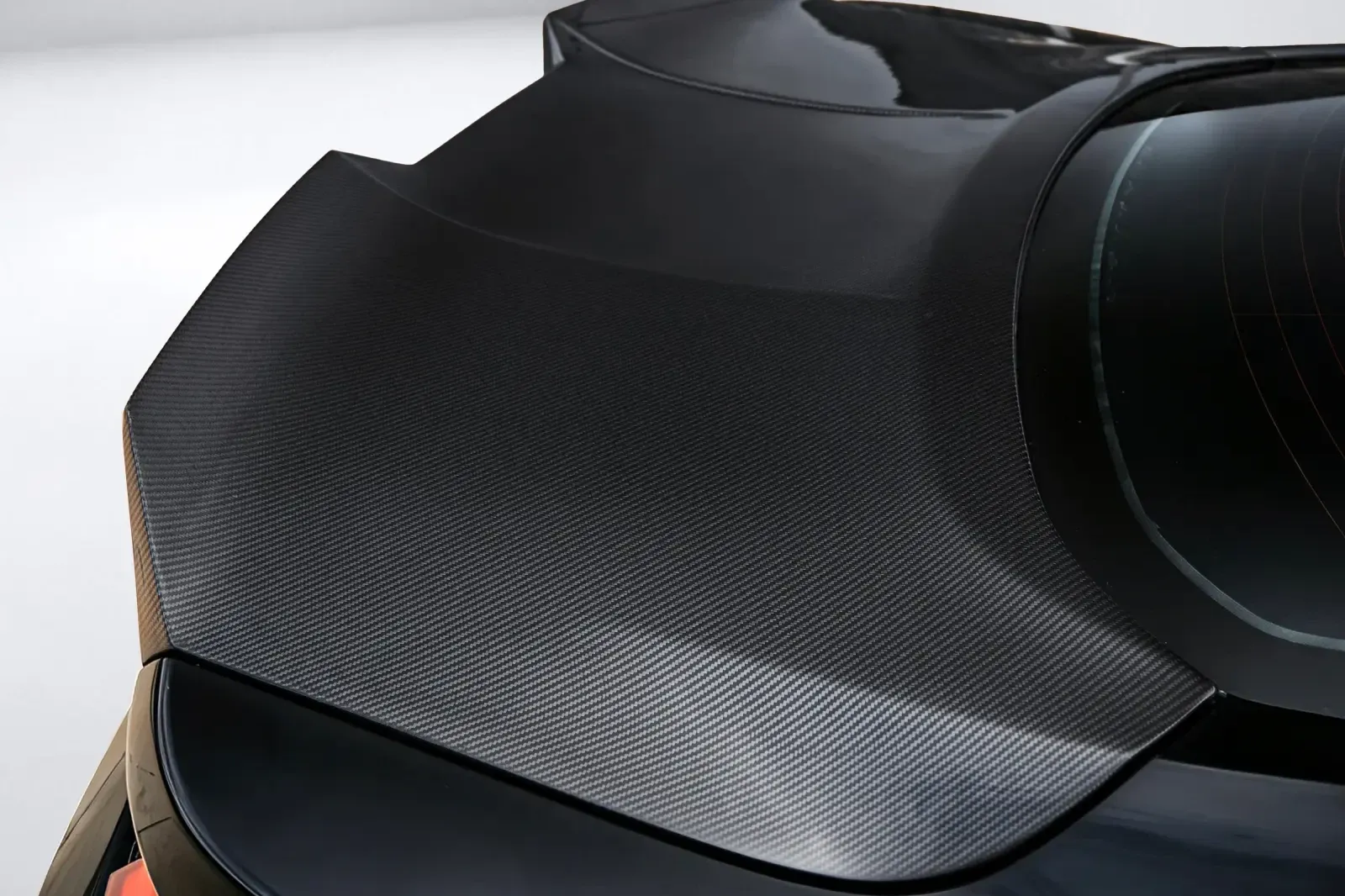
What a spoiler looks like from the angle that matters: the part continues the body's surface, and there is no airfoil standing off it.
What a Wing Does — and Why Plenty of Aftermarket Wings Underperform
A wing is an airfoil turned upside down. Air accelerates over the lower surface, pressure drops there, and the difference between the two faces produces a force pushing the element — and through the struts, the car — toward the road. That force rises with the square of speed: double the speed and you have four times the downforce. The same scaling applies to a spoiler's lift reduction, so the scaling law is not the difference between them; the difference is that a spoiler takes away lift the body already had, while a wing adds a lifting surface of its own. This is also why wing profiles get modeled in detail rather than eyeballed — NASA's aerodynamic optimization of an IndyCar rear wing, for instance, reports that eliminating the separated region at the trailing edge of the flap raised downforce by about 6 percent (NASA FUN3D).
Two conditions decide whether that force actually arrives.
The wing has to be in clean air. A wing works by having smooth flow over both faces. If it sits in the turbulent wake coming off the roof and rear glass — which is exactly where a low, trunk-lid-mounted wing on a fastback tends to sit — the flow is not smooth, the pressure difference never builds properly, and the part is a very expensive shape. This is why the height of the element above the body matters as much as its profile, and why a wing fitted inside the roof wake is decoration whatever speed the car is doing.
The angle has to suit the airflow, not the horizon. As you increase the angle of attack, downforce rises until the flow separates from the lower surface — the stall angle — after which downforce falls away and drag climbs steeply. The trap is that angle of attack is measured against the air that actually arrives, not against the ground: on a car with a sloping rear deck, that air is already traveling downward, so a wing set visually "flat" can be well past its useful angle. Julian Edgar, who has been tuft-testing cars aerodynamically since 1989, puts the same point plainly and notes how many ineffective wings he sees for exactly these two reasons (HotCars, 2023).
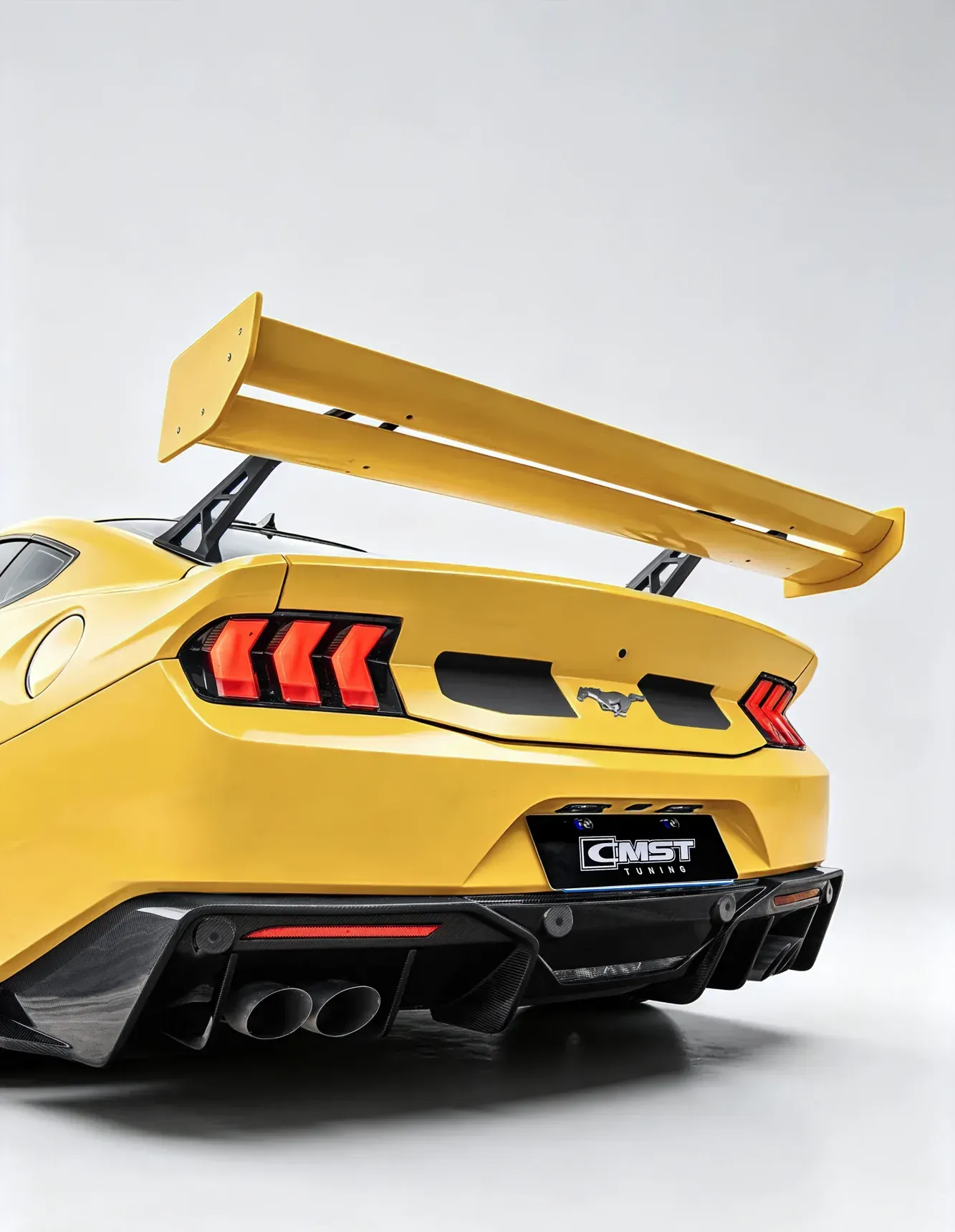
A wing, from the same angle: the element is held clear of the body, and the struts are carrying the load into the car.
Swan-neck mounting exists to protect the more sensitive face of the element. Hanging the wing from above means the brackets do not sit in the flow along the underside, so the low-pressure side stays undisturbed. Porsche introduced it to its own series-production cars with the 2021 911 GT3 and reports that the layout reduced flow losses and increased downforce, with the element adjustable across four positions; the same press material quotes 50 percent more downforce than the previous generation at 124 mph in the standard setting (Porsche Newsroom, 2021).
The cost side is not negotiable. Downforce is produced by turning air, and turning air costs drag. A wing that adds meaningful rear load will add drag, which shows up as a lower top speed and worse high-speed fuel consumption unless the rest of the car is reshaped around it.
Spoiler vs Wing, Side by Side
Spoiler | Rear wing | |
|---|---|---|
Mounting | Bonded or bolted to the body surface | Held off the body on struts, trunk lid or chassis |
Air underneath | Not the test — pedestal types have a gap too | Flow on both faces; that is where the load is made |
Main job | Manage separation, cut lift | Generate downforce |
Effect on drag | Neutral to lower | Higher, and rising with angle |
Where it pays off | Fast road, daily driving, OEM-style builds | Sustained high speed, track use |
Adjustable | No | Usually — angle, sometimes element height |
Asks of the front of the car | Very little | A matching front splitter or lip, or balance moves rearward |
Read the last two rows together and the practical advice writes itself: the adjustable part is the one that needs a supporting cast.
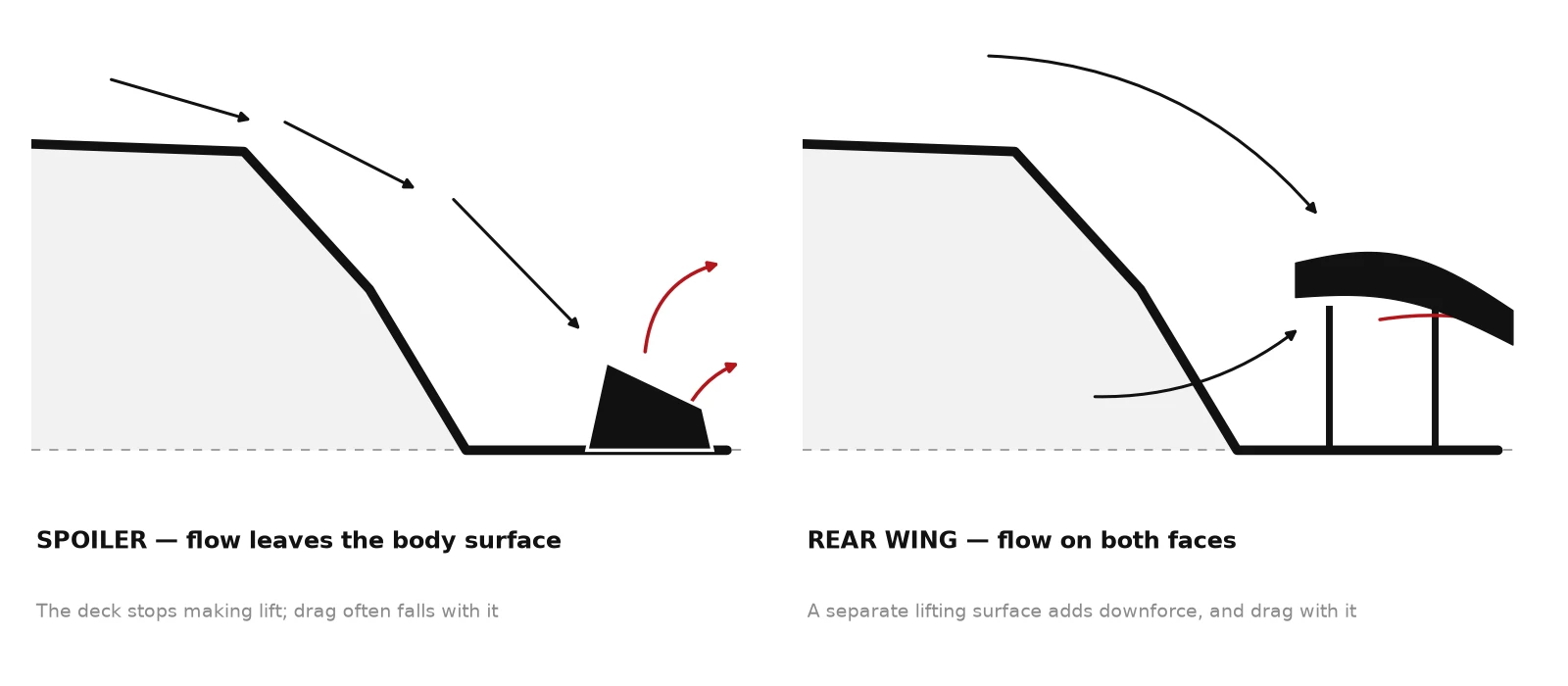
The two working principles side by side: one manages air that is already leaving the body, the other creates load of its own on both faces.
Why the Speed Question Is the Wrong Question
Search around and you will find confident numbers: spoilers "start working at 50 mph", wings "become significant at 70". Treat them as folklore. Aerodynamic force scales with dynamic pressure, which rises with the square of speed, so there is no switch that flips at a particular number — there is a continuous curve, and what counts as "working" depends entirely on the car, the part and what you are comparing it against.
The practical consequences are more useful than any threshold:
- A test drive at 40 mph tells you nothing about aero. At that speed the forces are small enough that tire pressure and passenger weight matter more.
- Small differences get amplified at speed. A change you cannot feel at 60 mph can be worth chasing at 130, in either direction.
- A part can be doing harm rather than nothing. A stalled wing or a badly balanced rear load does not announce itself; it shows up as a car that feels less settled than it did before.
If you want one number to carry around, make it the square: twice the speed, four times the force. Then ask at what speed your car actually spends time, because that is where the money goes.
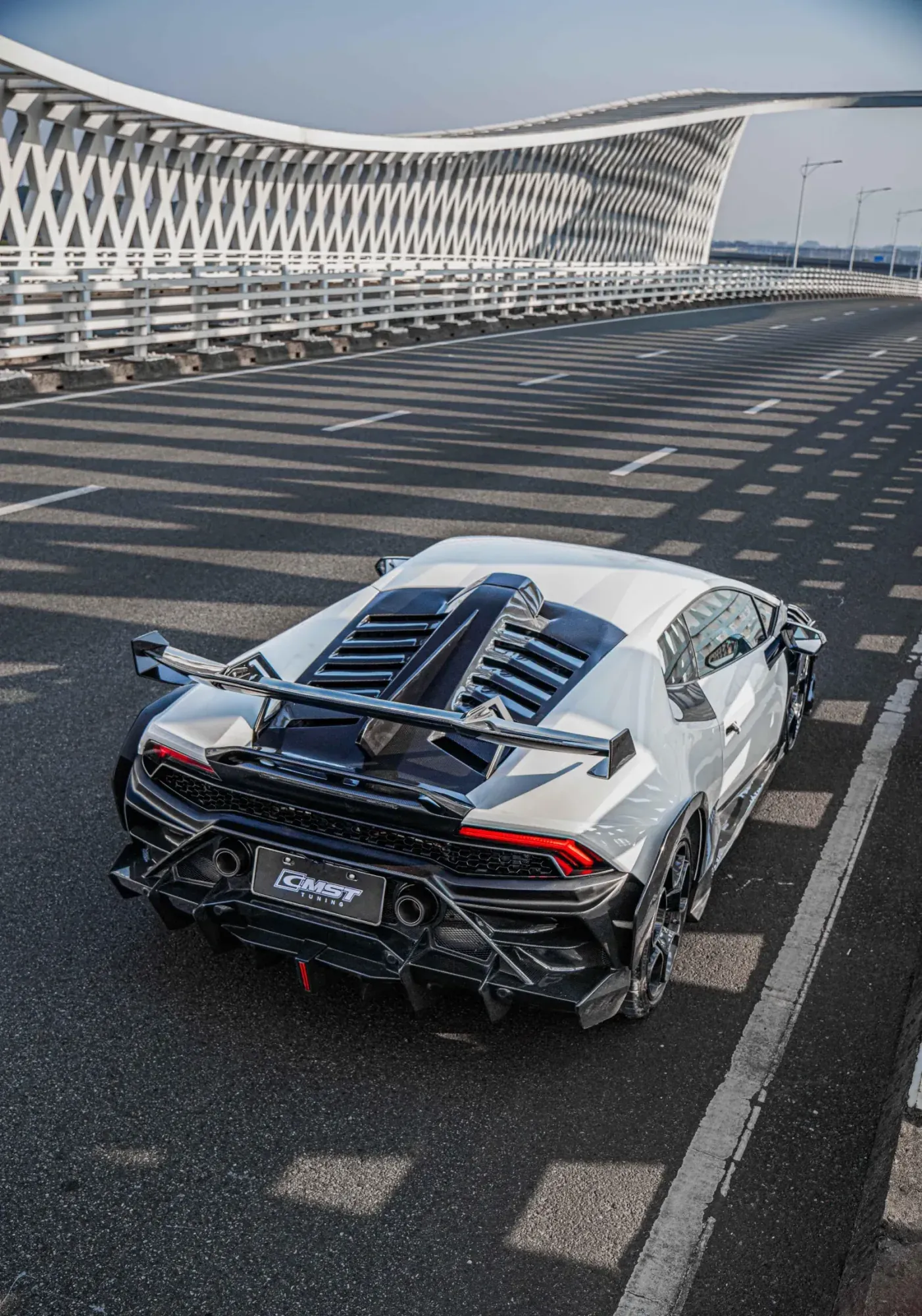
A wing in the situation it was designed for: the element is carried on struts clear of the rear deck, with the gap under it visible from behind.
Which One Do You Need? Three Questions, In Order
Work through these in sequence. Most people discover they have already answered question two before they get to question three.
1. Where does the rear of your car feel light, and at what speed? If you cannot name a corner, a speed and a symptom — the rear stepping out over a crest, the steering going vague above a certain speed — then you do not currently have an aerodynamic problem, and neither part will fix one. Buy for appearance and say so; that is a legitimate reason to buy either.
2. Is there anything at the front? This is the question that decides most builds. A wing adds load to the rear axle. If the front of the car produces nothing, adding rear load moves the aerodynamic balance rearward, and the car will push into understeer at exactly the speeds where you wanted it planted. A front lip or splitter is not decoration in that context; it is the other half of the change. With a stock front end, a spoiler is the lower-risk choice because the load it adds is small.
3. Do you want to adjust it, and are you willing to drill? A wing needs structure — struts, mounting points, and on a track car often a chassis mount. A spoiler usually needs adhesive, tape or the factory holes. If reversibility matters to you, that answers the question without any aerodynamics at all.
The outcomes tend to fall into four groups:
- Daily-driven street car. A lip or ducktail spoiler, chosen for the shape of the car rather than for a downforce claim. It will not transform the handling, and it will not add meaningful drag.
- Fast road car with occasional track days. Spoiler first. If you later add a front splitter and start noticing the rear moving at high speed, an adjustable wing set at a conservative angle is the next step — not the first one.
- Track car. A wing, with a front aero package to match and an angle you set from testing rather than from a photograph.
- Show car. Whichever the design needs. Just be honest that the choice is visual; a wing bought for stance does not have to justify itself aerodynamically.
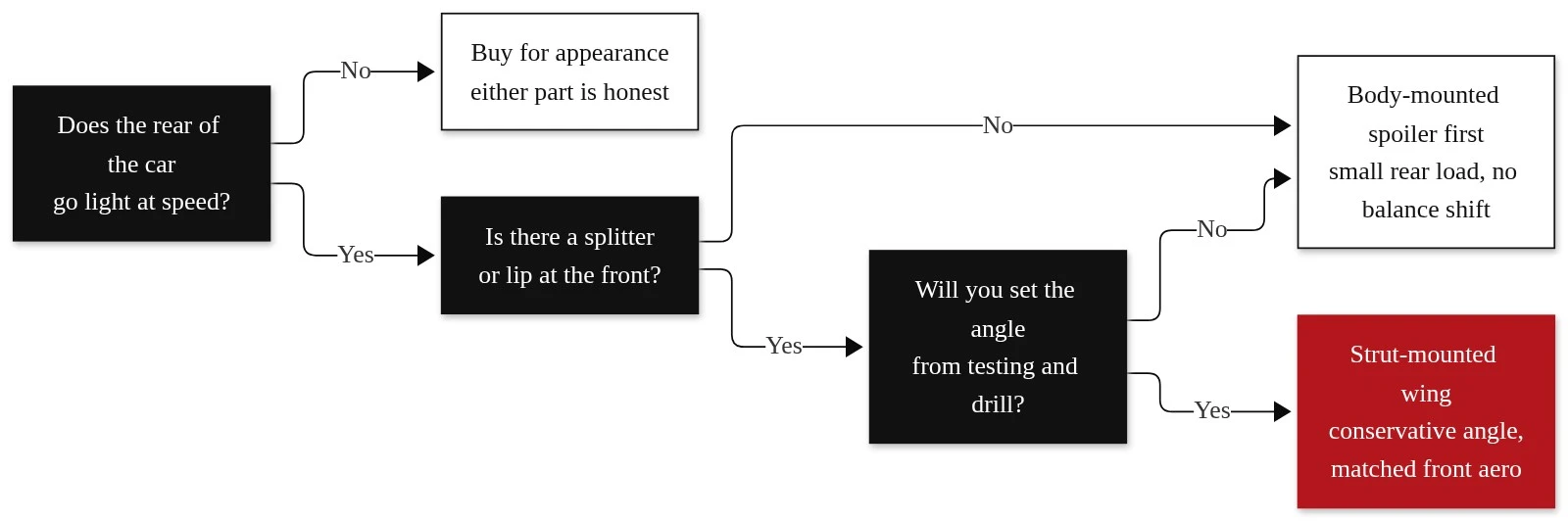
The three questions in order. The wing branch only opens after the front-end question is answered.
The Part Nobody Mentions: What Each One Asks of Your Car
Every comparison of these two parts stops at the airflow. The installation is where owners get surprised, and the two parts ask for very different things.
What it asks of you | Spoiler | Rear wing |
|---|---|---|
Mounting depth | Surface: tape, studs, factory holes | Structural: struts, backing plates, drilled holes |
Load path | Spread along the panel edge | Concentrated into two footprints, rising with speed |
Water risk | Seams and tape lines | Every hole you drill |
Reversible | Mostly — adhesive and alignment | Rarely — holes do not close |
A spoiler is a surface job. It follows the body, so the mounting is shallow, and the risks are cosmetic: alignment, paint contact, and the fact that a poorly bonded lip will lift at speed and take paint with it.
A wing is a structural job. Mounting to the trunk lid means the lid has to carry the load, which is why trunk-lid wings sometimes need reinforcing plates underneath; mounting to the chassis means holes through the body and a proper bracket. Either way you are drilling, sealing and thinking about water: an unsealed hole in a trunk lid ends up in the spare-wheel well.
Then there are the things that were never designed around a wing. Rear cameras, parking sensors, antennas and high-level brake lights all live in the area a wing wants to occupy. On hatchbacks and wagons, a roof spoiler can foul the tailgate's travel or the top of the glass if it is fitted without checking. None of this is exotic, but all of it is easier to notice before the holes are drilled.
Which is why the fitment step matters more on a wing than on almost any other exterior part. Every panel has to be trial-fitted, gaps checked and mounting points lined up before anything is signed off. That discipline is what how fitment works is about.
It is also why every CMST mold gets its own trial fitting on a real car before it is approved rather than after.
Material choice is the other variable, and it bites harder on a wing. The element is a loaded structure: if it flexes, the angle of attack changes with speed, and a wing whose angle wanders is not doing the job it was set to do. That is the argument for a stiff carbon element over a flexible one, and it is the same reasoning that runs through whether dry carbon is worth it — the stiffness difference matters less on a spoiler, which carries almost no load, than on a wing.
Cost follows the same fault line, and it answers a question buyers ask constantly: why a wing costs so much more than a spoiler covering a similar patch of bodywork. A spoiler is one shaped panel — a single mold, a single finish, and the labor sits in bonding and alignment. A wing is a small assembly: element, two uprights, mounting hardware and often an adjustment mechanism, each with its own tooling and its own tolerance to hold. You are paying for structure, not surface area.
One last thing worth saying plainly: holes do not come back. If you are unsure between the two, fit the spoiler first and live with it for a season. It is the cheaper experiment, and it is the one you can undo.
FAQ
Why are car wings called spoilers?
Because a large share of what people call a wing on a road car is a spoiler. Genuine strut-mounted wings are rare on production cars — they were rare when the Plymouth Superbird wore one in 1970 and they are rare now — so one common explanation is that the word simply migrated across. Add the British habit of calling a fender a wing, and the terminology gets genuinely confusing. The physical distinction settles it: is the part a surface of the body, or an airfoil of its own?
Does a spoiler add downforce?
A little, indirectly, and not much. A spoiler's main effect is to reduce the lift the body was already generating, which increases the load on the rear axle. That is a real gain in stability, but it is not the same as a wing creating new downforce from a lifting surface. Any figure quoted without a speed is marketing rather than measurement.
Can a car have both?
Yes, and plenty do — a trunk-lid lip plus a wing is a common combination on track cars. The load adds up, though, and so does the balance problem: two rear devices and a standard front end will move the car's aero balance further rearward than either part alone.
What about cars with a retractable spoiler?
Some modern cars carry a rear element that sits flush with the body and deploys at speed, on a linkage or an electric drive. Once it is up, the same distinction applies: a blade that still follows the body is a spoiler, and a separate airfoil making load of its own is a wing — whether or not it rises on struts. What changes is that the car decides when the part is in the airflow, so anything you add has to work with that decision rather than against it.
Does a wing hurt fuel economy?
At high speed, yes, in the same way that any increase in drag does. At town speeds the effect is negligible next to everything else the car is doing. If long-distance cruising is most of your driving, that is a genuine argument for the spoiler.
Choosing Between Them
The decision is simpler than the market makes it look. If your car is a road car and you want the rear to feel more settled without adding drag, a body-mounted spoiler does that job and asks nothing of the rest of the car. If you are chasing rear load at sustained speed, you want a wing — and you will get more out of it by matching the front, setting the angle from testing, and mounting it to something that can take the load than by choosing the largest element that fits.
Either way, the parts belong to a system rather than a shopping list. The aero parts guide puts splitters, lips, spoilers, wings and diffusers in the order they actually interact, which is the right place to check before you commit to the first purchase.
Next step
Send the vehicle, the parts you are considering and the finish you want — we reply with fitment notes and a quote.
Send an inquiryKeep reading
Related notes
What Is Fitment? Panel Gaps and Trial Fits
Fitment is how well an aero panel agrees with the car: the gap, the flush and the contact pattern, measured on a real car — not promised by the word bolt-on.
Overfenders vs Fender Flares: Which Fits?
Overfenders and fender flares are one part under two names. What each term means, the three ways to cover a wider wheel, and how to measure before you buy.
Dodge Charger Widebody Kits: What Fits
A dodge charger widebody kit is really three different products. What fits your model year, what the factory Widebody changed, and what each route costs.